How a new SF permit could enable more "hostile architecture"

Add Axios as your preferred source to
see more of our stories on Google.
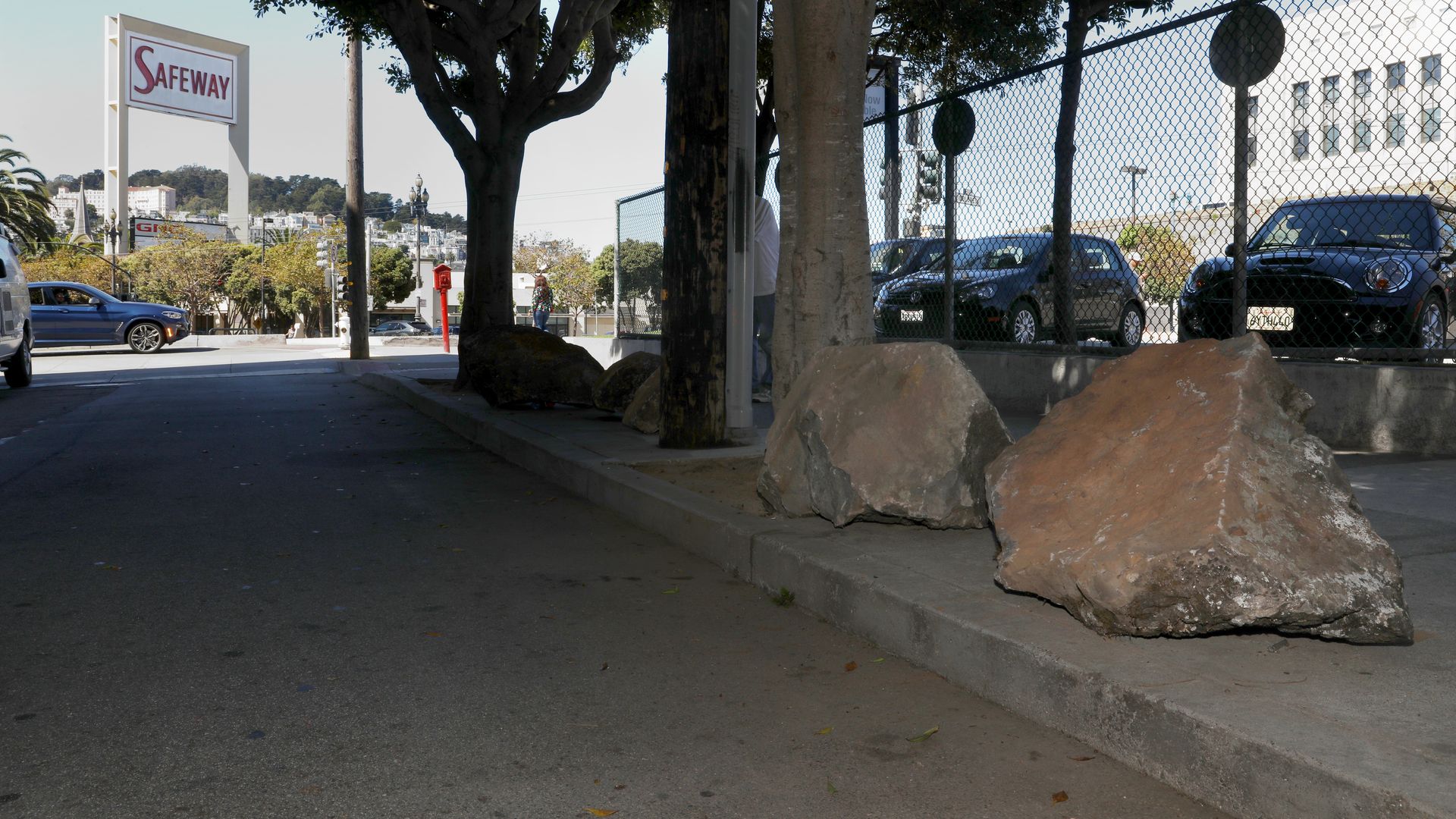
Boulders near Clinton Park are placed to deter homeless encampments. Photo: Liz Hafalia/San Francisco Chronicle via Getty Images
A new permit aimed at enhancing San Francisco neighborhoods could usher in more projects critics deem "hostile architecture" as some residents and businesses increasingly seek to deter homeless encampments.
Why it matters: Local advocates have said that "hostile architecture" — a term often used to describe anti-homeless urban designs — fails to address the city's limited shelter beds and the larger housing crisis while criminalizing people who have nowhere to go.
- In the Mission District alone, there are over 2,000 planters, according to a recent block-by-block count conducted by Mission Local.
- That includes $25,000 worth of planters organized by a group of residents.
State of play: San Franciscans are currently allowed to put up projects like planters without a permit, but they must follow certain guidelines — like ensuring a paved path of travel.
- The "Love Our Neighborhoods" permit, which the city wants to launch this spring, would streamline the process and make it easier for people to apply to put in enhancements, which could range from little libraries to benches.
- Though the projects would still be subject to certain accessibility standards, the procedural aspect would be "very low barrier" and less bureaucratic, San Francisco Public Works policy and communications director Rachel Gordon told Axios.
- The new permit would also enable the city to maintain a list of registered projects so it can hold the right people accountable if hazards arise — something that's not always clear right now, according to Gordon.
Yes, but: Advocates for the homeless say it could lead to inhumane projects that target unhoused people.
- Housing unhoused people should be the goal, "rather than putting up hostile barriers that make it even more difficult for folks who simply are trying to secure a place to sleep," Jennifer Friedenbach, executive director of the Coalition on Homelessness, said in an email to Axios.
- Boulders, spikes and segmented benches are among the projects that have been implemented in the city in recent years.
- It ends up targeting "people who use or rely on public space more than others, including youth, low-income people and people experiencing homelessness, who are disproportionately Black and Indigenous people," the National Coalition for the Homeless stated in a 2023 report.
The other side: Proponents of the architecture say it's the only way to keep sidewalks open and clean, citing safety concerns.
- Some have also expressed skepticism at how planters could hurt unhoused populations.
Of note: The city itself maintains a neutral position on the use of "hostile architecture" — landscaping projects aren't required to evaluate possible impacts on unhoused people — but will step in if there are complaints over accessibility issues like blocked sidewalks, according to Gordon.
- Some projects approved by the city have been seen as "hostile architecture" in the past, but the city's expectation is for its use as beautification or landscaping, Gordon said.
- She added she understands both perspectives, however. "It's a tough one, and it's not just San Francisco that's grappling with this."