Bay Area's rate of new business applications fell in 2022


Add Axios as your preferred source to
see more of our stories on Google.
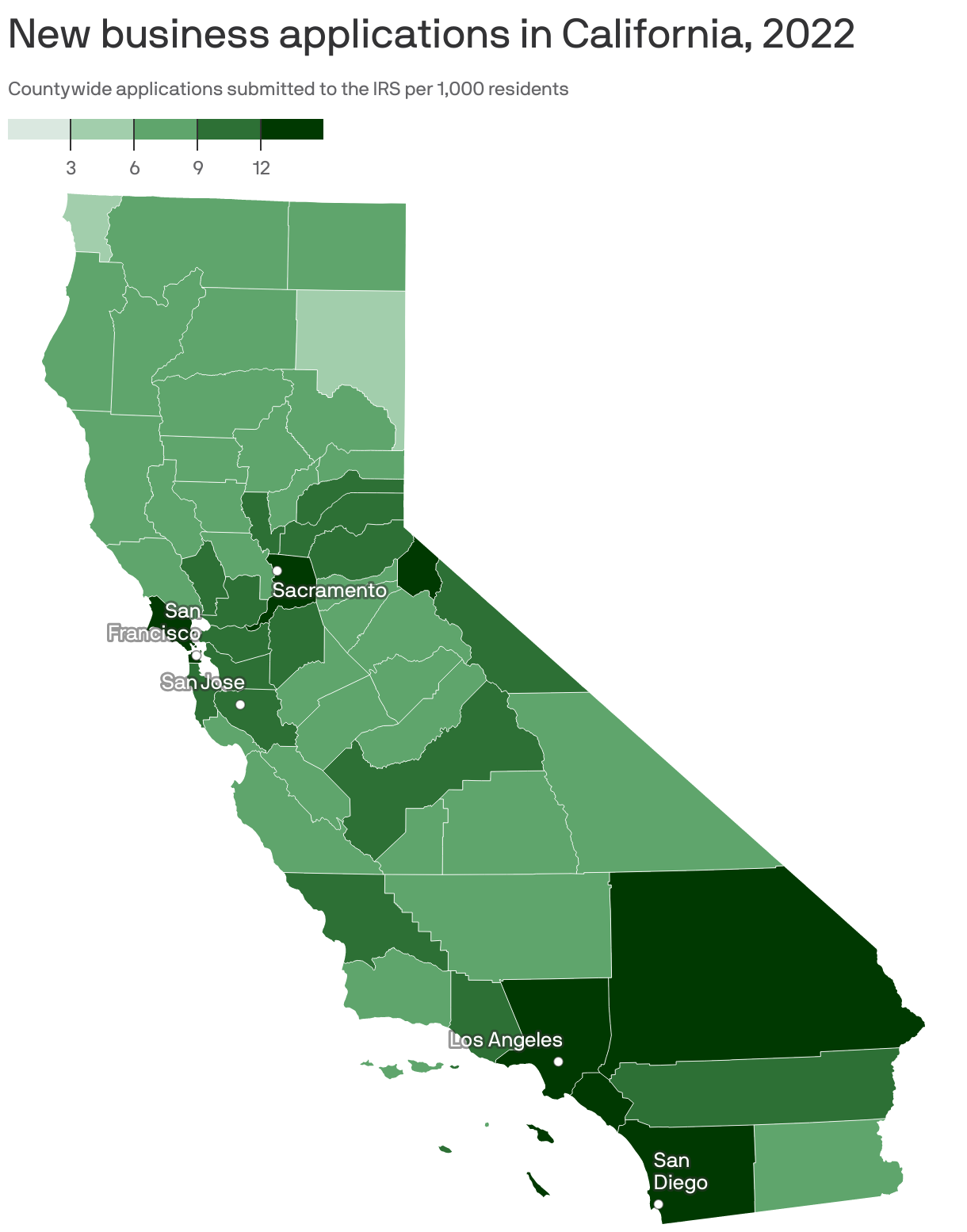
The San Francisco Bay Area saw a lower rate of new business applications last year than it did in 2021.
Why it matters: New business applications are an important measure of an area's perceived economic health. If many people are trying to start new companies in a given city, it's a sign that they're bullish on the area's prospects.
- The word "startup" tends to evoke buzzy Silicon Valley tech ventures. But young companies of all stripes, from stores and restaurants to software and manufacturing firms, play a big economic role.
Driving the news: Nearly 13 new business applications per 1,000 residents were filed across the San Francisco metro area in 2022, new U.S. Census Bureau and IRS data show.
- That's down 9% from 2021, which recorded almost 14 per 1,000 residents.
- New applications totaled a little over 57,000 across the region last year.
Between the lines: While the Bay Area remains a draw for startups and tech innovators, San Francisco itself has been embroiled in a "doom loop" narrative in recent months amid a rising number of restaurants, companies and retail stores leaving the city.
- San Francisco's office vacancy rate increased slightly to 31.6% in the second quarter of 2023, according to a new report from real estate and investment firm CBRE Group.
- But demand for office space has also seen an uptick, led by venture-capital-backed companies that include several AI companies, the report noted.
The big picture: Just over 5 million new business applications were filed nationwide in 2022, or about 15 for every 1,000 residents.
- That's down about 6.6% from 2021, when nearly 5.4 million applications were filed nationwide, or about 16 for every 1,000 residents.
- Miami/Fort Lauderdale/West Palm Beach (40.9) took the top spot for major metro areas as ranked by new business applications per 1,000 residents in 2022.
Of note: Many of the hottest spots for new business applications also have booming populations.
- That makes sense, as economic growth and population increases tend to go hand in hand.
Yes, but: A filed application is no guarantee of a healthy, thriving business to follow — but at the very least it's a sign of economic optimism.
What to watch: San Francisco is showing signs of stability, the city's chief economist, Ted Egan, told the San Francisco Chronicle earlier this month.
- Census data found that the city's population loss slowed to 0.3% from July 2021 to July 2022, a significant drop from the previous year’s 6.3%.