Report: Texas' detained immigrants held in solitary confinement


Add Axios as your preferred source to
see more of our stories on Google.
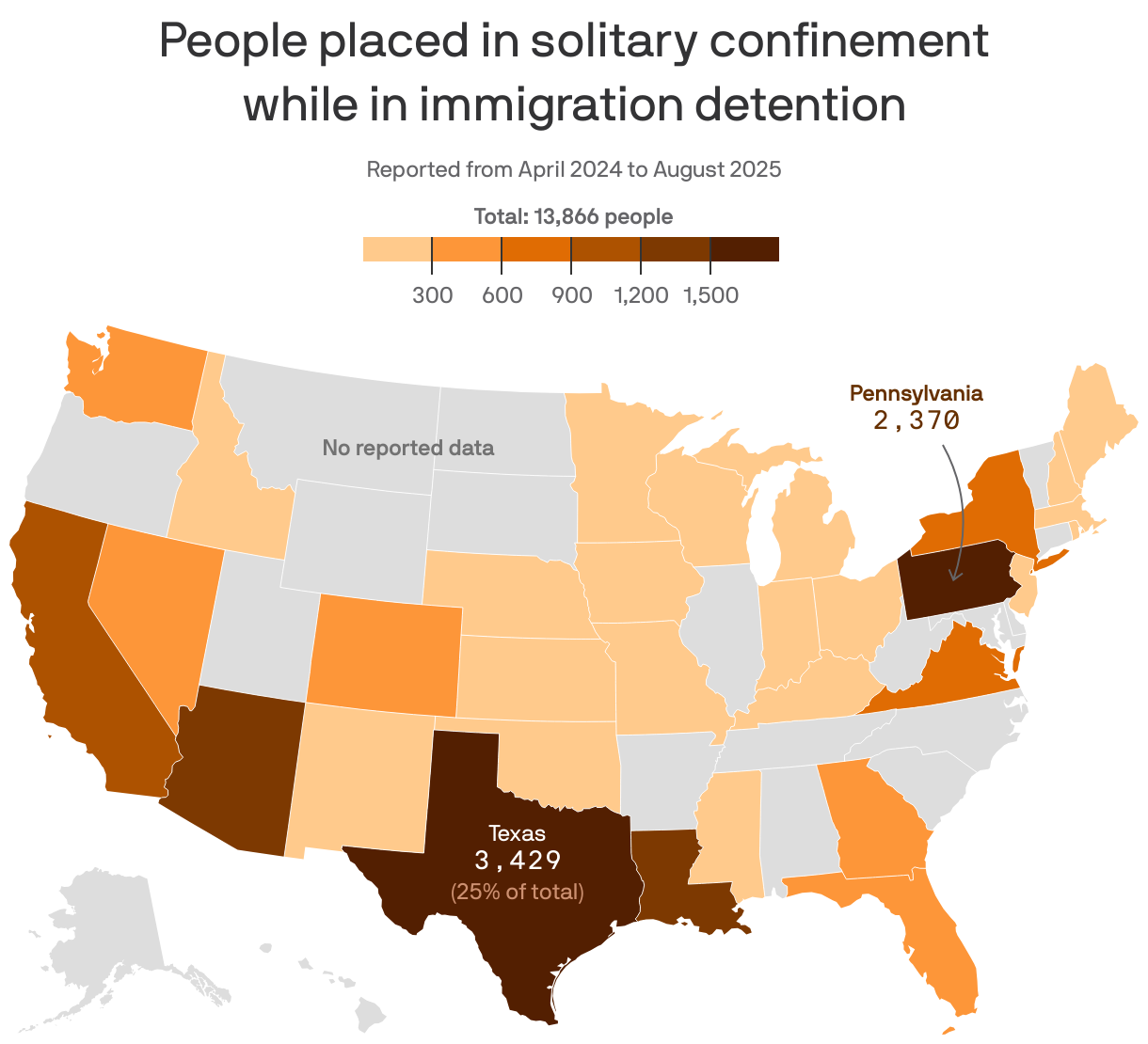
Immigrant detention centers in Texas, including one near San Antonio, were among the facilities with the highest number of people in solitary confinement this year, per recent research.
Why it matters: U.S. solitary confinement placements increasingly drag on for 15 days or longer, which the United Nations says constitutes psychological torture, according to a report by Harvard University researchers and Physicians for Human Rights.
- The researchers focused on immigrant detention centers, which experts say are primarily used to hold immigrants and ensure they make their court hearings and check-ins — not to punish them for immigration violations.
The big picture: Nearly 14,000 people were placed in solitary confinement in immigrant detention centers nationwide between April 2024 and August 2025, per new data provided to Axios.
- Researchers detailed an increase in solitary confinement placements and, for some populations, weeks-long isolation.
- The report, which relies on ICE's data collections, didn't show the duration of solitary confinement placements for all detainees, just for those labeled as "vulnerable," like those with mental health issues.
By the numbers: The report found that the South Texas ICE Processing Center in Pearsall, about 55 miles southwest of San Antonio, had 488 people isolated from April 2024 to May 2025 — the fourth highest nationwide.
- Moshannon Valley Processing Center in Philipsburg, Pennsylvania, had the highest number of people isolated (1,905), followed by Montgomery Processing Center in Conroe, Texas (1,075).
Caveat: Researchers also warn that ICE data is typically incomplete, suggesting there could be an undercount of solitary confinement placements.
- Larger facilities are likely to have higher solitary confinement numbers because they detain more people overall, the report notes. The Pearsall center is one of the largest in the ICE system.
Yes, but: El Paso Service Processing Centers reported disproportionately high numbers of people in solitary confinement compared to capacity, per the report.
What they're saying: "We are torturing people simply because they want a better life in the U.S.," says Sam Zarifi, executive director of Physicians for Human Rights, a New York-based organization that uses medicine to advocate against human rights violations.
- ICE didn't respond to several emails from Axios seeking comment.
What's next: The report urged state and local officials to use their own power to end or reduce the use of solitary confinement in local facilities with ICE contracts.