Hybrid bird near San Antonio is likely result of climate change

Add Axios as your preferred source to
see more of our stories on Google.
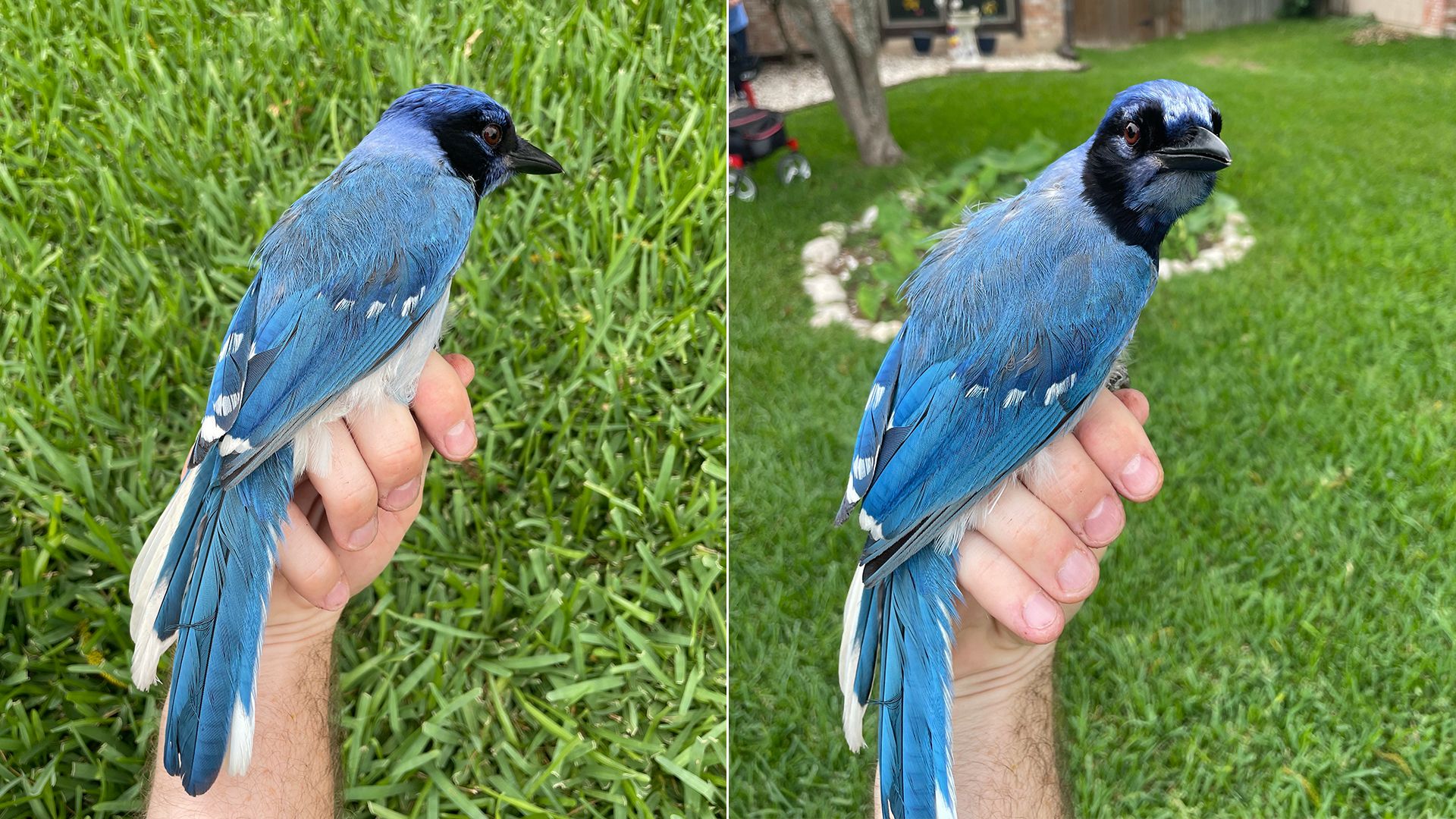
The rare hybrid bird found in a San Antonio suburb. Photos: Courtesy of Brian Stokes/University of Texas at Austin
The offspring of a green jay and a blue jay, recently discovered in a suburb northeast of San Antonio, may be among the first examples of two different bird species mating due to climate change.
Why it matters: Shifting weather patterns appear to have expanded the habitats of the two species, University of Texas at Austin researchers announced.
Zoom in: The green jay is a tropical bird found across Central America, whose range in the 1950s just barely extended north of Mexico into South Texas. Blue jays, which live across the eastern U.S., had a range about as far west as Houston.
- They almost never came into contact with each other, researchers said.
- But since then, their ranges have met in the middle around San Antonio, as green jays traveled north and blue jays moved west.
What they're saying: "We think it's the first observed vertebrate that's hybridized as a result of two species both expanding their ranges due, at least in part, to climate change," Brian Stokes, a doctoral candidate at UT studying green jays in Texas, said in a statement.
How it works: Stokes regularly monitors social media for birding sights. Upon seeing a post from a woman near San Antonio of the odd-looking bird, he got in touch, and the woman invited Stokes to see the bird up close.
- He was able to catch the bird to take a blood sample and mark its leg to help find it in the future. Stokes then released it.
Context: Stokes and his faculty adviser, Tim Keitt, have now published an analysis in the journal Ecology and Evolution.
- The bird, a male, is similar to a hybrid bird that researchers created in the 1970s by crossing a green and blue jay in captivity. That bird was preserved through taxidermy and is held by the Fort Worth Museum of Science and History.
The bottom line: "Hybridization is probably way more common in the natural world than researchers know about because there's just so much inability to report these things happening," Stokes said.
- "And it's probably possible in a lot of species that we just don't see because they're physically separated from one another and so they don't get the chance to try to mate."