AI could send Texas power prices soaring


Add Axios as your preferred source to
see more of our stories on Google.
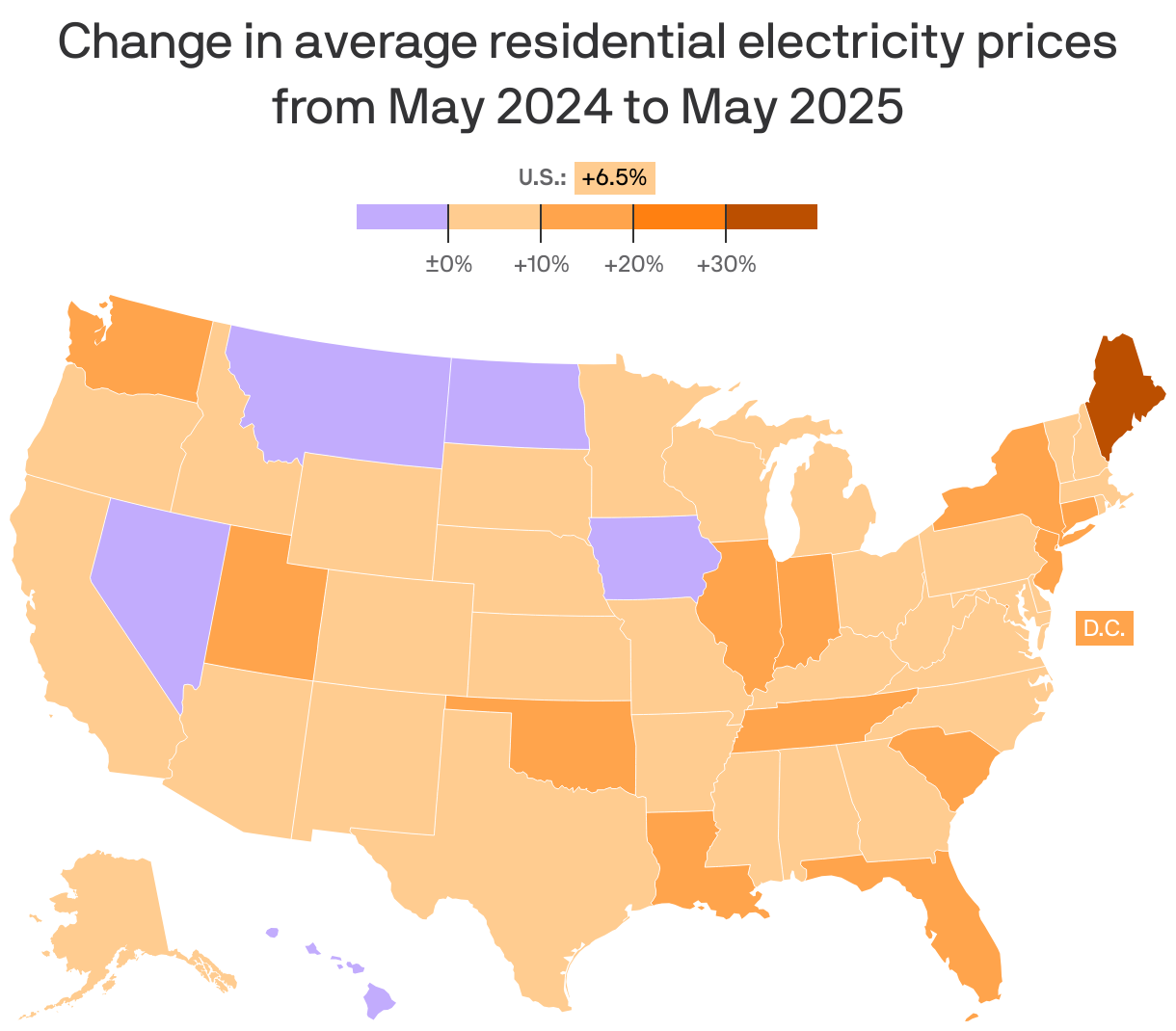
Texas electricity prices rose 4.4% over the past year — less than the national average — but experts say a surge in energy-hungry data centers could soon send costs soaring.
Why it matters: The AI boom could drive up power bills, adding to the financial strain as inflation hits household essentials.
By the numbers: The national average retail price for 1 kilowatt-hour of electricity rose from 16.41 cents to 17.47 cents between May 2024 and May 2025, a 6.5% jump, per the U.S. Energy Information Administration.
- Texas' price increased from 14.84 cents to 15.49 cents.
- Maine saw the largest spike at 36.3%, followed by Connecticut (18.4%) and Utah (15.2%).
Between the lines: Power prices vary by region and depend on a mix of supply, demand, fuel costs and infrastructure.
- Many analysts say energy-intensive data centers are a growing factor, especially in regions where they're booming.
- That's due to their immediate consumption, plus grid operators' investments in new transmission infrastructure to meet projected demand.
What they're saying: "Anywhere you're seeing a massive takeoff in load growth, the most likely cause is data centers, and that is almost certainly going to have an impact on electric rates," says Cathy Kunkel, energy consultant at the Institute for Energy Economics and Financial Analysis.
Zoom in: In Texas, demand could double or quadruple by 2035, according to University of Houston researchers. Without upgrades, that risks a 27– to 40-gigawatt annual shortfall.
- CPS Energy is seeking 400 megawatts of new wind power — its largest request in over a decade — to help meet rising demand.
- The San Antonio–Austin data center market has quadrupled in size since 2020, per the Express-News.
State of play: After the passage of Senate Bill 6 in June, Texas is one of the first states to require emergency shutoff switches for data centers, giving the Electric Reliability Council of Texas the power to cut service during crises like heat waves or winter storms.
The bottom line: Many of us are paying for the AI boom, whether we use the tech or not.