How Medicaid and SNAP cuts could affect Texas' economy


Add Axios as your preferred source to
see more of our stories on Google.
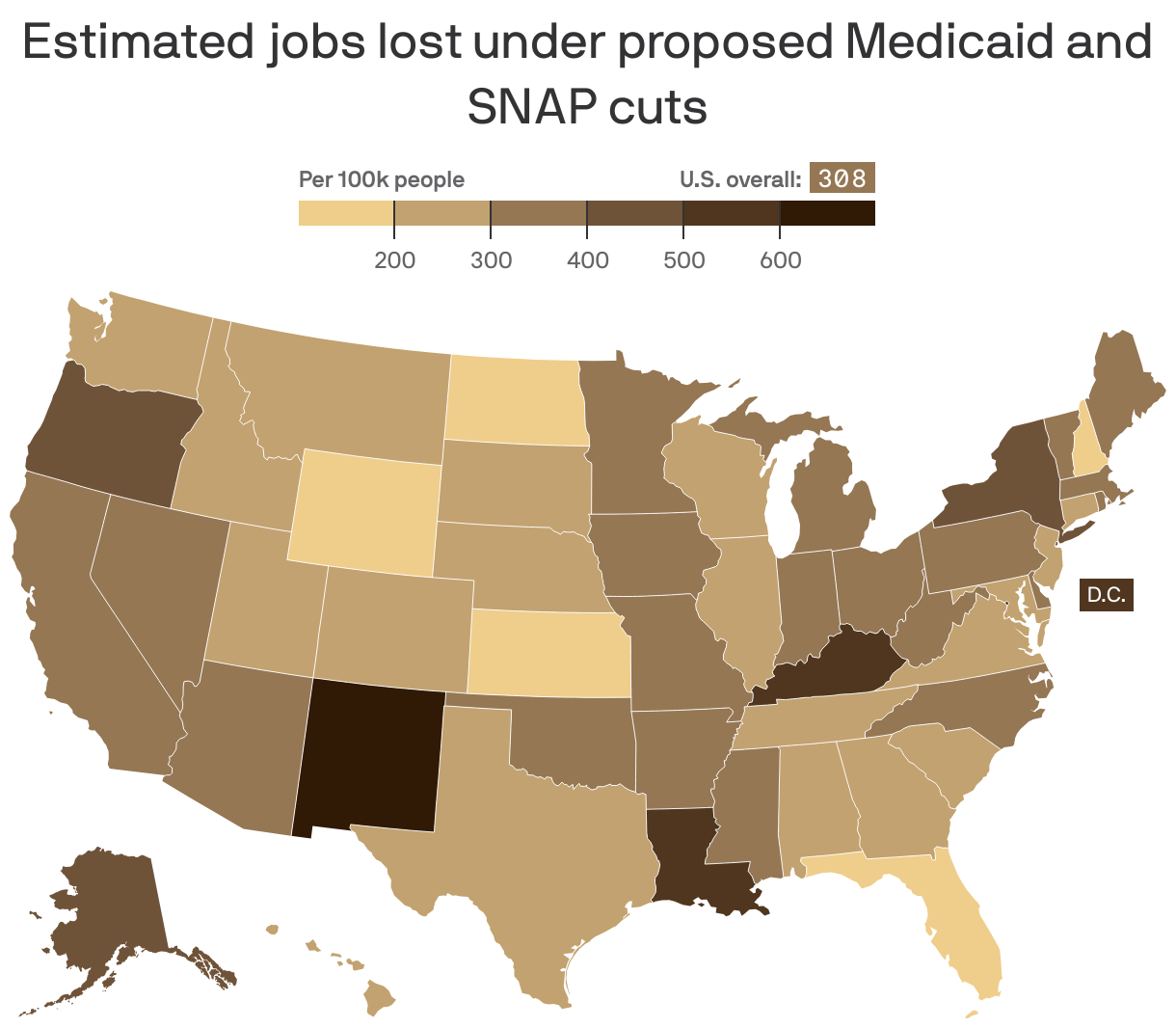
Texas could lose thousands of jobs and billions of dollars in economic output under potential Medicaid and food aid cuts, a new estimate finds.
Why it matters: Millions of Texans rely on federal financial assistance — money that gets spent at doctors' offices, grocery stores and so on, supporting jobs and economic activity.
Driving the news: The House of Representatives' latest budget resolution calls for more than $1 trillion in combined cuts to programs overseen by the House commerce and agriculture committees, which include Medicaid and the Supplemental Nutrition Assistance Program (SNAP).
- The details of any such cuts would need to be sorted out in Congress; the Senate has not yet worked out its own budget blueprint.
What they did: Meanwhile, a new analysis from the Commonwealth Fund and the George Washington University Milken Institute School of Public Health seeks to estimate the economic consequences of major Medicaid and SNAP cuts.
- The researchers' estimates assume $880 billion and $230 billion in broad Medicaid and SNAP cuts over 10 years, respectively, spread out evenly over the decade and proportionately among states.
What they found: If those cuts take effect, researchers estimate that in 2026 Texas would lose:
- Nearly $7 billion to its state gross domestic product, the value of Texas' economy
- 67,500 jobs
- More than $402 million in state and local taxes.
Caveat: Any actual cuts to Medicaid and SNAP could wind up being smaller.
What they're saying: "Some have argued that Medicaid or SNAP budgets can be cut harmlessly by eliminating 'waste or fraud,'" the researchers write.
- "But as we've shown ... drastic reductions in federal funding will necessarily have major financial repercussions, because they shrink the flow of dollars into states' economies."
What's next: Although Republicans, who control the White House and both houses of Congress, are eager to reduce federal spending, cutting widely used entitlement programs like Medicaid has long been considered political suicide.
- The latest polling shows broad support for leaving Medicaid untouched or increasing spending, even among Republican voters — numbers that may give some lawmakers pause before approving big cuts.