What Texas could lose if Trump cuts FEMA


Add Axios as your preferred source to
see more of our stories on Google.
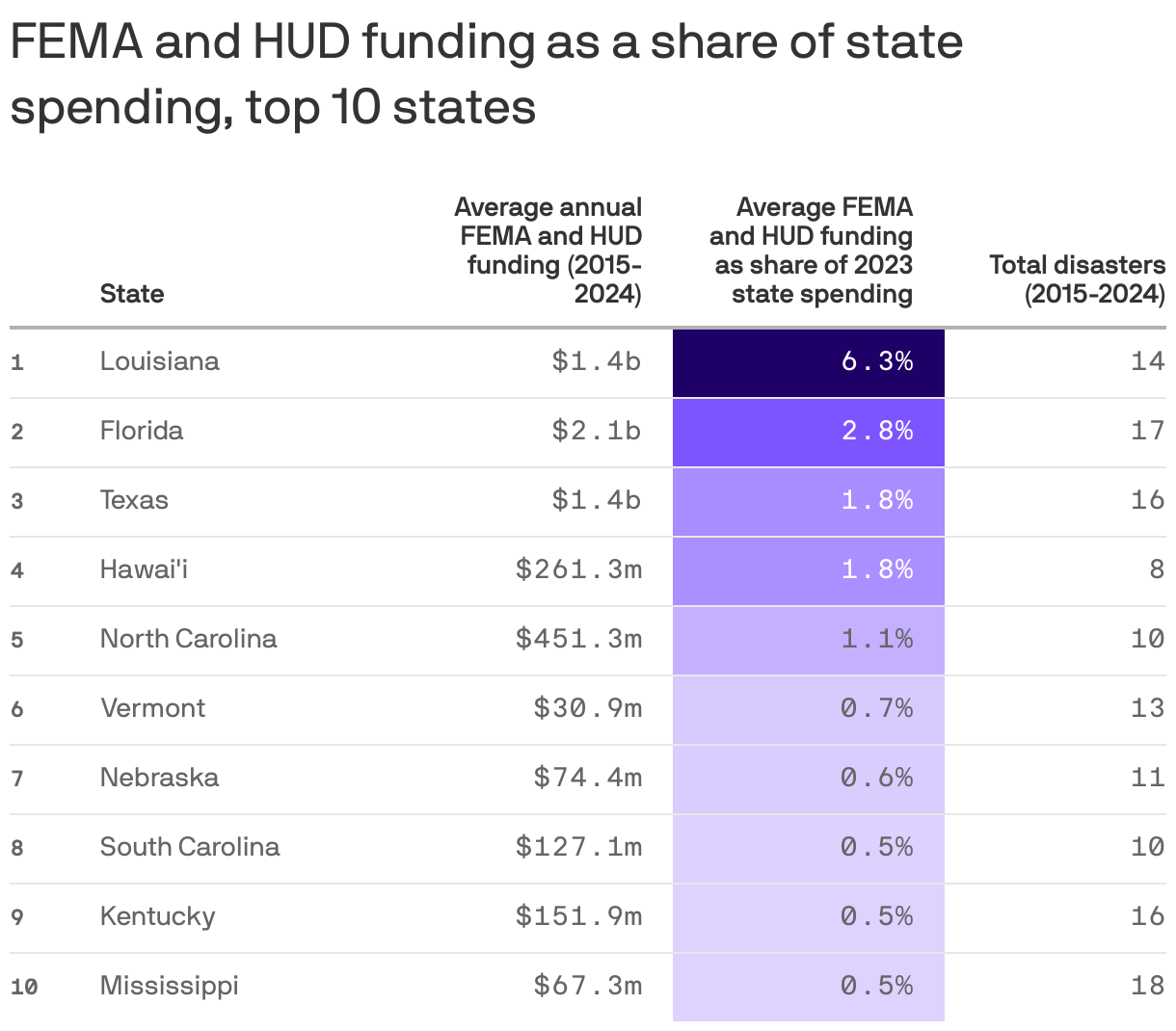
Texas could face greater financial burdens than most other states if President Trump slashes federal resources for disaster relief, a new analysis finds.
Why it matters: Trump floated "fundamentally overhauling or reforming" FEMA, or "maybe getting rid" of it entirely — fueling concerns that U.S. disaster relief could be thrown into chaos.
By the numbers: Texas would be hit especially hard by reductions in federal relief funding, according to the Carnegie Disaster Dollar Database.
- The state received an average of about $1.4 billion a year in FEMA and HUD relief funding from 2015 to 2024, covering 16 disasters.
- That's equal to 1.8% of Texas' approximate $79 billion in overall spending in fiscal year 2023.
Zoom in: Last year, FEMA doled out about $1.2 billion in Houston to help with recovery from Hurricane Beryl and a separate severe windstorm. HUD spent another $938 million total for both events.
- It's not just coastal cities at risk — residents in more than 100 Texas counties, including Bexar, qualified for FEMA aid after the deadly 2021 winter storm.
- The state received $43.6 million in federal assistance.
Separately, FEMA in the past has reimbursed some costs of operating San Antonio's Migrant Resource Center.
- It has a pending $13.2 million reimbursement that the Trump administration is keeping until the city provides details about "activities" at the now-shuttered center. The city says it plans on providing the information.
Driving the news: Trump is reportedly mulling an executive order empowering state and local governments to handle disaster readiness and relief, and he has already created a "FEMA review council."
- FEMA and other federal agencies funnel billions of dollars to people and communities affected by disasters, ranging from building and infrastructure assistance to financial and direct services for households.
- It's unclear how or whether Trump's order could change that.
What they're saying: "Up to now, when there is a disaster, the [federal] government responds," says Sarah Labowitz of the Carnegie Endowment for International Peace. Labowitz leads the spending database.
- "They clean up the debris, they rebuild the schools, they run shelters, they clean the drinking water."