Brackenridge Park bond and tree removal remain on hold

Add Axios as your preferred source to
see more of our stories on Google.

A large tree leans over the historic river walls in Brackenridge Park. Photo: Megan Stringer/Axios
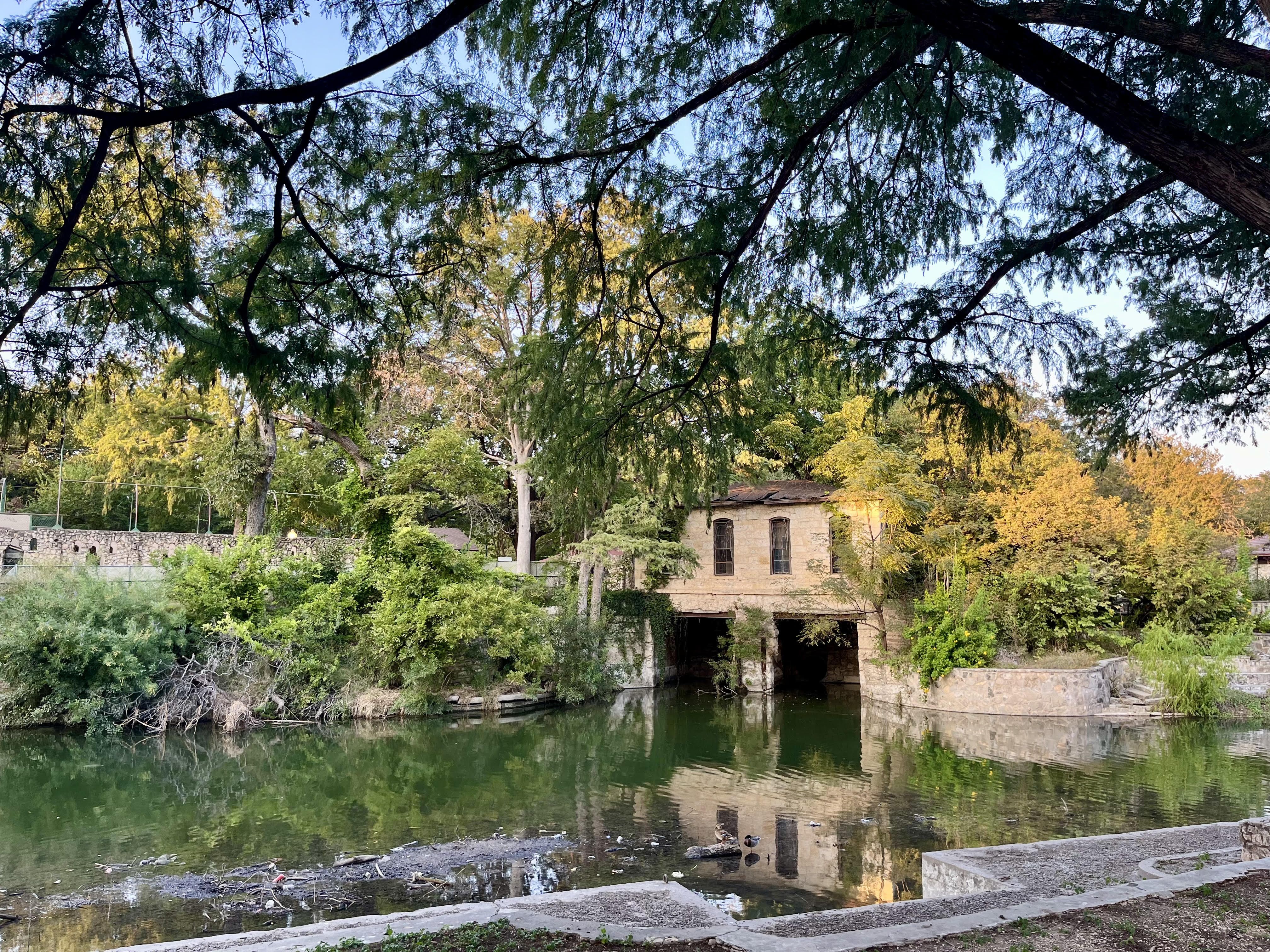
Along the San Antonio River on the northern end of Brackenridge Park, an empty limestone building dating back to 1877 sits in disrepair — full of dust and scattered with branches and broken glass.
The big picture: Without the Pump House at Lambert Beach, San Antonio wouldn't have expanded into the growing metropolis it is today. It's the site of the city's first modern water system, part of San Antonio's story of growth.
- Now it's surrounded by trees.
Why it matters: City officials say the trees must go to preserve historic structures, but many residents feel they're integral to the park's atmosphere and history.
State of play: Some tree roots have grown into the river walls, which can cause the walls to crumble, Shanon Shea Miller, director of the city's Office of Historic Preservation, tells Axios.
The latest: The first phase of a bond project that voters approved in 2017, which includes restoring the Pump House and river walls, remains on hold. Miller says the city is still awaiting environmental and historic permits from the U.S. Army Corps of Engineers.
- There's no clear timeline for when, or if, the city will receive the needed permits. Section 106 of the National Historic Preservation Act requires consultation with Native American tribes when a project could impact their historic and cultural resources.
By the numbers: Out of 83 trees in the phase one project area, 48 are currently slated for removal, down from 70 trees in the initial design.
- Of those, four are invasive, four are dead or dying, and 10 are considered small (less than 6 inches in diameter), Miller says.
- 24 trees are between 6 and 24 inches in diameter.
- The other six are heritage trees, meaning they're 24 inches or larger. Some range in age from 36 to 92 years.
- An additional 21 trees in the project area will be relocated.
- Of the trees being preserved, 11 are heritage.
Zoom in: Blanquita Sullivan, who lives in the River Road neighborhood by the park, doesn't want Brackenridge Park to look too polished. She thinks the bond project appears overly designed.
- "If the trees — they're so beautiful and majestic — are removed and replaced by somewhat more controlled, manicured trees and a lot more contemporary design, it loses a little bit of that bohemian romance that people love."
The other side: "The city really exhausted all options and looked closely at what the solutions might be," Miller says. "Ultimately, our charge is to balance that tree preservation, the cultural resource preservation, with delivering a project that ensures future public access."
- Moving the walls would have impacted the river's flow, possibly creating flooding problems elsewhere, or it would have required removing other trees, Miller says.
Like many, Sullivan believes that officials could have worked harder to preserve both the trees and the historic structures.
- Miller says if there had been maintenance after the walls were built, "Then the trees wouldn't have been allowed to grow in such close proximity to the walls."
Signs of the lack of upkeep are visible throughout the park.
- Plywood boards act as a bridge.
- A historic restroom building sits closed to the public, a section of the roof broken, with portable toilets set up outside instead.

But it's also easy to see the park's quirks and the reasons people love its odd landscape.
- Tree branches swing overhead and form an arch from one side of the trail to the other.
Deferred maintenance impacts landscapes just as much as it does buildings, Michael Holleran, associate professor in the UT School of Architecture's historic preservation program, tells Axios. And people tend to be better at planning care for buildings over trees, he says.
- But landscapes are just as much a part of an area's history, and we often prescribe meaning to them.
- "Ultimately, preservation is about saving things you care about," Holleran says. "Heritage is … the history we care about. People value trees."
In San Antonio, officials have held seven public meetings since 2022 about the trees and the bond work, Miller says.
- But Sullivan, like others, felt residents' opinions weren't truly recognized and heard at the meetings.
Miller rejected that idea, saying the project is now "absolutely" better because of public input — and that the city reduced the number of trees slated for removal because of it.
- Sullivan and others say it doesn't matter as much, with six heritage trees still slated for removal.
The bottom line: "People, suddenly, they didn't really trust any of what was going on," Sullivan says.
Editor's note: This article is part of a series about the challenges facing Brackenridge Park.
- Keep reading: Pushing for Native American representation at Brackenridge Park
- Read the previous article: Why Brackenridge Park is at a crossroads