Economic segregation in S.A. schools persists on Brown ruling's anniversary


Add Axios as your preferred source to
see more of our stories on Google.
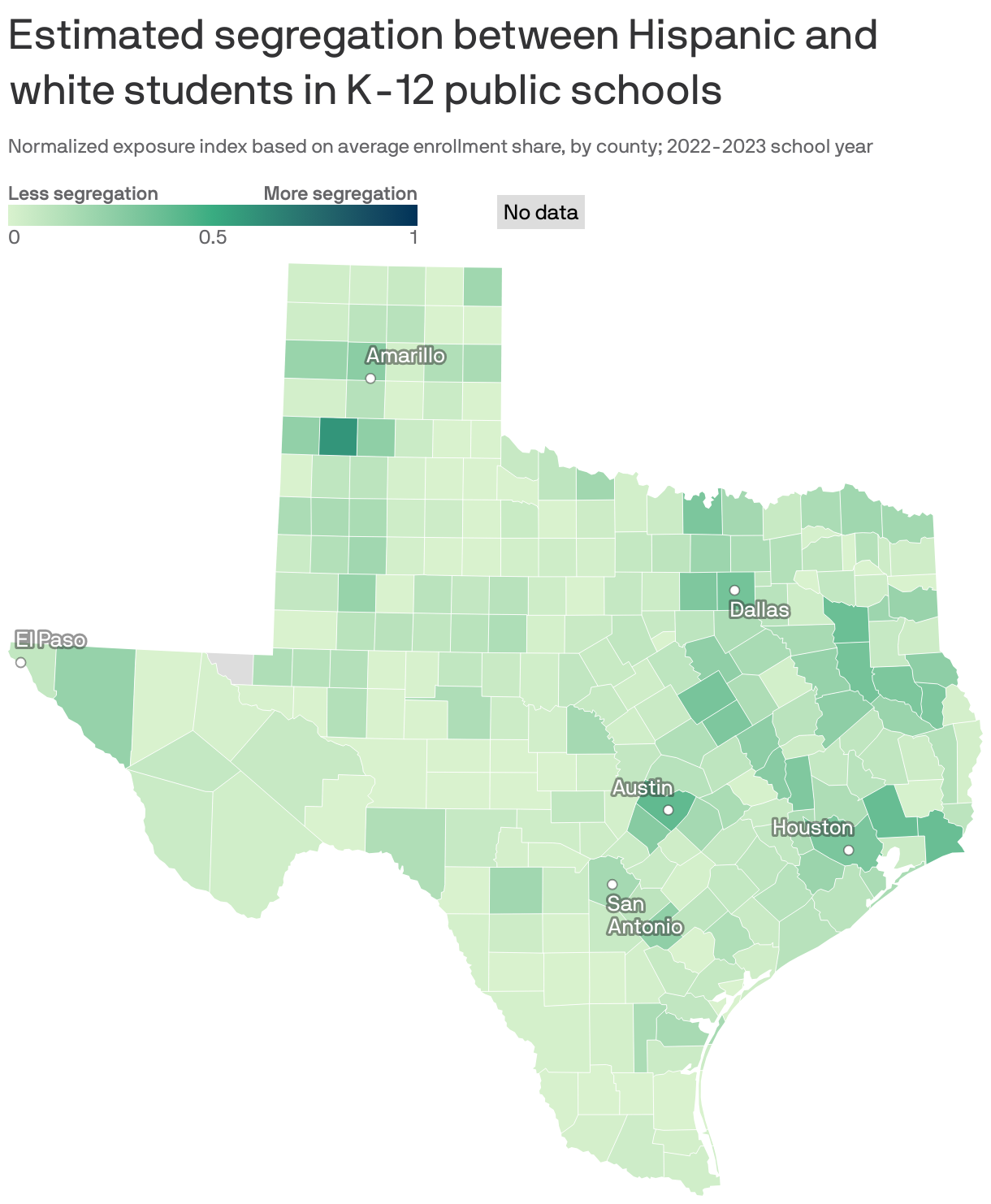
Most schools in the San Antonio area have low levels of racial and ethnic segregation, bucking a national trend of rising segregation — but stubborn economic divisions remain.
Why it matters: Researchers have found segregation disproportionately hurts Black and Latino students, whose schools tend to have fewer resources, higher teacher turnover and fewer advanced classes.
The big picture: Friday is the 70th anniversary of the landmark Brown v. Board of Education ruling that was meant to end legal school segregation in the U.S.
- Yet new reports show racial segregation in K-12 public schools has increased dramatically nationwide.
State of play: School districts in the San Antonio area have low levels of segregation among white and Hispanic students, according to an index of racial segregation published by researchers at Stanford University and the University of Southern California.
- White-Hispanic segregation has decreased in Bexar County since 1991, and now has a rating of 0.18.
- The rating measures segregation by exposure of students of different races and ethnicities. Zero is the least segregated and one is the most segregated.
Yes, but: At San Antonio ISD, segregation among Black and white students remains nearly the same as it was in 1991, and is among the highest segregation ratings in Texas.
- SAISD has a segregation rating of 0.48 for Black and white students.
Zoom in: SAISD's Highlands High School, in Southeast San Antonio, was a model of integration in 1991: 17.6% white, 10.6% Black and 71.4% Hispanic.
- By 2022, it was 2.3% white, 7.1% Black and 89.4% Hispanic.
Flashback: SAISD was one of the first school districts in the nation to desegregate following the Brown decision.
- In recent years, SAISD has worked to better integrate its schools with in-district charter schools and magnet programs.
Reality check: Economic school segregation remains in San Antonio.
- In the 1973 case of San Antonio ISD v. Rodriguez, the Supreme Court ruled that Texas was not discriminating against students based on wealth by basing school funding on local property taxes.
- Some districts remain much poorer — and smaller — than others. The smaller South San Antonio ISD has a revenue of about $109 million, and Edgewood ISD has a revenue of about $130 million. The much larger Northside ISD, by comparison, has revenue of about $1.28 billion.
- The splintered local school districts — at least 20 in Bexar County — don't help fix economic segregation today because of an unequal school funding system in Texas.
Other historic factors contribute to underlying economic division among districts, including:
- Housing policies that declared Black and Latino neighborhoods "hazardous" and blocked families from buying homes.
- White flight, when white families fled the cities for the suburbs to avoid integration.
Between the lines: When the Supreme Court handed down the 9-0 Brown decision in 1954, Mexican Americans and Puerto Ricans weren't considered in the ruling.
- Gary Orfield, co-director of the Civil Rights Project at UCLA, told Axios it would take years for Latinos to be included in school desegregation cases. Even then, enforcement was always weak.
What they're saying: Patricia Gándara, co-director of the Civil Rights Project, tells Axios that segregation of Latino children also has grown worse across the nation because some civil rights activists have given up after early gains.
- "It's been radio silence on the part of the advocates and continuous attacks on the part of the critics."