
What the failed Scobey development says about the future of transit in San Antonio

Add Axios as your preferred source to
see more of our stories on Google.
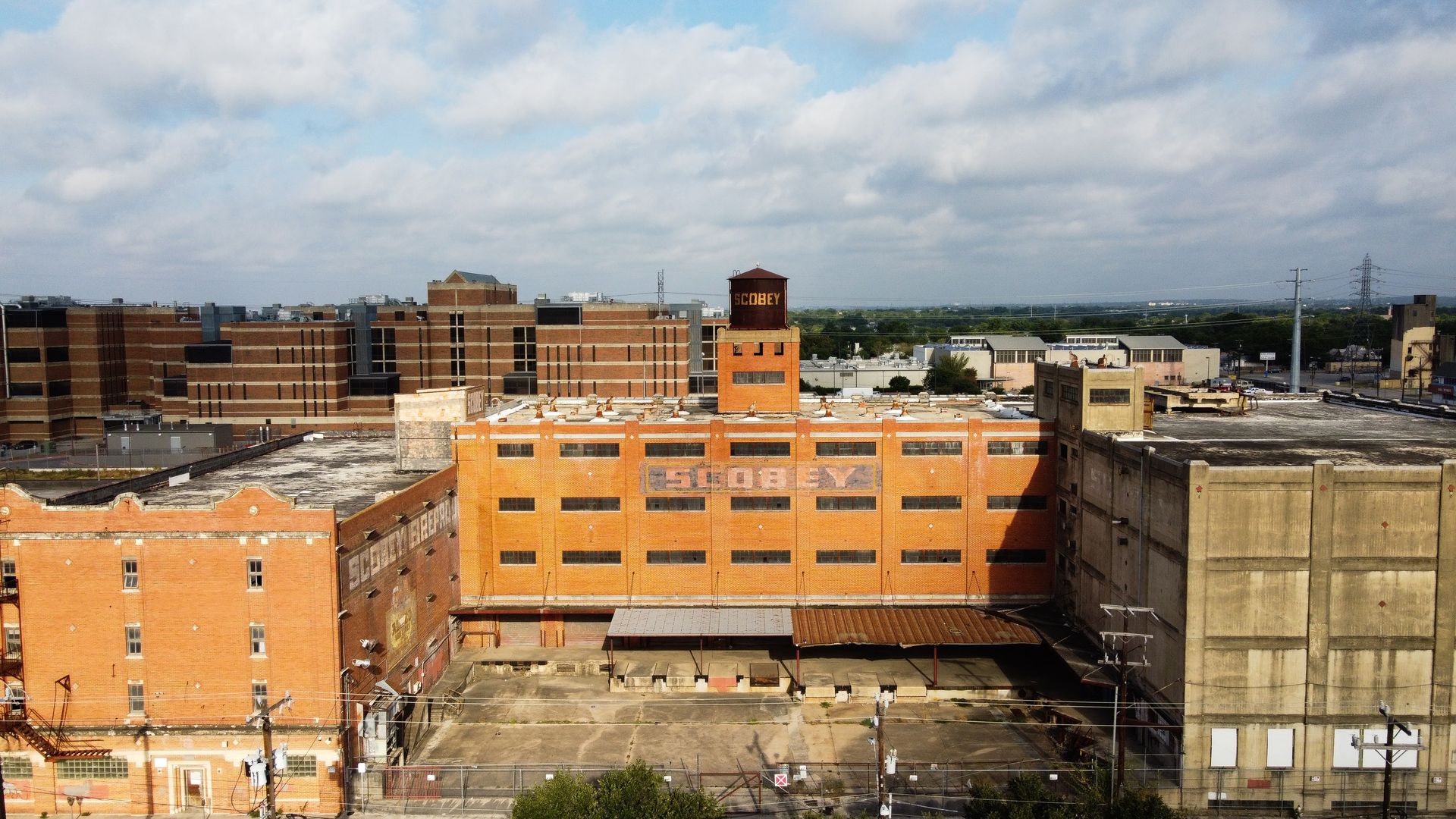
The Scobey complex, a series of vacant industrial buildings, sits on the near West Side close to VIA's Centro Plaza transit hub. Photo: Courtesy of VIA Metropolitan Transit
VIA Metropolitan Transit spent years trying to build San Antonio's first mixed-use development to focus on public transportation access.
- But after the Scobey project fell through last month, the city is grappling with what future development around its bus routes can and should look like.
Why it matters: The project's failure highlights the challenges of transit-oriented development in a sprawling and fast-growing city and prompts questions about which people such developments should serve.
- It also leaves the West Side community — which has long faced poverty and a lack of investment from government leaders and businesses — again waiting on improved access to transit and jobs.
How it works: So-called transit-oriented developments (TODs) cluster housing, jobs and business around a public transit station. Supporters say they reduce congestion and carbon emissions while locating people close to jobs and businesses.
- But like any new real estate investment, TODs have the potential to raise housing prices and displace the low-income residents that many transit developments are meant to serve in the first place.
Catch up fast: VIA bought the Scobey complex, a series of vacant industrial buildings near its busy Centro Plaza station, in 2017. In 2021, the agency chose West Side developer DreamOn to turn the complex into housing, offices and retail space.
- But VIA and DreamOn halted the plan last month, citing poor market conditions and higher costs for material and labor. (They had not applied for federal funding.)
- The news came after neighbors questioned whether planned housing would be affordable enough for the community.
What they're saying: VIA is going back to the drawing board and continuing to engage the neighborhood on the site's future, director of communications Josh Baugh tells Axios.
- "Everything is on the table at this point," he says. "It's still very fresh and we are committed to doing this outreach."
- But VIA officials know they need to do something with the building — "It's an eyesore," Baugh says.
The big picture: San Antonio has a car-centric history, Phil Lasley, a research scientist at the Texas A&M Transportation Institute, tells Axios.
- And the Alamo City hasn't had much incentive to develop its transit because its traffic (believe it or not) hasn't been as congested as other major cities, Lasley says.
- But that's changing as San Antonio grows.
Zoom out: Since the pandemic, Lasley says transit agencies across the country are facing a reckoning over whom they should serve: low-income residents who can't afford a car or young professionals who choose not to own a car and want to live in walkable neighborhoods.
Be smart: When they work, however, TODs can boost transit ridership, in theory giving agencies more resources to serve all residents, Lasley says.
Reality check: Transit-oriented development faces particular challenges in a city like San Antonio, Ming Zhang, a professor at the University of Texas at Austin who researches TODs, tells Axios.
- It's harder to build dense development around bus corridors — which dominate San Antonio's system — than around rail stations, he says.
Plus: These developments are subject to the same market forces as any other, Zhang says. Developers often want less risk and more certainty from a project.
- And San Antonio's West Side — home to the county jail and Haven for Hope homeless services — has historically struggled to attract real estate investment.
What's next: TODs may still emerge elsewhere in San Antonio.
VIA expects to open its first Advanced Rapid Transit bus route by 2027, dubbed the Green Line, from the airport to the Missions area.
- Its dedicated lane should run faster and more reliably than the existing service, and City Council members want to create a transit-oriented development plan for it.
The bottom line: "Given the size of San Antonio, and also the demographics, there is a potential for transit," Zhang says.
- "When there's a good chance for good transit, then there's potential for good TOD."