How NOLA Ready became New Orleans' emergency megaphone

Add Axios as your preferred source to
see more of our stories on Google.
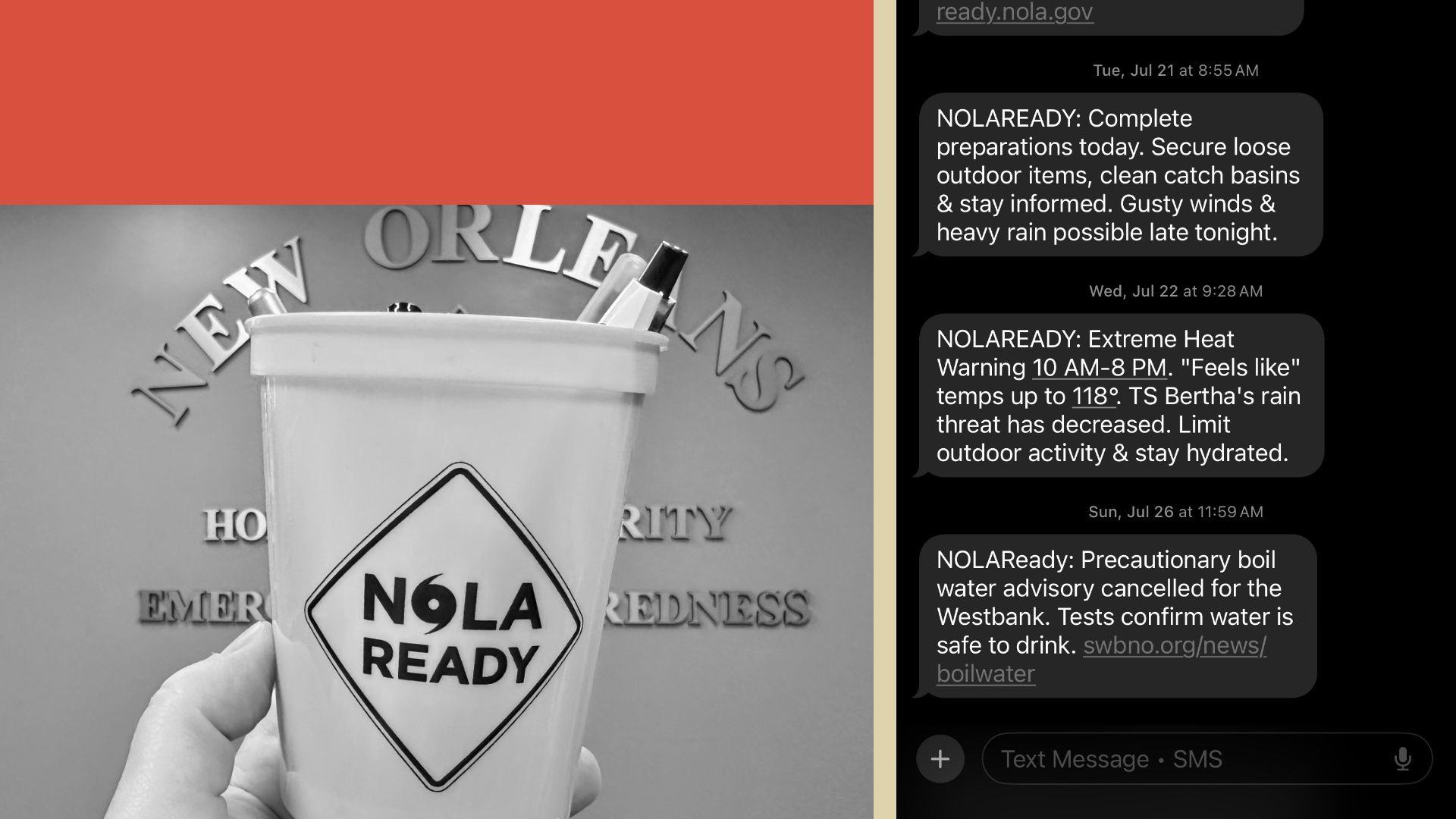
Photo collage: Carlie Kollath Wells/Axios
Buzz. Avoid this intersection because of a building collapse. Buzz. The West Bank is under a boil water advisory. Buzz buzz buzz.
Why it matters: NOLA Ready has become one of New Orleans' most powerful tools for reaching residents directly, and the city keeps finding new uses for it.
The big picture: About 250,000 people get the emergency text alerts — equivalent to nearly 70% of the population of New Orleans.
- It's the public-facing brand of the New Orleans Office of Coordination and Emergency Management, which previously was called the homeland security office.
- The city doesn't ask for additional information when people sign up, so it's unclear how many are locals and visitors.
Behind the scenes: Emma Skilbred works with the "small but mighty" team (ahem — she's the only one in her branch) behind the texts.
- She juggles two phones, one that she never turns off. It has a "really annoying old lady" ringtone, she jokes.
- She manually sends most texts, even at 2am.
Catch up quick: Then-Mayor Ray Nagin launched NOLA Ready in 2007 in the aftermath of Hurricane Katrina.
- The original focus was on hurricane season, but the mission has evolved over the years.
- Now, the messaging includes severe weather alerts, critical missing persons, boil water advisories and interstate closures, among other emergencies.
- Alerts need to affect a large number of people to meet the threshold, Skilbred says.
How it works: NOLA Ready plays a coordination role, Skilbred says.
- The office relies on calls from partner agencies — National Weather Service, NOPD, NOFD, EMS, SWBNO, etc. — to notify the team when an alert is needed.
- Once the information is verified, the team converts it into a simple, timely and actionable message.
Reality check: New Orleans City Council regularly encourages leaders to use the powerful tool, especially when there is a lapse in communication.
- Case in point: After last year's jailbreak, members were unhappy about the hourslong delay in notifying the public and urged officials to communicate through NOLA Ready going forward.
- In years past, council members were also unhappy with delays in neutral ground parking notifications. Now, those alerts are a regular occurrence.
- Sewerage and Water Board alerts were recently expanded too, partly at the council's urging after multiple water main breaks earlier this year.
By the numbers: NOLA Ready averages 15 to 30 texts per month.
- Most users are signed up for general emergency alerts in English, with another 5,000 getting them in Spanish.
- About 30,000 users opt in for extra messages for Mardi Gras, COVID and other special events.
Sign up: Text NOLAREADY to 77295 for alerts.
The bottom line: "People don't need to go through emergencies alone," Skilbred says. "We hold your hand. We want to create a culture here in the city that we are preparing together (and) we are recovering together."