The fight over coastal Louisiana's future isn't going away

Add Axios as your preferred source to
see more of our stories on Google.
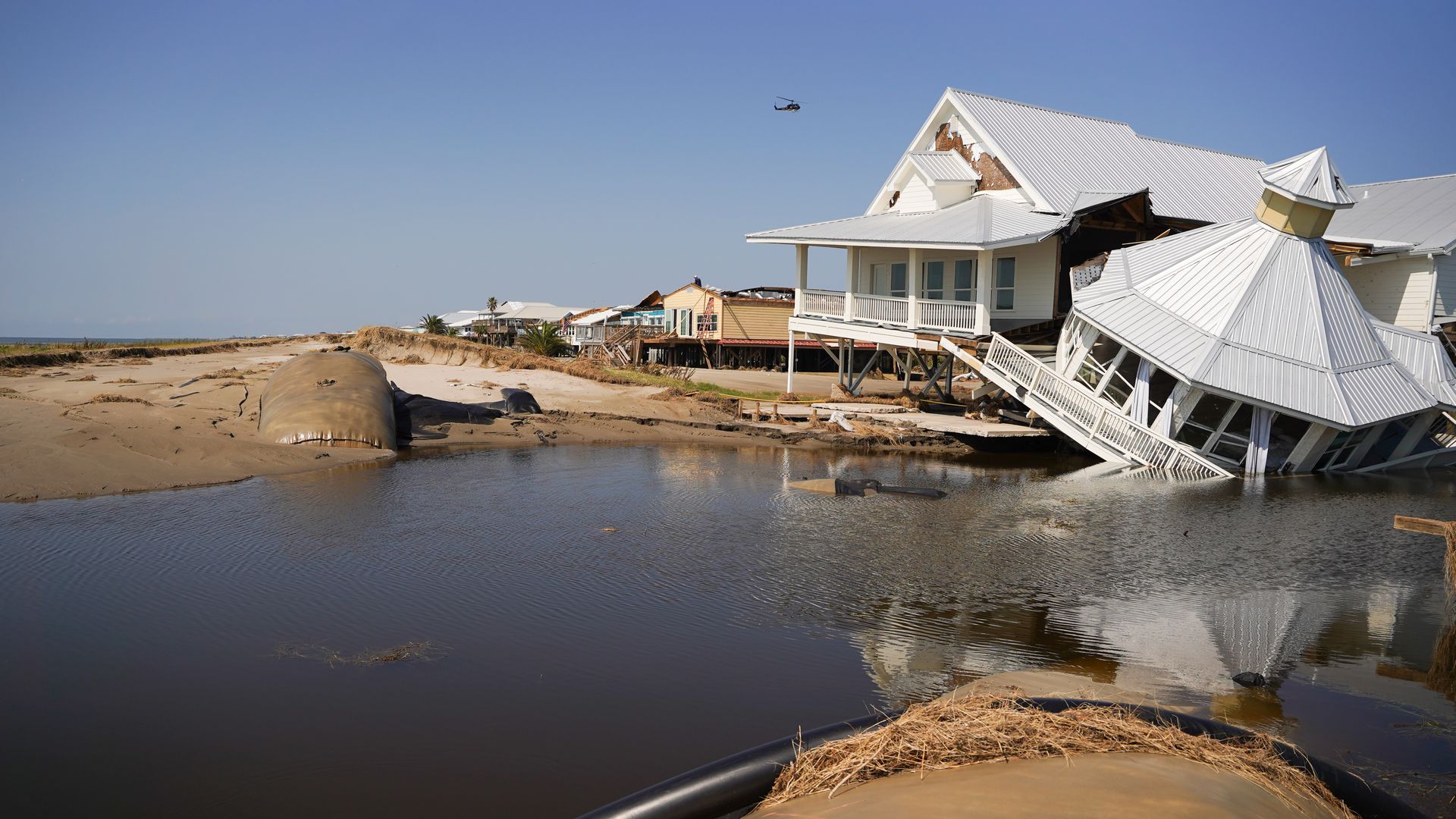
A storm-damaged house near a breached levee after Hurricane Ida in September 2021 in Grand Isle. Photo: Sean Rayford/Getty Images
A Tulane researcher behind a controversial study that called for planning a gradual relocation from Louisiana's vulnerable coastal areas is defending the work after weeks of criticism from local leaders.
Why it matters: The study argued that long-term sea level rise will eventually make permanent reliance on levees unsustainable, sparking a fierce debate over what the state should do next.
The big picture: Tulane coastal geologist and lead author Torbjörn Törnqvist told the Baton Rouge Press Club this week that people missed the point of the paper, writes David J. Mitchell with The Times-Picayune.
- Louisiana could become the global leader in responding to sea level rise, Mitchell writes of Törnqvist's comments.
- The study sparked a "long-overdue, community-wide conversation," Törnqvist wrote in a follow-up letter, but does not call for a government-led relocation.
- "Within the context of climate-driven sea-level rise, our home is also the most vulnerable major low-lying coastal zone in the world," he wrote.
Catch up quick: The researchers identified what they say was the Gulf's ancient shoreline near present-day Ponchatoula, arguing it offers a glimpse of how far inland the coast could eventually move.
- Now is the time to start planning for a multi-generational relocation from coastal areas, the researchers say.
The other side: Local leaders blasted the study.
- Mayor Helena Moreno, in a NOLA.com opinion piece, said researchers underestimate human innovation and questioned why "New Orleans was uniquely singled out for abandonment," and not Miami or New York.
- GNO Inc. president and CEO Michael Hecht, in a letter in The Guardian, criticized the study, saying it was "rife with flaws" and "abandonment is simply not realistic."
- Törnqvist pushed back Monday, Mitchell writes, saying Moreno appeared not to have read the study and accused Hecht of making "disgusting" comments about the authors.
Between the lines: The argument touches a nerve in New Orleans, where residents still remember the post-Katrina debate over whether the city should be rebuilt.
- A grassroots group last month hosted a "dance & dissent party" called "We're Not Leaving" in response to the study.
Zoom in: The migration is already happening informally, LSU coastal scientist Sam Bentley tells the Louisiana Illuminator.
- Cameron Parish, which has been battered repeatedly by storms and coastal flooding, has lost 52% of its population since 2000, he says.
- New Orleans has lost 25% in that same period, with the largest loss after Hurricane Katrina. Go deeper.
- "Although population loss reflects Louisiana's statewide trends, coastal areas exhibit greater losses," the researchers write in the paper.
Case in point: Some people are already talking about leaving on their own terms.
- Debra Campbell, a leader with New Orleans-based A Community Voice, recently was on a national panel to discuss the grassroots effort to identify a less climate-vulnerable and more affordable city where some New Orleanians could relocate.
What's next: Louisiana needs to focus on "aggressive, science-informed" coastal restoration efforts to buy time while beginning difficult conversations about climate migration, Törnqvist writes in a letter to NOLA.com.
- "We are not giving up on anything or anyone," he writes.