The Indy Health District's master plan for longer lives

Add Axios as your preferred source to
see more of our stories on Google.
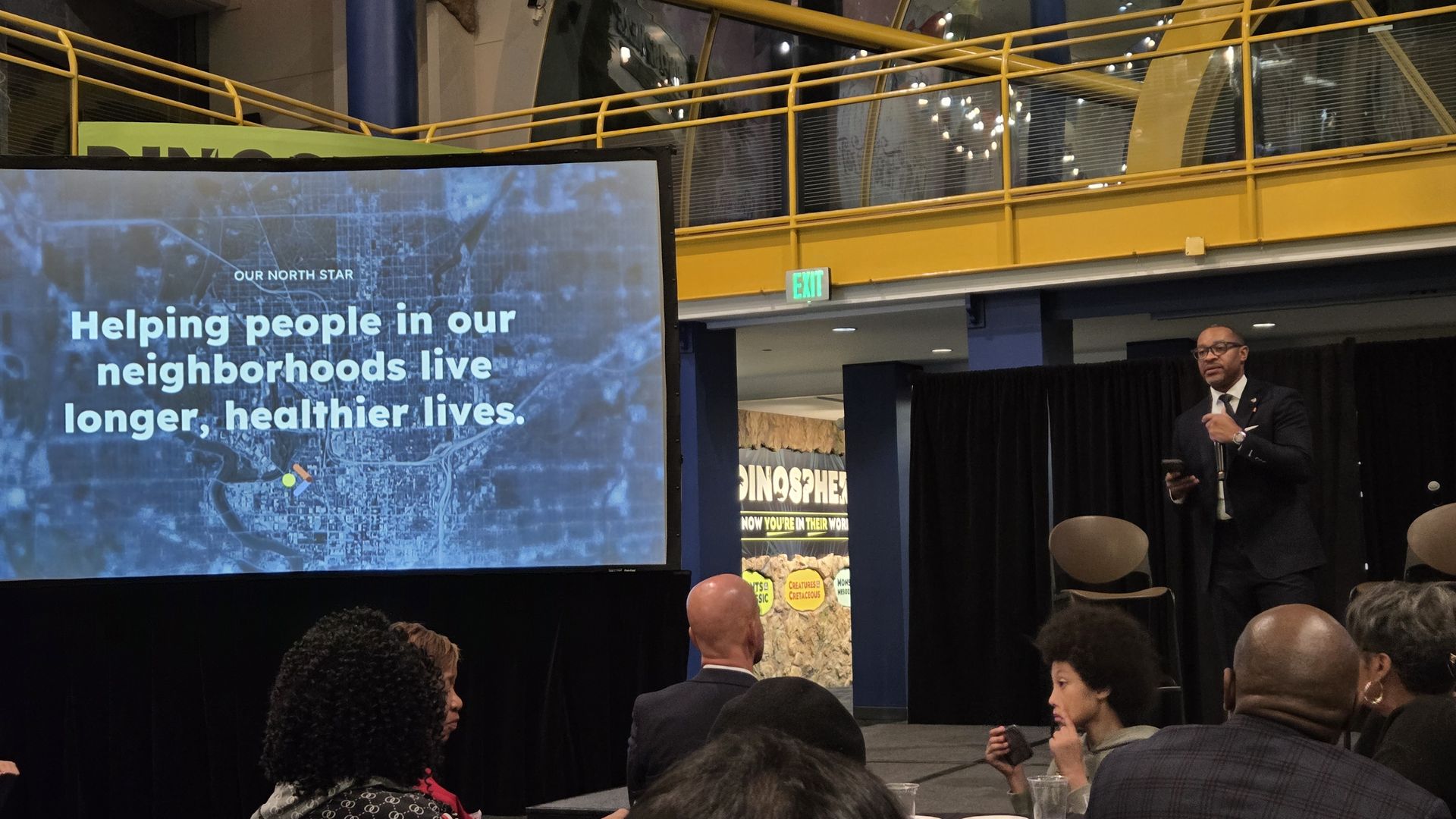
Indy Health District executive director Jamal Smith speaks at the 2026 State of the District event at The Children's Museum of Indianapolis. Photo: Justin L. Mack/Axios
The Indy Health District's 10-year plan to close a stark life expectancy gap in five historic neighborhoods puts groceries, housing stability, safer streets and economic opportunity at the forefront.
Why it matters: Residents of the Indy Health District live an average of 67 years, 6.5 years fewer than those in Marion County and more than a decade fewer than those in many nearby suburbs.
Context: The plan covers more than 1,500 acres and nearly 10,000 residents across Crown Hill, Historic Flanner House Homes, Highland Vicinity, Meridian Highland and Ransom Place.
- The district's core challenge is improving outcomes while making sure the area's longtime residents can afford to stay and benefit from new investment.
Driving the news: The nonprofit unveiled its 2026-2036 Quality of Life Plan Wednesday at the Children's Museum of Indianapolis, outlining six priorities shaped by residents' concerns.
- The six pillars are health and wellness; neighborhood infrastructure and environment; economic mobility and local entrepreneurship; family stability and youth development; community safety and justice; and community preservation and cultural identity.
- The district spent nearly a year gathering input through more than 500 survey responses, 100-plus interviews, neighborhood workshops and door-to-door outreach. Residents accounted for at least 70% of the input shaping the plan.
- The process included 49 Crispus Attucks High School students, who emphasized better career opportunities, mental health support and a safe place of their own to gather.
Zoom in: Affordable, healthy food emerged as a leading concern, alongside keeping homes in the family and making neighborhood improvements that benefit existing residents.
- At an October validation session, nearly 80 residents cast 349 votes on proposed goals and submitted almost 150 written comments. Their feedback strengthened the plan's commitments to property-tax relief, estate planning and home-repair assistance for seniors.
- Residents also called for a full-service grocery store within reach of every neighborhood. More than half of district residents currently live in a food desert, according to the district's health dashboard.
- The plan also prioritizes protecting the neighborhoods' historic Black identity and generational homeownership. Residents specifically raised concerns about gentrification and displacement as new development arrives.
What they're saying: "Progress cannot simply be measured by what we build," executive director Jamal Smith said Wednesday. "It must be also measured by the number of people who can benefit from the investments that we also make."
- "Thank you for loving your neighborhoods enough to advocate for them," he said. "Challenge us, and demand that we think bigger and better."
How it works: Life expectancy won't change overnight, so the district is working with the IU Fairbanks School of Public Health, the Polis Center at IU Indianapolis and Health by Design. They'll track roughly 30 measures across short-, medium- and long-term timelines.
- Valerie Yeager of the Fairbanks School of Public Health said the measures will help show whether initiatives are improving well-being before changes in life expectancy become apparent.
- The measures include factors such as education, health care access, neighborhood conditions, economic stability and residents' sense of community. A survey of 203 households found 66% believed neighbors would help them in an emergency, while 63% said they felt they belonged in their neighborhood.
- Yeager said tracking who moves in and out is also essential. Otherwise, an apparent improvement in life expectancy could be misleading if healthier newcomers replace longtime residents.
What's next: IHD will organize resident and partner working groups around the six pillars, use a public health-impact dashboard to track roughly 30 measures and report progress annually.
- The district is already pursuing priorities like adding early-learning capacity, operating floating farmers markets and supporting a $25 million investment in the Crispus Attucks High School expansion.