Old News: The Indiana State Fairgrounds Coliseum explosion

Add Axios as your preferred source to
see more of our stories on Google.
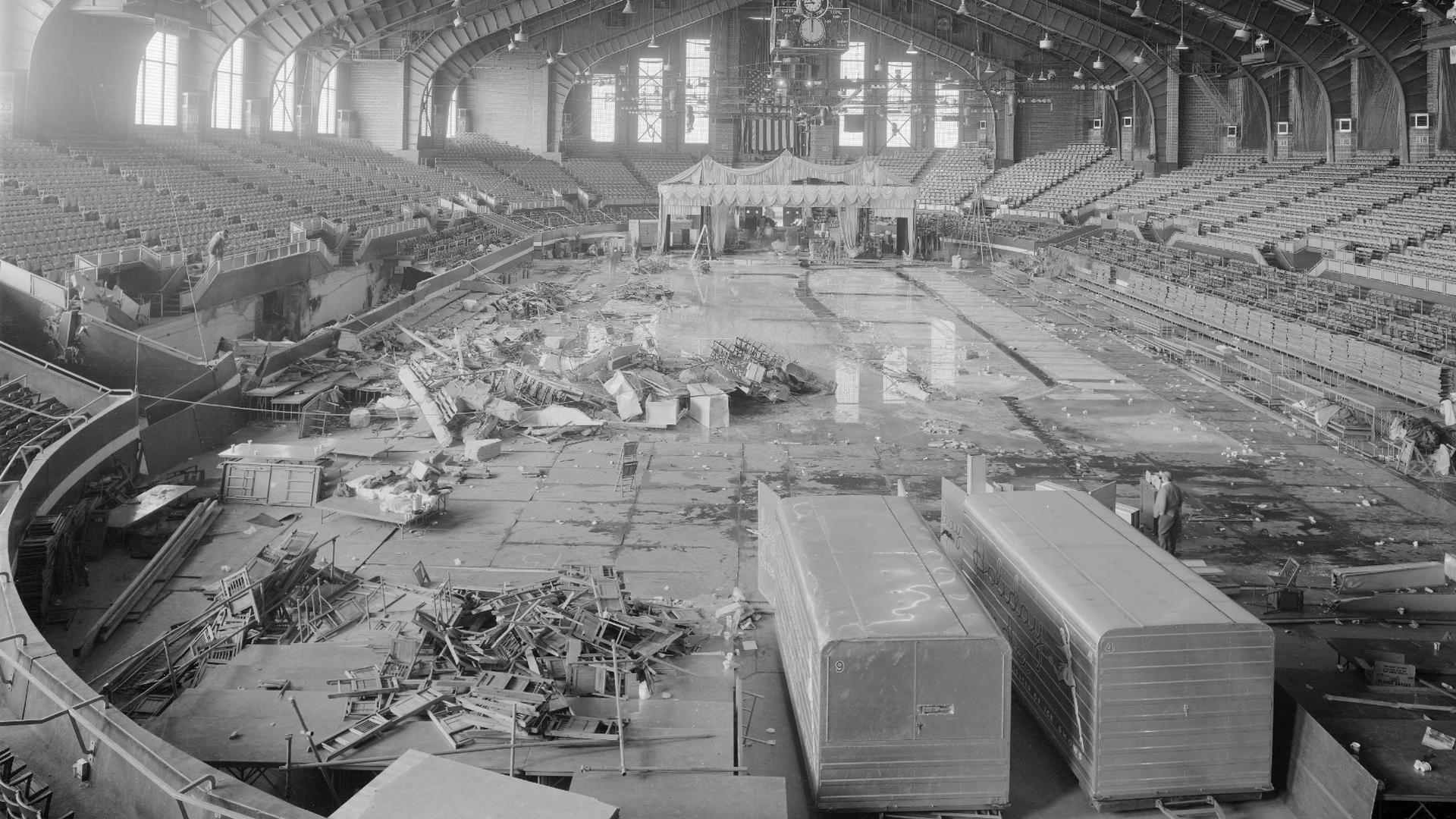
Photo: Courtesy of the Bass Photo Co. Collection/Indiana Historical Society
Sixty-three years ago, a Halloween-night ice show turned into one of Indianapolis' deadliest disasters when a propane explosion killed dozens of people and injured hundreds more.
Why it matters: The blast exposed unsafe propane storage and weaknesses in mass-casualty planning, changing how Indianapolis coordinated emergency response and hospital communications.
Flashback: On Oct. 31, 1963, more than 4,000 spectators gathered for "Holiday on Ice" during Shriners Night at the Indiana State Fairgrounds Coliseum.
- Shortly after 11pm, an explosion ripped through the south-side seating area.
- Officials said a faulty valve on a rusted propane tank improperly stored in an unventilated concession-area storeroom allowed gas to leak.
- The gas ignited near an electric popcorn machine, triggering the initial blast. A second explosion followed when other propane tanks erupted.
By the numbers: 54 people died at the scene and 20 more later died from their injuries, according to Indianapolis historical records.
Zoom in: Indianapolis police, firefighters, the Red Cross, the Salvation Army and hundreds of volunteers rushed to help.
- Volunteers and first responders used ambulances, buses and private cars to take victims to area hospitals.
- A nearby cattle barn became a makeshift hospital, and the ice floor served as a temporary morgue.
The big picture: The disaster overwhelmed an emergency response system that lacked mass-casualty planning and effective ways to distribute patients among hospitals.
- Indianapolis upgraded its inter-hospital communication system the next year.
- The city's response also became the subject of "Disaster in Aisle 13," a disaster-research case study examining coordination, communication and emergency mobilization.
Between the lines: The incident also triggered years of litigation with more than 400 lawsuits seeking roughly $70 million in damages, resulting in $4.6 million in settlement payouts.
The bottom line: The Coliseum was repaired and reopened, hosting the Beatles in 1964.