IMPD adopts stricter Flock rules amid debate, misuse


Add Axios as your preferred source to
see more of our stories on Google.

Photo illustration: Brendan Lynch/Axios. Photo: Smith Collection/Gado/Getty Images
Hundreds of automated license plate readers are watching Indianapolis streets, putting the city near the center of a growing national fight over police surveillance.
Why it matters: Flock cameras and other automated license plate readers (ALPRs) can help police fight crime, but their ability to track vehicles has fueled a growing backlash and calls for tighter oversight or removal.
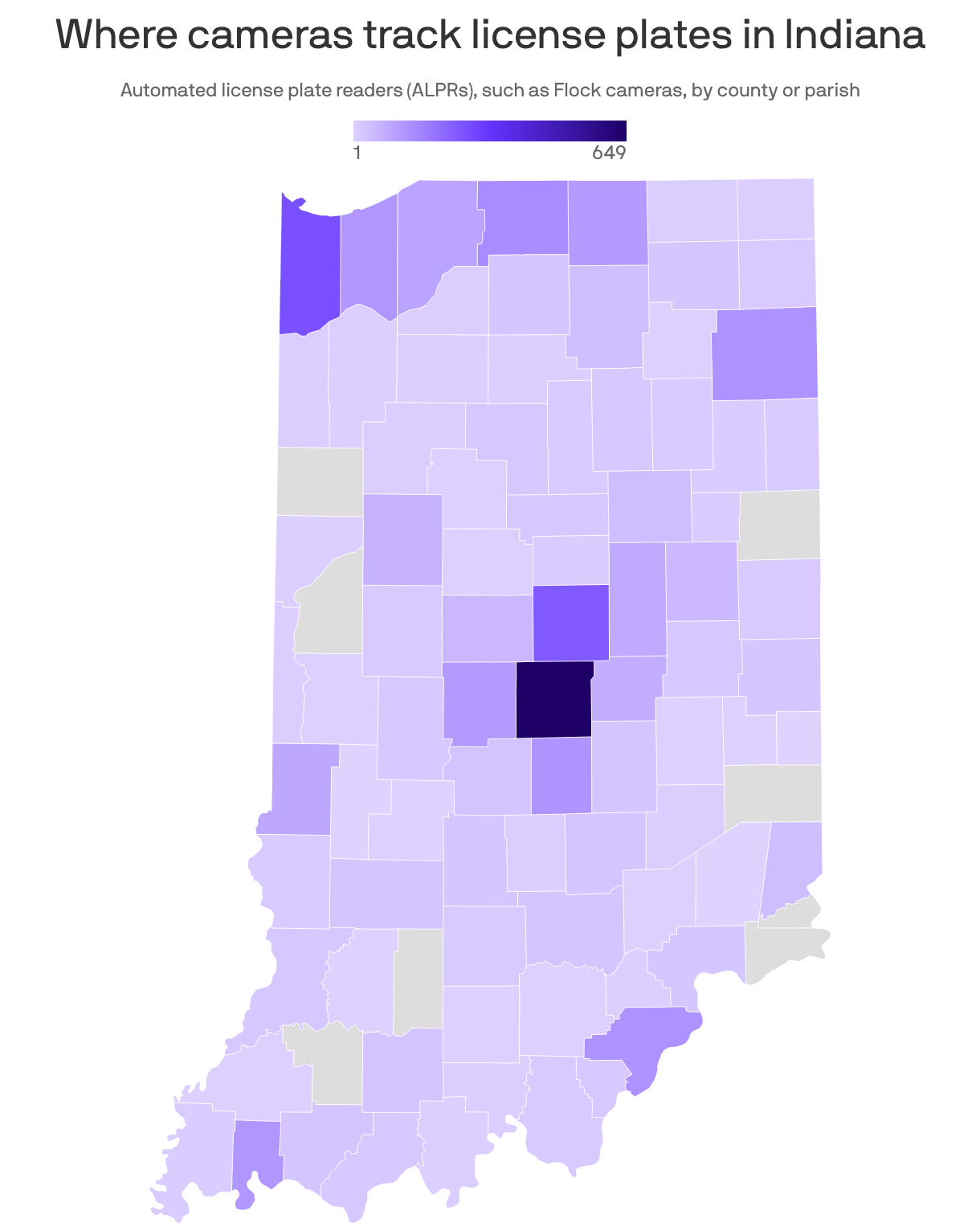
By the numbers: Volunteers had documented 649 automated license plate readers in Marion County as of Sept. 4, the most among Indiana counties tracked by the public Finding Flock database.
- Hamilton County's 249 are the third most in the state, behind Lake County's 270.
Catch up quick: IMPD rolled out hundreds of Flock cameras over the last several years and signed a four-year contract with the company in 2025.
- The agency has said it expects to spend $1 million annually on the technology, but the contract allows for up to $6 million over its duration.
- The cameras automatically capture license plates and vehicle data.
What they're saying: "Without a doubt, technologies such as ALPRs help us solve crimes faster, remove violent offenders from our neighborhoods and locate endangered or missing people when time matters the most," IMPD chief Tanya Terry said during a recent City-County Council committee meeting.
- Terry added that IMPD will use "every tool available" to solve crime.
- "ALPRs are a tool that has truly saved lives," she said.
Yes, but: Indianapolis' network has faced increased scrutiny over how the information can be and is being used.
- An IMPD officer was recently suspended without pay and recommended for termination after it was discovered he was tracking license plates for personal reasons.
- "Misuse is unacceptable. Misuse hurts our credibility and erodes the public trust that is essential to our mission," Terry said. "Technology itself is not the problem. Misuse is."
The latest: Terry said IMPD has drafted a new ALPR use policy, which users had to sign to maintain access to the system, and a new daily auditing process to identify potential misuse more quickly.
- Previous oversight included "spot checking," which Terry said was "clearly not enough."
- The department also now requires every search to be tied to a case or Computer Aided Dispatch number. In the past, that was optional.
The big picture: The issue isn't unique to Indianapolis. About 140,000 automated license plate readers, including thousands of Flock cameras, are installed across the U.S., and debate is intensifying as some communities reconsider or remove the cameras amid concerns about surveillance and misuse.
- Misuse has occurred around the country, including dozens of instances of stalking.
- One of those was a Jackson County, Indiana, deputy who allegedly used ALPRs to look up his then-girlfriend's car more than 2,000 times. He's since resigned and been charged with misconduct and fraud.
What we're watching: Whether the backlash prompts state lawmakers to tighten the rules around how the information can be stored and used.
- Terry said IMPD has talked with lawmakers about introducing legislation around proper use during the upcoming Indiana General Assembly session.
What's next: IMPD's General Orders Board is expected next month to consider the ALPR policy that the department is now largely using, including a potential shortening of the retention period from 30 days to seven days.