Greencastle infant at Riley Children's Hospital with rare genetic condition

Add Axios as your preferred source to
see more of our stories on Google.
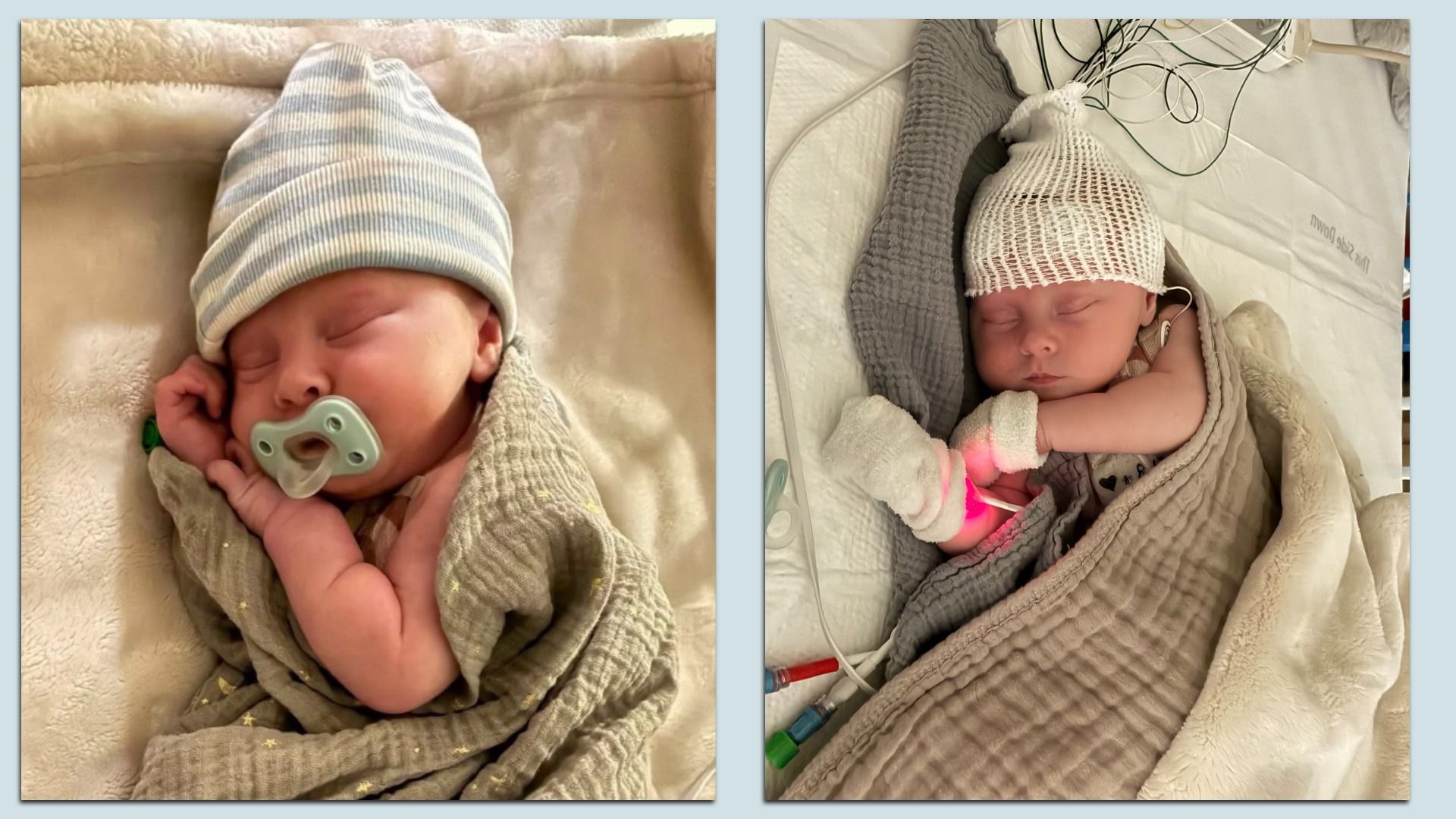
Photos: Courtesy of Jody Feiss
Maddox Richey is just 3 weeks old — a perfect blond-haired, blue-eyed infant.
Why it matters: "He's calm and peaceful. … He's just a normal baby," says his aunt Jody Feiss.
- Except baby Maddox also has an exceedingly rare genetic condition called Krabbe disease, a devastating degenerative neurological condition that progresses quickly and usually ends in death.
Driving the news: Half Liter BBQ in Broad Ripple, where one of Maddox's aunts works, is hosting a fundraiser for the family on Tuesday, donating 15% of all sales and $1 from every beer sold from open to close.
- Maddox's parents, Jenna Burton and Mason Richey, live in Greencastle but have essentially moved into Riley Children's Hospital while they wait for a spot to open up at the nearby Ronald McDonald House.
- He started a week of chemotherapy Saturday and will receive a stem cell transplant in the coming days — all of which needs to be done before he's 30 days old. He'll need to stay in the hospital for monitoring for several months afterward.
What they're saying: "It doesn't impact a tremendous number of families," Feiss tells Axios, "but the families it impacts, it changes their lives forever and ever."
- She's hoping efforts like the fundraiser at Half Liter and the GoFundMe that's been set up for Maddox will educate people about the disease and provide the family enough support so that his parents can focus on being with their son — not worrying about bills, missed work or the costs of what his long-term care may be.
State of play: Maddox's condition was caught on his newborn screening.
- While the average lifespan for an infant with Krabbe is 13 months, research shows that asymptomatic babies, like Maddox, treated within the first 30 days of life can live longer and have normal childhoods.
- Because of the rarity of the condition, which occurs when both parents are carriers and both pass on the gene to their child, there's little information available about long-term outcomes.
Context: Feiss, who lives in Indianapolis, and her family have some idea of what it can look like.
- Her uncle was diagnosed with Krabbe at 4 years old. He lived to 15, she said, and progressed from a normal, healthy toddler to a child who was blind, wheelchair-bound and required a feeding tube.
- Maddox's parents did not know they were both carriers and had no idea anything was wrong until after the newborn screening.
"Everything changed overnight," Feiss says. "Having a new baby, being at home and being in love. … That was all quickly taken from my sister."
- While there is no cure for Krabbe disease, Feiss hopes that with treatment, one will be developed in Maddox's lifetime.
- "He's just this beautiful soul and he's got a village here," Feiss says. "We're hoping to see him through and walk with him every step of the way."
If you go: Half Liter BBQ, 5301 Winthrop Ave., is open from 11am-10pm Tuesday.