E-bike and e-scooter injuries surge in the Indianapolis area


Add Axios as your preferred source to
see more of our stories on Google.
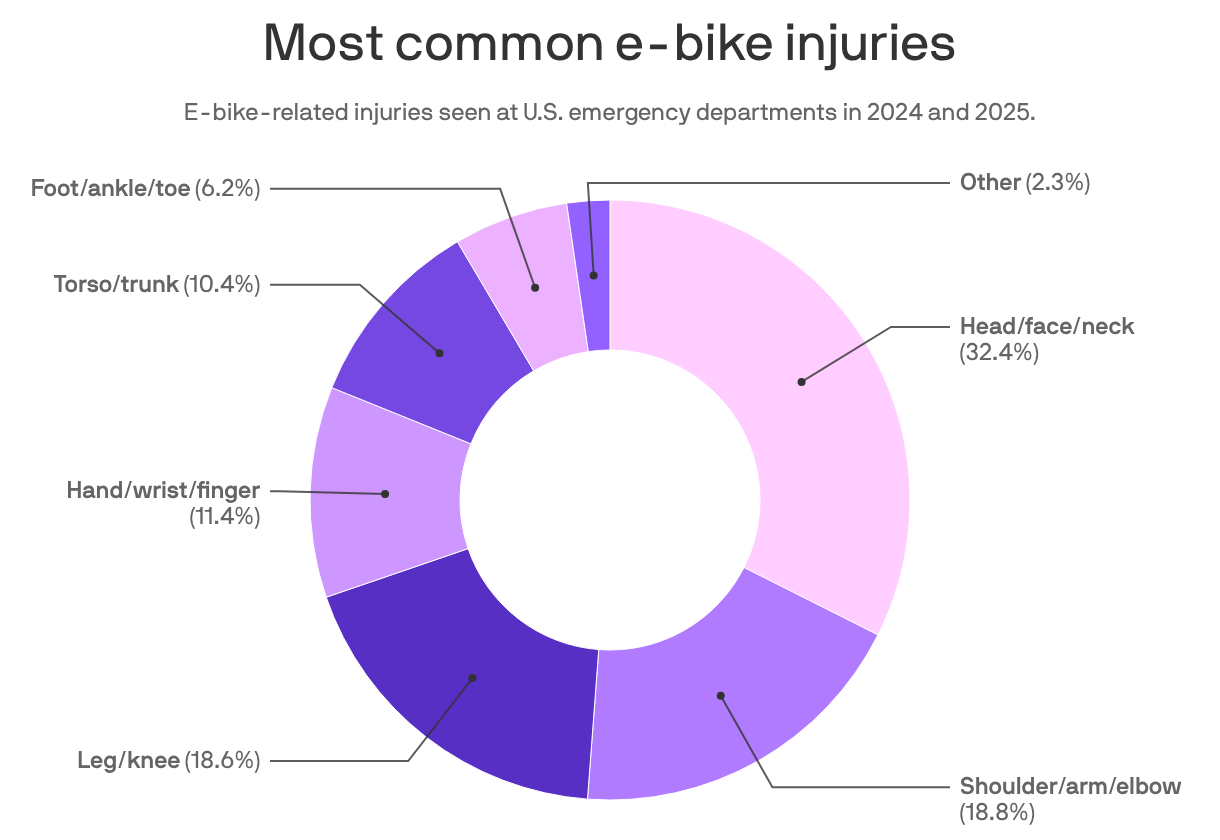
Local trauma specialists warn the ongoing e-bike boom is fueling a spike in injuries in Central Indiana, especially among young riders.
Why it matters: Experts say the vehicles aren't inherently more dangerous than traditional versions, but their higher speeds can increase the severity of crashes.
Driving the news: Riley Children's Health issued an alert this week, along with statistics showing that they've seen 17 e-bike-related injuries this year as of July 1.
- That's up from none recorded in all of 2023, four in 2024 and 12 in 2025.
- Nine of the 2026 injuries happened in June.
What they're saying: "It's a huge increase that we're seeing," said Riley Trauma Program Manager Tracy Spitzer. "These injuries are not just bumps and bruises ... they're skull fractures. They're major abdominal injuries."
- Spitzer added that because e-bikes can travel at high speeds, having the proper gear and adult supervision is paramount.
- "Bike helmet is great, but it probably isn't going to sustain that same impact as something more like a motorcycle helmet," she said.
Threat level: Early Sunday, an e-bike operator was killed on Indianapolis' west side after being struck by a vehicle in the southbound lanes of Interstate 465.
- The crash is being investigated as a hit-and-run, and Indiana State Police believe the man who was killed was riding an e-bike in the right lane of I-465 when he was struck.
Zoom out: E-bike sales in the U.S. have more than quadrupled over the past five years.
- About 41% of all emergency visits for e-bike injuries in 2024 and 2025 involved patients ages 10–19, per National Electronic Injury Surveillance System estimates.
Between the lines: The speed and weight of e-bikes make them more difficult for inexperienced riders to control, increasing the risk of serious injuries.
- They use electric motors that amplify a rider's pedaling effort. Some models include a throttle that propels the bike without pedaling.
- Youth-oriented models are limited to about 20 mph, but some users illegally bypass those speed limiters.
No federal law regulates e-bike use, leaving states and local governments to set their own rules.
- Helmet laws also vary widely. Thirteen states require helmets for all e-bike riders, 11 have conditional or bike-class-specific requirements, and 26 do not require helmets for adults, though some have separate rules for children.
Zoom in: IMPD is leaning into education and enforcement as more riders — including many on devices that don't legally qualify as e-bikes — hit the city's trail network.
- IMPD North District has run multiple public-safety pushes on the Monon Trail, warning that many higher-powered "e-bikes" are actually banned motorized devices.
- In May, the Fishers City Council approved an expansion of the city's electric-powered vehicle ordinance after police raised concerns about unsafe driving.
Worthy of your time: The American Academy of Orthopedic Surgeons offers a list of tips to prevent e-bike injuries, including wearing a helmet every time and putting phones and headphones away while riding.