30 over 30: The Monon Trail

Add Axios as your preferred source to
see more of our stories on Google.
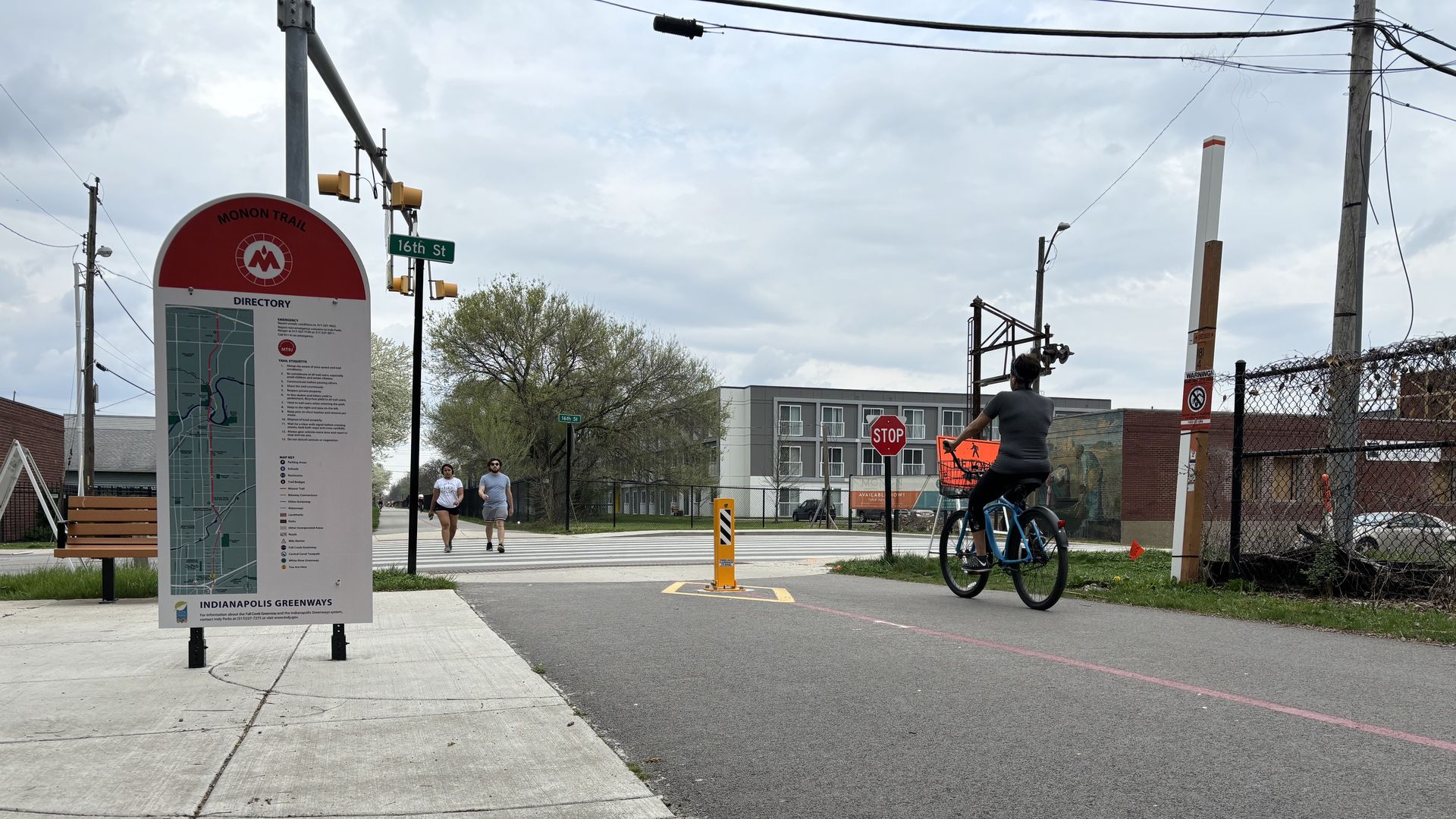
The intersection of 16th Street and the Monon Trail in downtown Indianapolis. Photo: Arika Herron/Axios
In honor of Global Running Day, we're celebrating one of Central Indiana's favorite pavements to pound.
The big picture: Today, the popular Monon Trail spans roughly 30 miles from downtown Indianapolis north through Hamilton County.
- It's largely considered one of the city's best amenities and its success has helped catalyze the creation of new trails statewide.
Yes, but: When former City-County Councilor Ray Irvin conceived of converting the abandoned railroad into a walking, running and biking trail nearly four decades ago, not everyone thought it was a good idea.
- "We had tremendous fights with the NIMBYs–'Not in My Backyard' types," he told Indianapolis Monthly in a 2013 interview.
Flashback: From the 1850s to 1980s, the Monon Line ran between Louisville and Chicago and hauled Indiana limestone, farm goods, coal and even Union soldiers and supplies during the Civil War.
- When it closed, it quickly became a dumping ground and eyesore.
- That's when Irvin and the city stepped in, paying about $1.5 million for the first 10 miles of the abandoned Monon railroad corridor.
State of play: The first stretch in Broad Ripple proved the concept and those original 10 miles grew — even if Carmelites still picketed the opening of its first stretch in 2002.
- Today, it's so popular in Carmel that the city has widened stretches of it through downtown into a 140-foot-wide greenway with paths, green spaces and play areas.
More than three decades later, the trail is celebrated locally and beyond — it's been inducted into the Rail to Trails Conservancy's Hall of Fame, which recognizes exemplary rail-trails across the country.
- "Monon Trail is more than a greenway; it's a commuter super-highway, a linear park for families, an inexpensive way for folks to get exercise," the Conservancy wrote. "In many ways, it's the asphalt lifeblood of those Hoosier communities."