Indy's population grows as nationwide immigration plummets


Add Axios as your preferred source to
see more of our stories on Google.
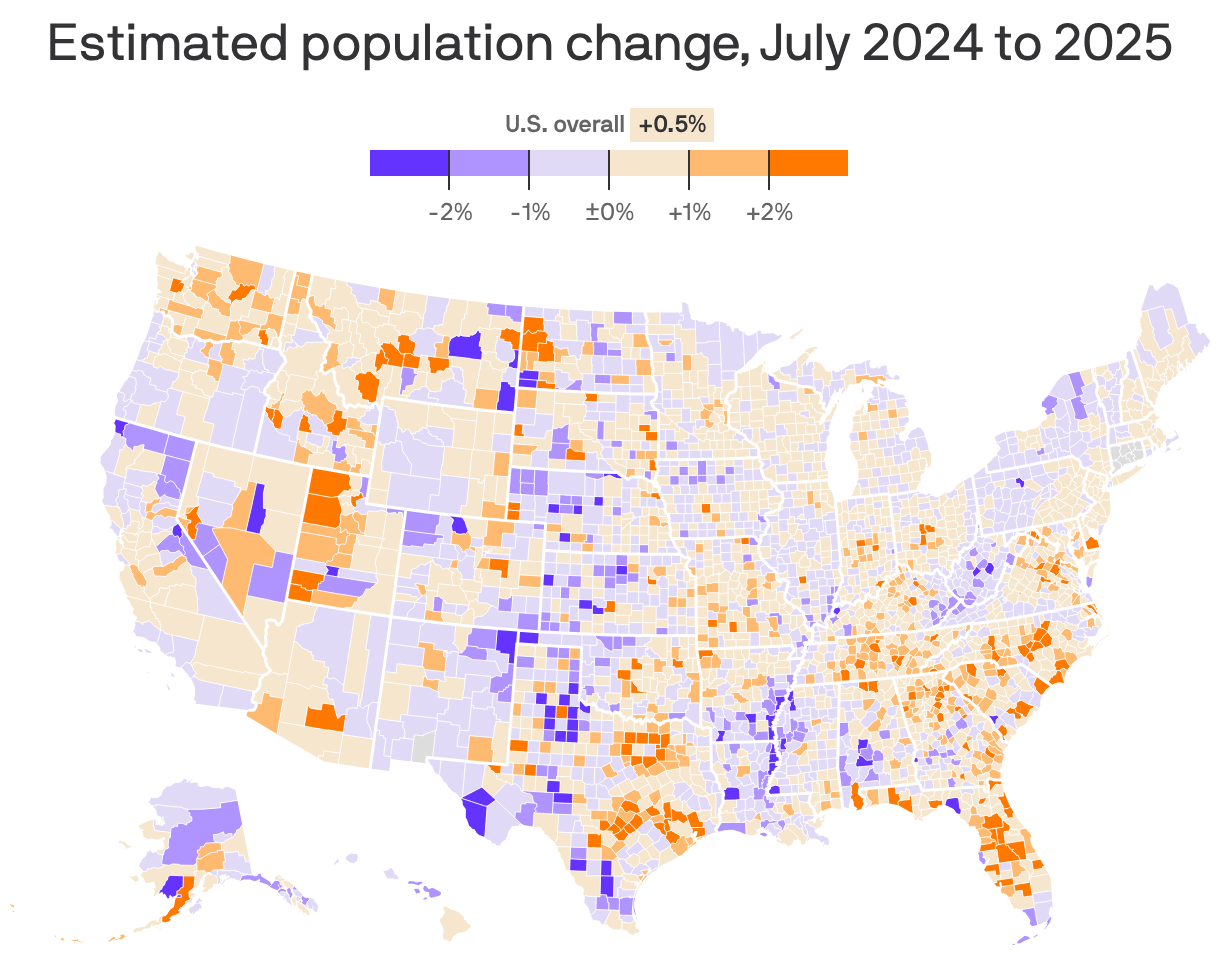
Population growth is slowing in most counties nationwide amid a massive drop in immigration, but the Indianapolis metro is doing its best to buck the trend.
Why it matters: New Census data offers the best look yet at how tighter immigration enforcement is affecting America's demographic makeup.
By the numbers: Our metro area grew by over 22,000 people from 2024 to 2025 — more than 1%, double the national growth average.
- The area's total population was 2,205,695 people last year.
- Statewide, an Indiana University Kelley School of Business analysis found that the Hoosier State added 38,579 residents in 2025 to reach a total population of 6.97 million.
Between the lines: For the third straight year, Boone and Hancock counties were the fastest-growing in Indiana. Boone County had a 2.6% growth rate, and Hancock County grew by 2.4%.
- Clark (2.1%), Hamilton (1.9%) and Johnson (1.9%) counties rounded out the top five.
What they're saying: "Since 2023, Indiana has had an average annual growth of more than 43,900 residents per year, which is the state's largest increase over a three-year stretch since adding roughly 48,700 residents a year from 2006 to 2008," Matt Kinghorn, senior demographer at the Indiana Business Research Center, said in a statement.
Zoom in: Kinghorn said while the state's growth rate between then and now is similar, the factors driving the increase has changed.
- From 2006 to 2008, the difference between births and deaths accounted for 70% of Indiana's growth. Over the past three years, migration has been responsible for 81% of gains.
- Indiana had 8,561 more births than deaths in 2025, a 7% drop compared with the previous year.
- International migration was the largest source of Indiana's growth in 2025, with a net inflow of 17,852 residents.
Yes, but: Net international migration to Indiana declined by 53% from 2024 to 2025, according to IU.
Zoom out: International migration fell in nine out of 10 U.S. counties between 2024 and 2025 compared with the prior period, the Census Bureau says.
State of play: That drop is hitting populous areas especially hard.
- Census Bureau demographer George M. Hayward, in a statement: "The nation's largest counties ... are often international migration hubs, gaining large numbers of international migrants and losing people that move to other parts of the country via domestic migration."
- "With fewer gains from international migration, these types of counties saw their population growth diminish or even turn into loss."
Case in point: California's Los Angeles County lost nearly 54,000 people from 2024 to 2025, down about -0.6%. (It remains the biggest U.S. county, with about 9.7 million people.)
The big picture: The U.S. overall still grew by 0.5% between 2024 and 2025.
- But that's down from 1% over the previous period.
Nationwide natural change (births minus deaths) held steady, while international migration plummeted from about 2.8 million people to 1.3 million — about a 55% drop.
- Caveat: The Census' international migration data include both foreigners and Americans coming home from abroad, including military service members.