Here's how Indiana's "bring your baby to work" policy is going

Add Axios as your preferred source to
see more of our stories on Google.
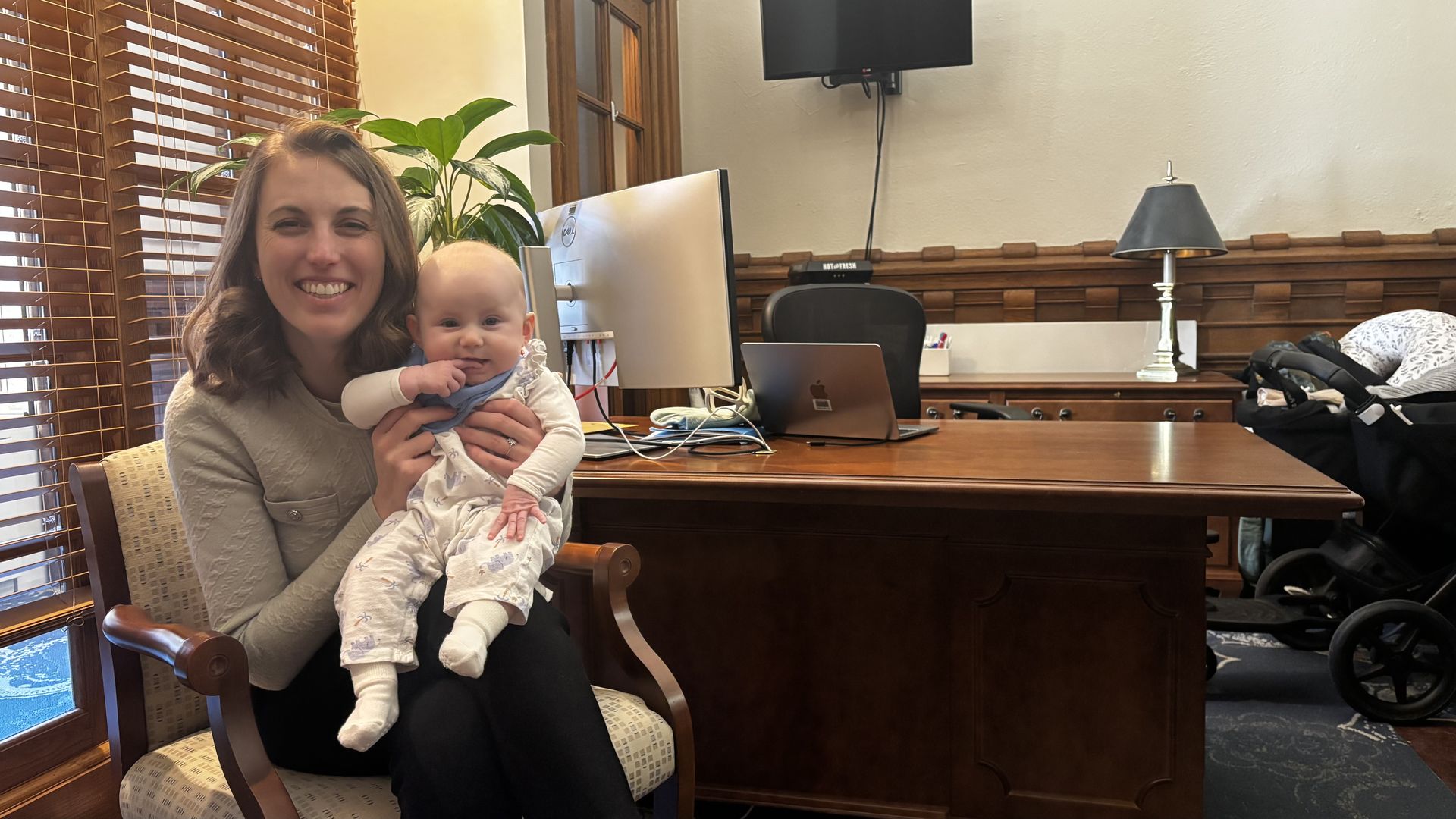
Jessica Roeder and her 4-month-old, Liesl, who regularly attends meetings with the governor and other state leaders. Photo: Arika Herron/Axios
When Gov. Mike Braun announced his new "bring your baby to work" policy, it was widely panned as everything from out of touch to insulting.
Why it matters: Three months in, the administration is evaluating the policy's effectiveness and looking at how to expand it.
Driving the news: Braun announced his "Family First Workplace" policy in December, which allows some state employees to bring their infants — up to 6 months old — to work with them.
- It's being piloted in the governor's office, the Indiana Department of Health and the State Personnel Department.
Zoom in: One of the first people to take Braun up on his offer was Jessica Roeder, his deputy chief of staff for operations, and her newborn, Liesl.
- "She has a pretty good schedule," Roeder told Axios. "She normally sleeps in the mornings. She pops around to meetings with me … and brings great joy to the meetings we're in."
- Roeder admits it's not for every parent or every infant. While Liesl is generally a quiet, easy baby, she says her first child may not have been as easy to have around the office.
What she's saying: Roeder said she had a day care lined up for Liesl, but delayed her start after the new policy was adopted.
- "This has provided me with a lot of valuable time with her that I wouldn't have had otherwise," she said.
State of play: While bringing an infant to work is an impossibility for many workers and not going to solve the state's child care crisis, the Braun administration says it's one piece of a larger "family-friendly" policy that includes more parental leave.
- New parental leave for state employees is four weeks.
- Braun removed the waiting period for eligibility, which was six months, and added six weeks of "childbirth recovery leave" for new moms (eight weeks for mothers who deliver via C-section).
- That policy also applies now to cases of fetal loss after 20 weeks.
By the numbers: So far, three state employees have opted in to bringing their infant to the office.
- The governor's office told Axios that additional participation from those and three more state government departments is expected this spring.
Zoom out: Indiana has experienced a rash of child care center closures and has seen the waitlist for Child Care and Development Fund vouchers grow to more than 30,000 in response to the freeze on the program meant to help low-income working parents pay for child care.
- Despite calls to direct more funding to the program during the legislative session that ended last month, the moves made were relatively small.
- Senate Enrolled Act 4 allows Braun to direct money from the Financial Responsibility and Opportunity Growth Fund to CCDF.
- Another measure expands tax credits for businesses that provide child care to employees.
What's next: Additional state agencies may join as the pilot expands.
- "Findings from the pilot will help inform future decisions, with the long-term goal of making the program available to all employees who want to take advantage of it … where it aligns with operational needs and agency missions," the office's spokesperson told Axios.