Breaking down Indy's new snow plowing plan

Add Axios as your preferred source to
see more of our stories on Google.
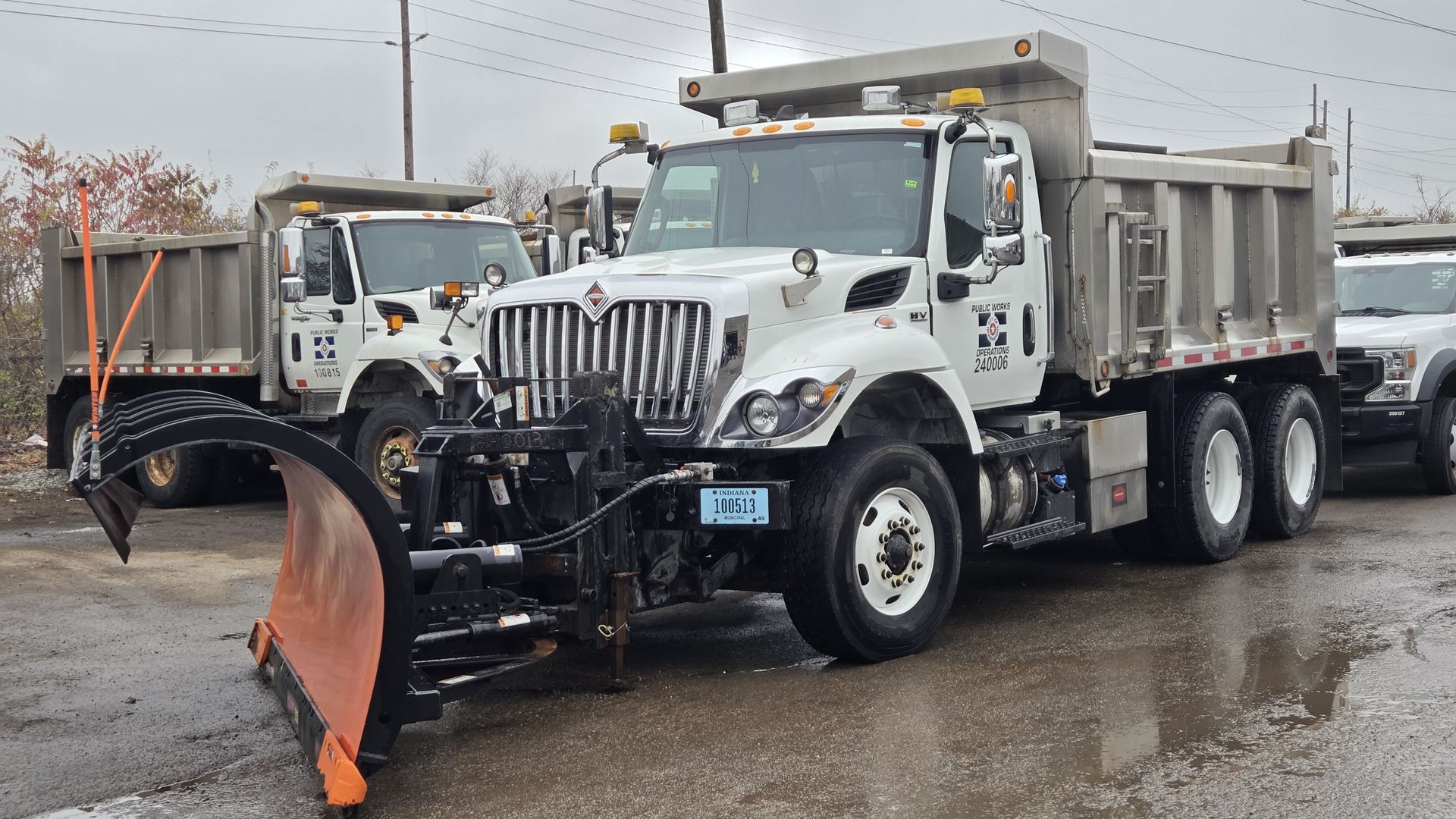
Indy DPW's snow fighting force is ready to roll for the winter. Photo: Justin L. Mack/Axios
Indianapolis city leaders say a new snow-removal policy hitting the streets this winter aims to increase efficiency and transparency.
Why it matters: The changes are in response to frustration that peaked in January when many residential streets were left unplowed in the wake of storms that battered Indy with heavy snow and sub-zero conditions.
- In April, the Indianapolis City-County Council unanimously approved a new system that calls for all streets to be plowed if snowfall surpasses 4 inches.
How it works: The policy splits city streets into three priority levels and deploys resources accordingly.
- Priority one includes major thoroughfares like Washington Street, Keystone Avenue and Raymond Street, as well as streets abutting hospitals and fire stations. These will be cleared curb-to-curb when there is measurable accumulation.
- Priority two includes connector streets like Auburn Street or Ritter Avenue, and streets abutting schools, trustees offices and township small claims courts. These will be cleared to provide one passable lane when snowfall reaches 2 inches or more.
- All remaining public roads are priority three and will be cleared to provide one passable lane when there is at least 4 inches of snow.
Between the lines: Indy Department of Public Works will handle all plowing for priority one, but priority two and three will use contractors when there's more than 4 inches.
- Officials said the cost of turning to contractors is between $700,000 and $1.3 million per callout.
Zoom in: Bike lanes and trails will be plowed when snowfall exceeds 2 inches, and salt will be used on a case-by-case basis.
- The most frequently traveled routes, categorized as group one, will be cleared first. It includes the Monon Trail, Fall Creek Trail, Nickel Plate Trail, Pennsy Trail and B&O Trail.
- Group two — which includes protected bike lanes within the Mile Square — comes next, and all remaining protected bike lanes will be plowed last as part of group three.
- Bike lanes along priority one streets will be cleared before the snow reaches 2 inches.
Yes, but: Officials say the thresholds are guidelines and not hard, fast rules that will prevent areas from getting plowed if needed.
- The new policy also gives Indy DPW flexibility.
- "For example, if it snowed 4 inches in some parts of the county but it's going to be 49 degrees the next day and all of it's going to melt before the contractors could even have an impact, then we're not going to spend a million dollars to do something that isn't going to make a difference," said Indy DPW chief financial officer Sam Beres.
- "These are standards that we can use to give folks an idea of what a reasonable expectation is."
By the numbers: On average, Indianapolis sees 22 days of measurable snow each year, per DPW data.
- We get more than 2 inches of snow an average of 3.7 days a year, and more than 4 inches an average of 1.3 days a year.
What we're watching: The NOAA's 2025-26 winter outlook calls for above-average precipitation in Indiana between December and February, but that doesn't mean above-average snow.
- There is an equal chance of above-average or below-average temperatures.