Lung cancer rates high among Hoosiers


Add Axios as your preferred source to
see more of our stories on Google.
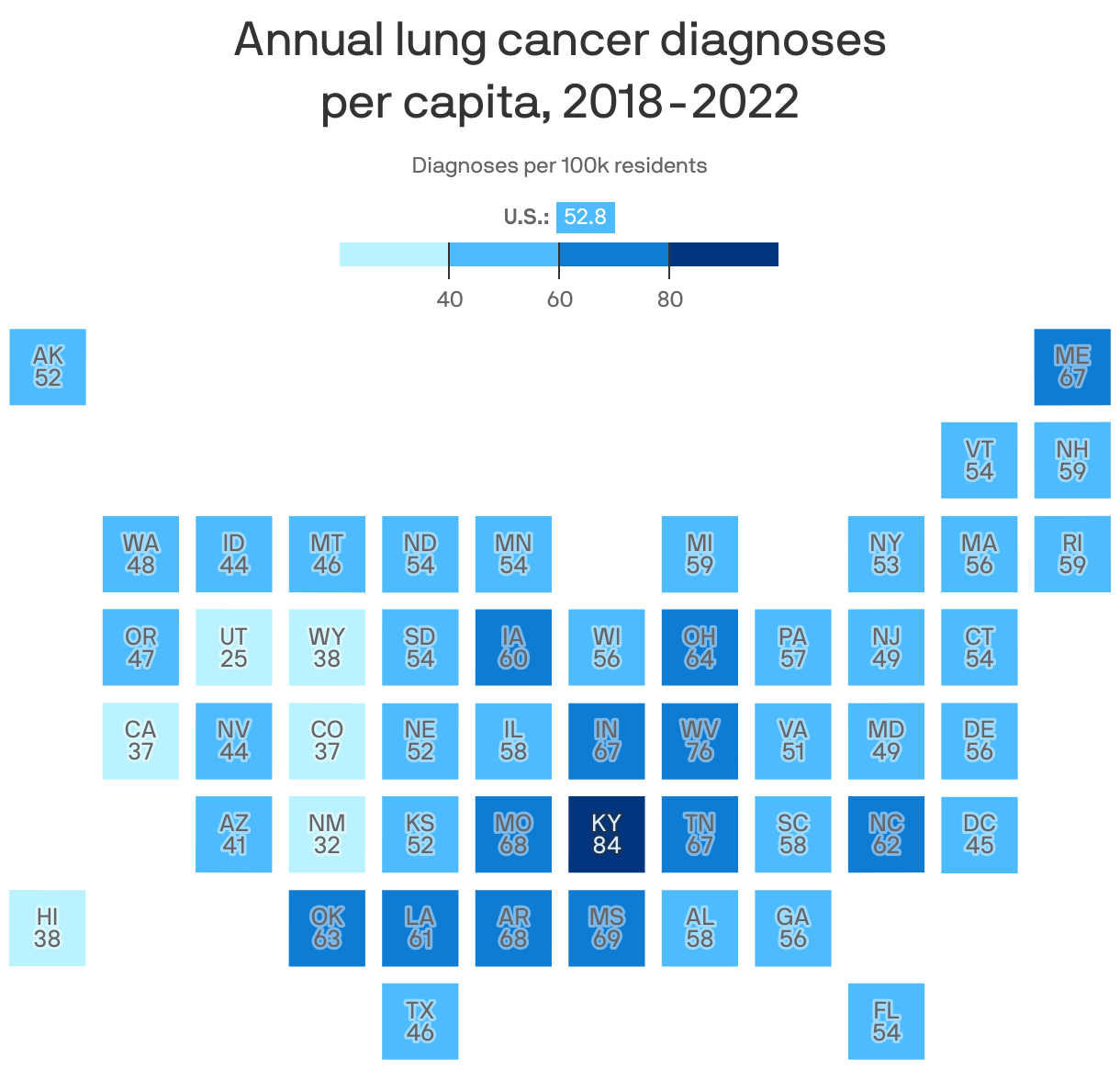
Indiana has one of the highest lung cancer rates in the country, per a recent report from the American Lung Association.
Why it matters: Nearly 227,000 people nationwide will be diagnosed with lung cancer this year.
- It is still the leading cause of cancer deaths — but the five-year survival rate has increased to almost 30%, the group finds, up from 18% about a decade ago.
- That's thanks in part to screening, testing and treatment developments.
Yes, but: Trump-era budget and staffing cuts at the National Institutes of Health and Centers for Disease Control and Prevention — plus "deep cuts" to Medicaid and the Affordable Care Act — "could threaten this progress," the Lung Association warns.
Zoom in: Indiana had the sixth-highest rate (67.2) of annual lung cancer diagnoses per 100,000 residents between 2018 and 2022. That's well above the national average of 52.8%.
- The state also ranks 39th for early diagnosis, with 26.8% of cases detected at a more treatable stage, slightly below the national average of 28.1%.
- "The state still has a lot of work to do to make sure that more of those at high risk for lung cancer are screened," the report states.
Between the lines: Deep racial gaps persist around lung cancer treatment and survivability, the group notes.
- "People of color who are diagnosed with lung cancer face worse outcomes compared to white individuals: They are less likely to be diagnosed early, less likely to receive surgical treatment, and more likely to not receive any treatment."
- "Additionally, survival rates were significantly lower among Black individuals and Indigenous people compared to white individuals."
What they're saying: In a statement, Lung Association president and CEO Harold Wimmer hailed the progress against "a disease that is absolutely devastating to too many families across the U.S.," while lamenting recent cuts to America's public health infrastructure.
- "CDC is critical in helping to prevent lung cancer by funding programs to prevent tobacco use and help people quit, and the research done at NIH has led to 73 new treatments for lung cancer in the last decade alone," Wimmer said.
- "The cuts to programs and research are devastating. Lives hang in the balance — we must keep up the momentum."