How social media played part in 1/3 of youth gun homicides in Indianapolis

Add Axios as your preferred source to
see more of our stories on Google.

Illustration: Brendan Lynch/Axios
This article was co-reported by Chalkbeat Indiana and Axios Indianapolis as part of a reporting partnership on youth gun violence in Indianapolis.
As 17-year-old Oswin Ortiz Jr. lay outside his home in 2019, his father approached him and asked who had shot him.
- "All he could say was 'Snapchat' and pointed to his phone," police wrote in charging documents for Joshua Grow, who eventually pleaded guilty in connection with Ortiz Jr.'s shooting and was sentenced to 40 years in prison.
- After Ortiz Jr. died, police officers went through his Snapchat account, where they found videos he took showing the THC he was trying to sell and messages setting up a sale with Grow, who was 18 at the time.
Why it matters: Deaths like Ortiz Jr.'s are far from rare. Since 2018, over one-third of the gun homicides involving Indianapolis youth for which prosecutors have brought charges have involved social media use, according to Marion County court documents.
Behind the scenes: Over several months, reporters from Axios Indianapolis and Chalkbeat Indiana reviewed hundreds of pages of court documents and interviewed key stakeholders to better understand what is driving youth gun violence in the city.
The big picture: Teenagers have used social media to set up drug deals that turned into robberies gone wrong. Trash talking has started online and ended in gunfire. Messages and videos have become clues for police to follow after the fact.
- Social media's complex role in youth-related gun crime makes for a daunting obstacle in curbing the city's violence problem that's killing dozens of kids each year.
- Already, 21 kids ages 19 and under have been killed by gunfire in 2025, more than all of last year.
Stunning stat: Since 2020, nearly 200 kids have been shot and killed in Indianapolis.
State of play: Platforms like Instagram can expose vulnerable youth to a false reality where violence is typical, students and experts say.
- It can also amplify pre-existing drama between students before an audience of their peers both during and outside of school hours.
- And investigators say it can make communication between teenagers meeting up to trade a gun or buy marijuana instantaneous and discreet.
Between the lines: Each of these factors contributes to a youth violence problem that's difficult to solve, but not impossible, researchers say.
What they're saying: There are effective strategies to combat the youth violence problem that social media is exacerbating, Paul Boxer, a professor of psychology at Rutgers and author of "The Future of Youth Violence Prevention: A Mixtape for Practice, Policy, and Research," told us.
- However, they often come with a fairly significant upfront investment that communities may not always want to make — despite cost-effectiveness studies that show a positive return.
- "We can prevent youth violence," Boxer said. "We can prevent gun violence. Where there's a will, there's a way."
What we're watching: Calls for the city to do more reached a fever pitch earlier this year following a mass shooting involving at least four teens in the heart of downtown during July Fourth weekend.


Social media makes private fights public
Online fighting and trash talk can spread like wildfire on social media, and it has contributed to a rise in youth violence.
The big picture: A beef that may have been limited to school hallways or a small group of people gets broadcast to huge audiences instantly, Boxer said.
- "Social media is so easy, so accessible, fast and expansive."
State of play: Since 2018, many of the gun homicides involving school-aged children that have reached the Marion County prosecutor's office have involved social media in some form.
- In 25 out of 71 of those murders, police documented the use of Instagram, Snapchat or Facebook in the moments leading up to or after the homicide, according to a Chalkbeat Indiana and Axios Indianapolis analysis of court documents for those arrested in connection with those deaths.
Our analysis examined cases filed from 2018 through late January 2025, and includes all cases in which a defendant or a victim was between the ages of 6 and 18.
- Yes, but: Not all defendants arrested in these cases were convicted of murder — some had their cases dropped, for example, while others pleaded guilty to a lesser charge.
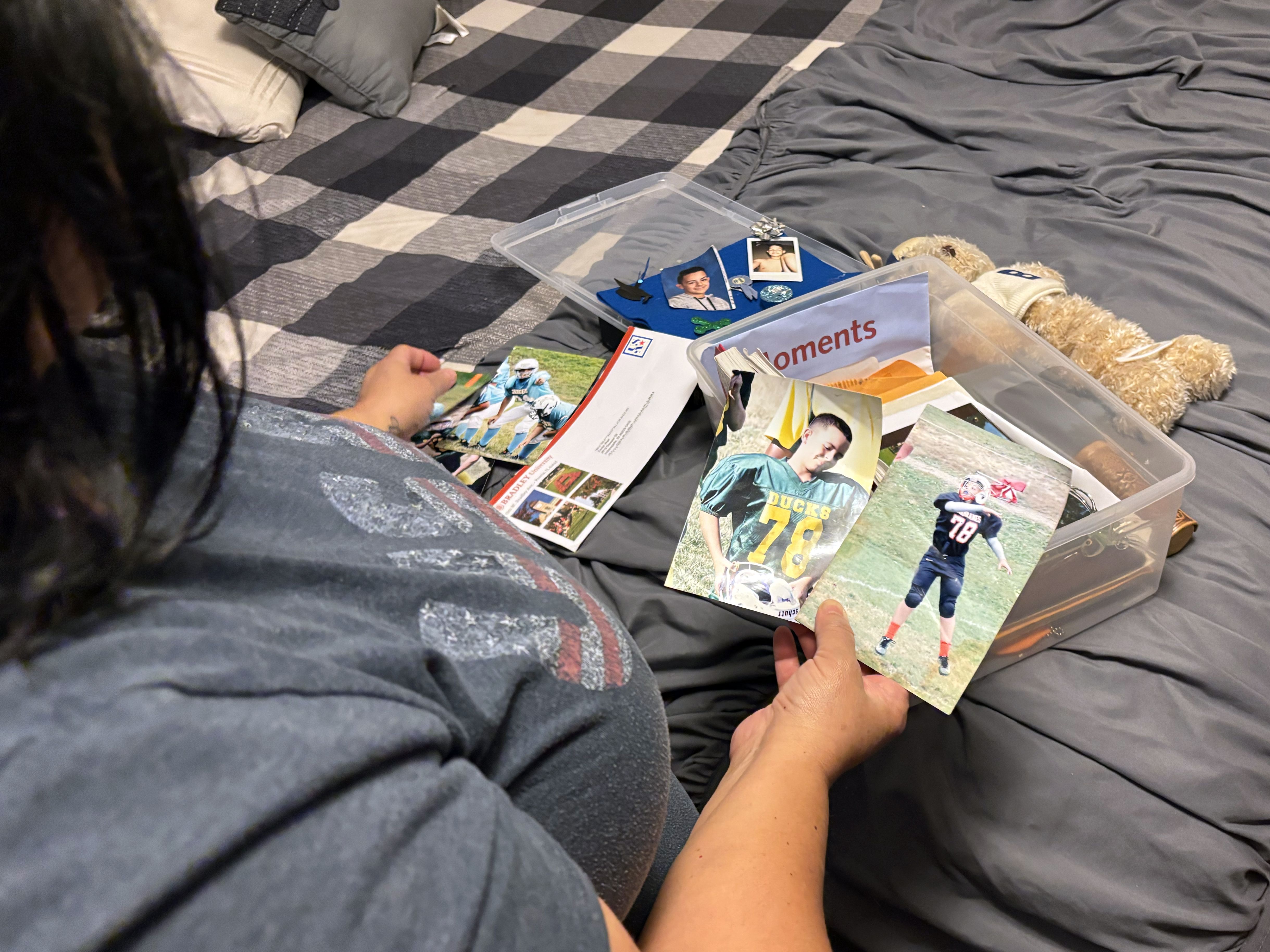
Zoom in: Ania Raines said she remembers her brother, Xavier Weir, arguing with people over Instagram and Snapchat in the months leading up to his 2019 death.
- In a back-and-forth that played out over social media stories for all their followers, a girl told 16-year-old Weir that he was being called a snitch for allegedly talking to police about car thefts in Carmel.
- Weir sent back laughing face emojis in response.
- Weir's mom, Michelle Raines, said she had no idea this was happening until after her son was shot. While he was in the hospital on life support, she sent her older son to tear apart his room and look for any sign that he'd been in trouble.
"I'm still trying to figure it out," Raines told us. "Like, how does this happen to my son? He played sports, he was totally not in the streets."
- Raines and her older son found no guns or drugs — nothing to explain Weir's shooting, but one of his friends showed Raines the posts.
- According to an affidavit for Isaiha Funez, one of two people charged in connection with Weir's murder, Weir had been in a feud with Funez's brother that culminated in the shooting.
Between the lines: To teenagers, social media serves as both entertainment and communication, students told us.
- Teens say they message each other on social media rather than exchanging phone numbers, which they find too personal.
- But that also means that communication between them can be easily publicized to their peers — and easier to hide from their parents.
What they're saying: "It's one thing for someone to be rude to you," Noa Kaufman-Nichols, a recent graduate of Shortridge High School, told us. "But for someone to be rude to you in front of hundreds of people and possibly more if you have a public account, I think that adds a level of anger that [wasn't] there before."
An alternate reality on social media

Hours before his murder in October 2021, 17-year-old Abdulla Mubarak posted two videos to his Snapchat, according to police records. He was standing in a field, talking and laughing with 22-year-old Michael James, who Mubarak recorded shooting a handgun with a Glock switch on it and emptying the gun's magazine.
- Their bodies, and that of 18-year-old Joseph Thomas, were later found in that field by a security guard.
Why it matters: Social media can present an echo chamber for teens — one in which having guns, money and marijuana is normalized, students and experts told us.
What they're saying: "It turns into something you see every day, basically. It influences you to be like these people," said Ariyah Mitchell, a recent Southport High School graduate who previously served on the Mayor's Youth Leadership Council.
What we found: In many of the court documents Chalkbeat Indiana and Axios Indianapolis reviewed for this project, police reported finding photos and videos of Indianapolis teens posting photos or videos of weapons and drugs.
- Plus: Kids often use social media to arrange to buy or trade guns and marijuana.
- Hours before his fatal shooting in 2019, Xavier Weir advertised THC or nicotine cartridges for sale on Snapchat. His shooters asked girls to set up a deal to buy the cartridges to lure Weir out so they could target him, according to police reports.
His was one of a dozen such cases.
- After Oswin Ortiz Jr. was shot the same year at age 17, police found videos of THC he wanted to sell in his Snapchat account, according to a probable cause affidavit.
- 16-year-old Michael Duerson was killed in April 2022 after setting up a deal to sell his gun on Instagram.
- Less than two weeks later, 19-year-old Jahmel Houston also arranged to sell or trade a gun on Instagram and ended up dead.
State of play: Social media algorithms often prefer controversial, emotional and violent content to drive activity and engagement, Boxer told us.
- "It's making [kids] believe the world is a violent place," Boxer said, "and suspect guns are a good way to solve problems."
It's how Marion County prosecutor Ryan Mears said Austin Green solved a problem he and several friends had with D'Londre Calmes, a former high school classmate, over a social media account name.
According to police reports, Green and friends tracked Calmes down at a gas station, followed his car and began shooting. After a brief pursuit, Calmes' car broke down.
- He got out and ran, limping from a gunshot wound to the right leg that had shattered his femur.
- Green chased Calmes down and shot him three times in the head, according to police.
- They found 22 bullet holes in his car.
The bottom line: "This case illustrates the troubling connection between social media and violence," Mears said in a press release after Green's murder conviction. "It is imperative to educate young people so that when conflicts arise, their decision is to choose peace rather than reach for a gun."
Solutions Indiana is (and isn't) considering

The problem of youth violence — and the role social media plays in exacerbating that problem — has solutions, according to Boxer.
The big picture: Research has shown that school-based social-emotional learning can be effective in improving student well-being and reducing violence.
Yes, but: Indiana has moved away from social-emotional learning in schools.
- As part of a larger school deregulation effort, Republican lawmakers removed teacher training requirements related to social-emotional learning, cultural competency and restorative justice from a bill at the last minute this past legislative session.
- Republicans said those trainings were not relevant to schools' core purpose.
- "Teachers should focus on academic rigor, math, science, reading, and writing, technical skills, instead of this emotional regulation, empathy, and et cetera," Sen. Gary Byrne (R-Byrneville) said of the rationale for the legislative change at the time.
Another possible solution: School counselors. Studies conducted in school settings have found that cognitive behavioral therapy-based anger management interventions are effective.
Reality check: Indiana has just one counselor for every 351 students, higher than the recommended ratio of 1-to-250.
- Ratios for other school-based mental health care providers are even worse, with 2,700 students assigned to a school psychologist and 1,829 students assigned to a social worker, according to Indiana University.
The state banned cellphones in K-12 schools, which school officials told us has been positive in reducing distractions and interpersonal issues in class.
- But kids are back on their devices before and after school.
Zoom out: Outside of school, Indianapolis officials recently implemented a stricter curfew for youth — but even city leaders disagree on the effectiveness of the policy. Councilor Dan Boots said at a recent City-County Council meeting that kids aren't the problem; guns are.
- And kids in Indianapolis have easy access to them. A 15-year-old we spoke with previously said it's "easy as one, two, three" to get a gun. He could get one in 20 minutes, he said.
- In the affidavits reviewed for this story, kids were operating in a world where possessing, buying and trading guns was the norm — because that echo chamber of social media and, often, their limited environment makes it seem that way.
Between the lines: Kids get guns from home when they're not stored properly, or kids know how to unlock the storage container. They're stolen from cars, bought illegally from older friends or relatives or traded for drugs or other weapons.
- For years, gun safety advocates have tried — and failed — to pass safe storage legislation to limit youth access to firearms. Bills to establish criminal penalties for gun owners who fail to secure firearms that get used by children — and to incentivize storage through tax credits for gun safes, locks and similar devices — haven't even received a hearing at the Indiana General Assembly in recent years.
- "Kids wouldn't be having gun fights, shooting each other if they didn't have access to firearms," Boxer said.
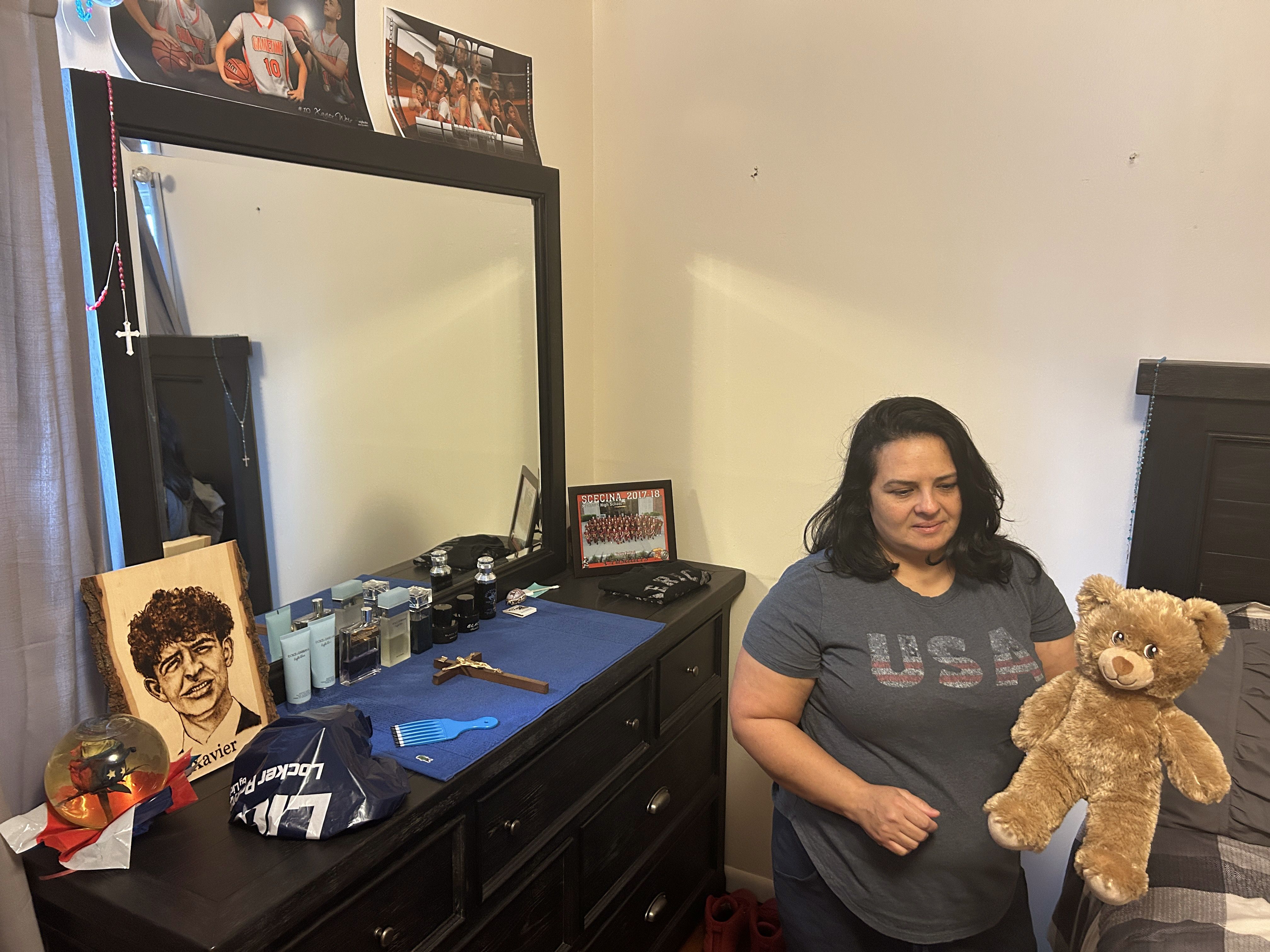
Michelle Raines, whose son Xavier Weir was shot and killed in 2019, wishes kids didn't have access to something else.
- From his bedroom, which remains as he left it with tennis shoe boxes on display and photos of his basketball and football teams, Raines said, "I wish we could just not have a phone."
Go deeper: Read the Chalkbeat story here.