Indianapolis sees increase in heat streaks


Add Axios as your preferred source to
see more of our stories on Google.
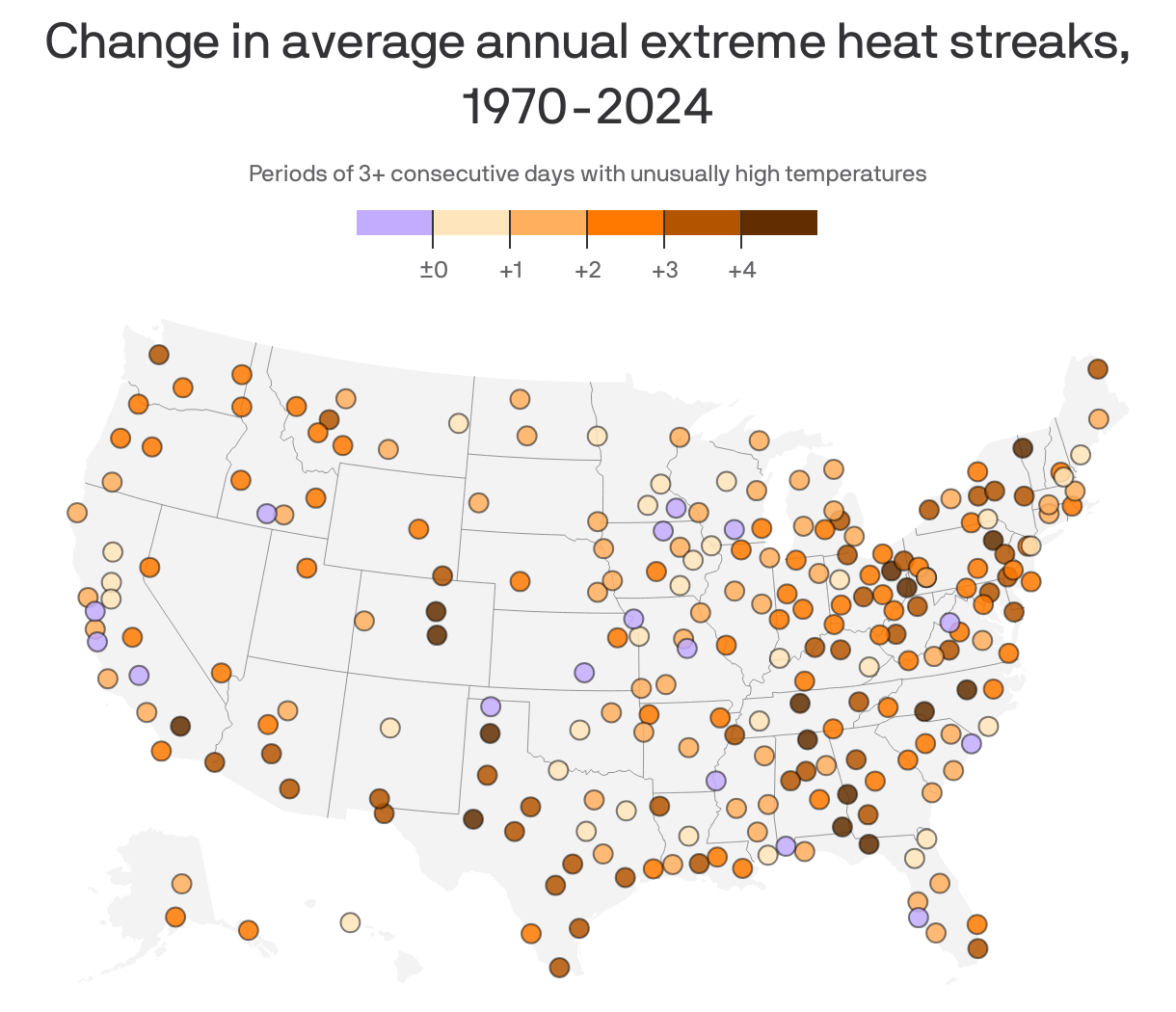
We're finally getting a break from the heat today, but don't get used to it. Heat streaks are becoming a way of life in many U.S. cities, including Indianapolis.
Why it matters: Prolonged heat — as much of the U.S. has experienced this summer — is particularly hazardous to human health.
- Extreme heat's effects on the body tend to be cumulative, and warm nights offer little reprieve for those without air conditioning.
- Multi-day heat streaks are also challenging for power grid operators, given all the energy-intensive A/C use.
Driving the news: The average number of annual extreme heat streaks rose between 1970-2024 in 80% of the 247 U.S. cities analyzed in a new report from Climate Central, a climate research group.
- The nearly 200 cities with an increase now have two more annual heat streaks on average.
How it works: Climate Central defines an "extreme heat streak" as three or more days in a row with maximum temperatures over the 90th percentile of a given location's daily max temperatures during the 1991-2020 period.
Zoom in: In Indianapolis, the temperature threshold was 87°F.
- The number of heat streaks increased from four to six over the decades.
The latest: We just survived our fourth heat streak of the year — an eight-day stretch of scorchers.
Reality check: The latest heat streak last year didn't arrive until mid-September.
Zoom out: Some areas, like Nashville and Raleigh, now have a whopping five more heat streaks on average each year.
- A few places, like Myrtle Beach, South Carolina, and Sarasota, Florida, now have fewer heat streaks compared to 1970.
Between the lines: Climate change is making extreme heat more intense and more frequent, studies have shown.
- Many urban neighborhoods suffer from the "urban heat island" phenomenon, where buildings, roads and other structures trap heat, making it even hotter.