Scientists work to understand "cascading" hazards as flash floods become more prominent

Add Axios as your preferred source to
see more of our stories on Google.
Storms this summer have dumped intense rain on cities across the country, leaving towns flood-ravaged and forcing water rescues — the lasting effects of which IU associate professor of earth and atmospheric sciences Brian Yanites is working to understand better.
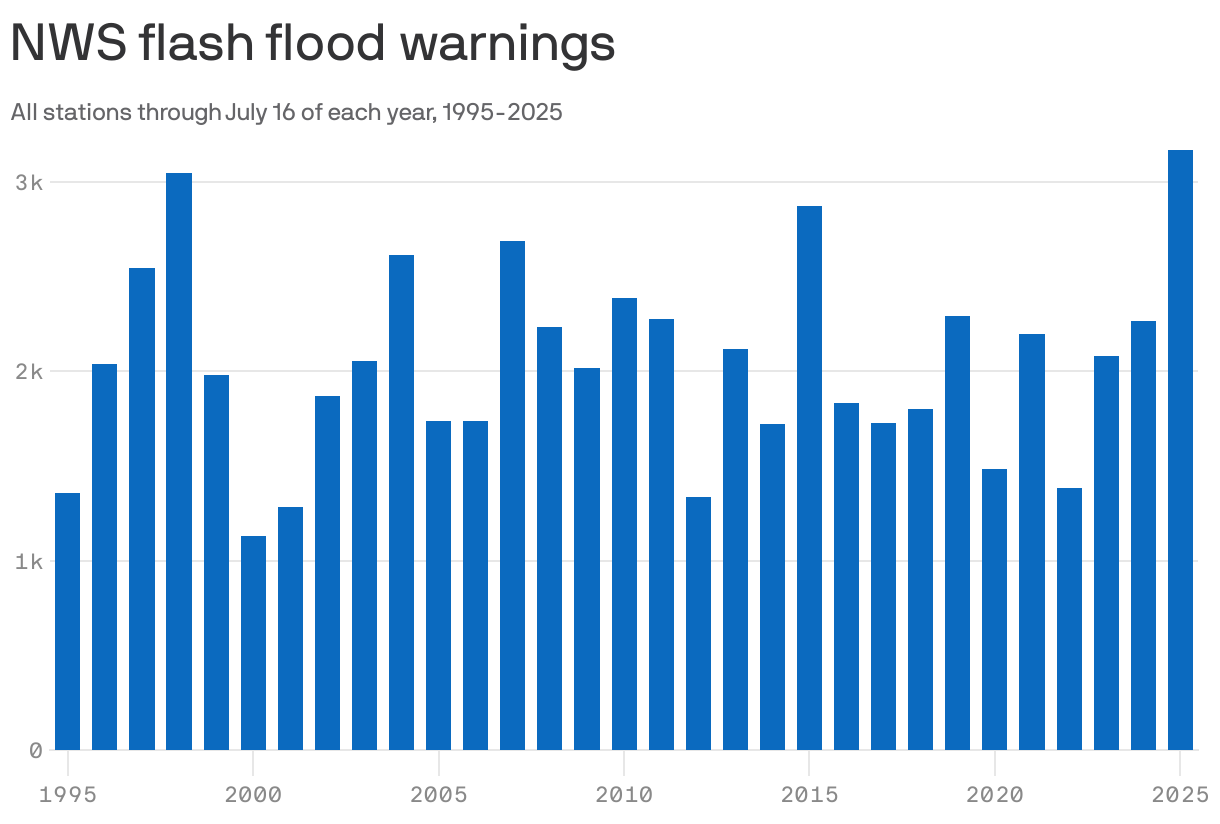
Why it matters: The above-average rainfall we've had in parts of the U.S., with some slow-moving storms dropping lots of water relatively quickly, has led to a record number of year-to-date flash flood warnings.
- Along with factors like topography, geology and drought, that rain can lead to major and sometimes fatal flash flooding events — as happened over the July 4 weekend in Texas' Hill Country, where at least 134 people were killed.
The big picture: Yanites is the lead author on new research published in the journal Science, working to understand how one extreme weather event, like the intense storms we're seeing lately, can increase the probability or risk of other events.
- Researchers call this phenomenon "cascading" hazards and they're happening more often, Yanites says.
What they're saying: "These land surfaces hazards happen in all 50 states," he tells Axios. "Nobody is immune."
- While climate change is increasing the frequency of intense storms, human development is also increasing the speed with which the landscape changes and those changes can also have a major impact on hazards such as flooding and landslides.
- "The surface of the earth is dynamic," Yanites says. "It changes over time naturally … but we also change it and whenever either of those happen, it changes the natural hazards we're exposed to."
Zoom in: Yanites is working with McCormick's Creek State Park to learn how the landscape responded to and was changed by the 2023 tornado that took down many trees and caused significant damage.
- "It's early," he says, "but one of the things we saw right away was that so much wood from the trees washed into the river system and started log jams in the river."
By the numbers: NWS offices issued 3,160 flash flood warnings nationwide this year through July 16, according to a tracker at Iowa State University's Iowa Environmental Mesonet.
- That's the most for that period in any year since records began in 1986.
- Flash flood warnings are issued when such an event is imminent or already occurring.
What's next: Yanites says new data and modeling will improve our ability to forecast where hazardous events can and will occur within the next 10 years.
What we're watching: Indiana is reexamining its own emergency alert and warning systems in the wake of the Texas disaster.