Purdue performs first canine cardiac ablation

Add Axios as your preferred source to
see more of our stories on Google.
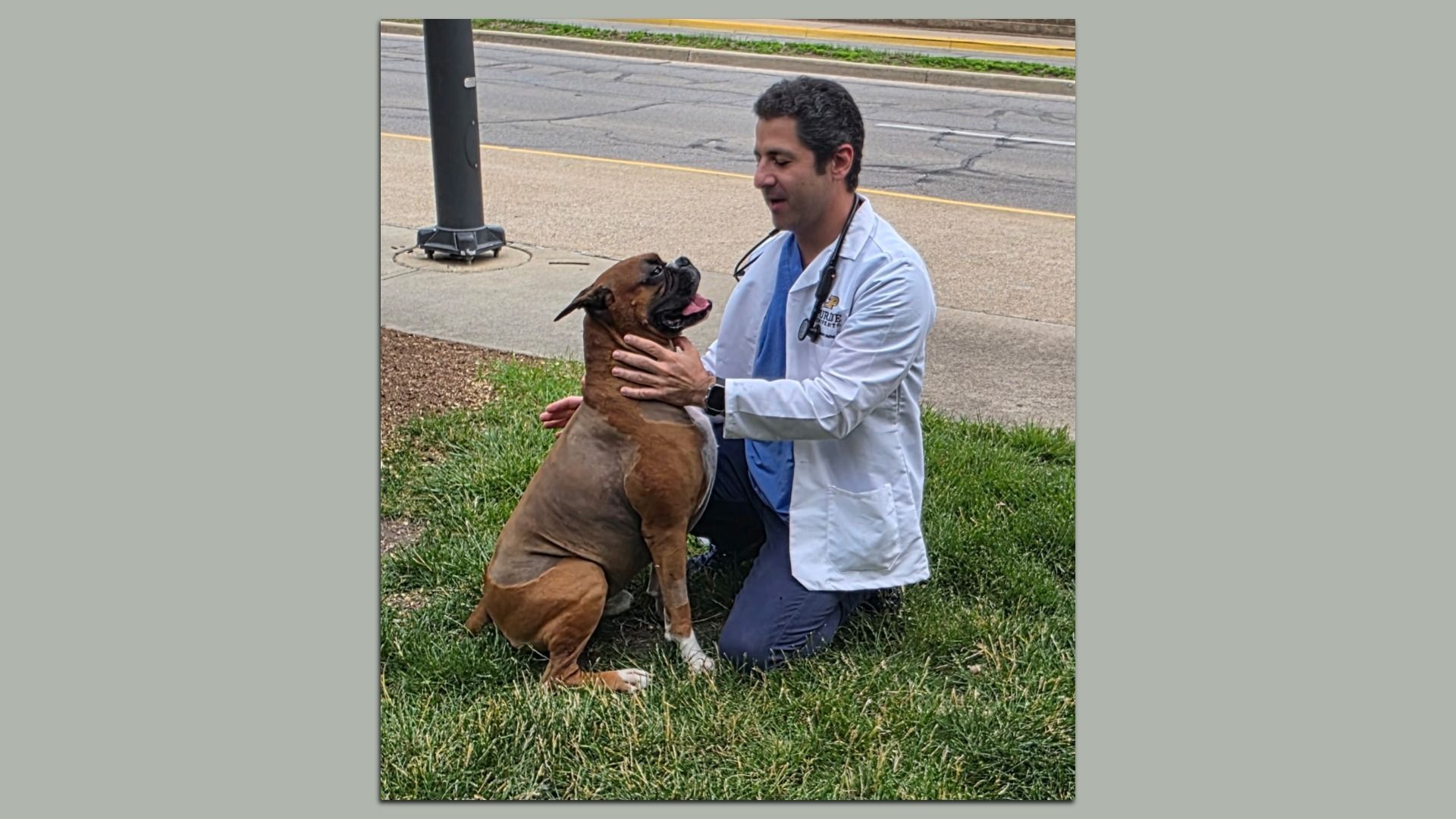
Luis Dos Santos with Ketchup the boxer. Photo: Courtesy of Tamara Hopkins
Ketchup, a grand champion boxer dog, was named for his little head and broad shoulders that give him the shape of a ketchup bottle, but it's his heart that makes him extra special.
Why it matters: Ketchup was the first dog to have a cardiac ablation at Purdue University's College of Veterinary Medicine, a procedure that could pave the way for better treatments in both dogs and humans.
State of play: Ketchup was suffering from cardiac arrhythmias, and after six months on medication to manage the condition, he wasn't responding.
- Two of his littermates had already died from the same genetic condition, relatively common in the boxer breed.
- Ketchup's owner, Tamara Hopkins, had met Luis Dos Santos, assistant professor of cardiology in the department of veterinary clinical sciences at Purdue, through the American Boxer Club and knew about his work to make Purdue one of just a few facilities in the nation to offer the procedure for dogs.
What she's saying: "We decided to operate and give him a chance to live longer and it worked," she said. "He's back to running and playing like he's a puppy again."
- Hopkins drove Ketchup from western Pennsylvania to be treated by Dos Santos.
How it works: Dos Santos said the ablation is nearly identical to the procedure performed in humans.
- The cardiac ablation is performed by placing catheters into the heart, and heat or cold energy is used to block faulty heart signals, restoring a typical heartbeat.
- "The (human) doctors said, 'If I didn't know it was a dog, I wouldn't have known this was a dog,'" he said. "Everything was behaving just like a human heart."
- A team of 10 was in the operating room for Ketchup's nearly three-hour surgery.
Flashback: For Dos Santos, the road to saving Ketchup started more than a decade ago when he was working in a lab that conducted arrhythmia research in animals.
- He came to Purdue in 2021 for the sole purpose of performing this procedure on a live dog.
- "This has been my goal," he said, "to establish our center here as a center where we can provide the health care that is the same provided to humans, because this is something that anti-arrhythmia drugs won't control. They need more, and it's not widely available elsewhere."
- He put together a team of colleagues at Purdue and doctors from Community Health Network in Indianapolis to work toward that goal, perfecting the technique and practicing on canine cadavers.
Between the lines: After getting the team and technique down, they needed to wait for the right patient. Like any surgery, it comes with risks.
- "We didn't want to do surgery just because we were ready," he said.
Along came Ketchup.
- "He's just a phenomenal boy, just a big old love bug," Hopkins said.
What's next: Dos Santos said the next step is raising awareness about the danger of cardiac disease in dogs and what help exists for them.
- "We believe it can be a game-changer for dogs with this same disease," he said.