How much less women make than men in Indiana


Add Axios as your preferred source to
see more of our stories on Google.
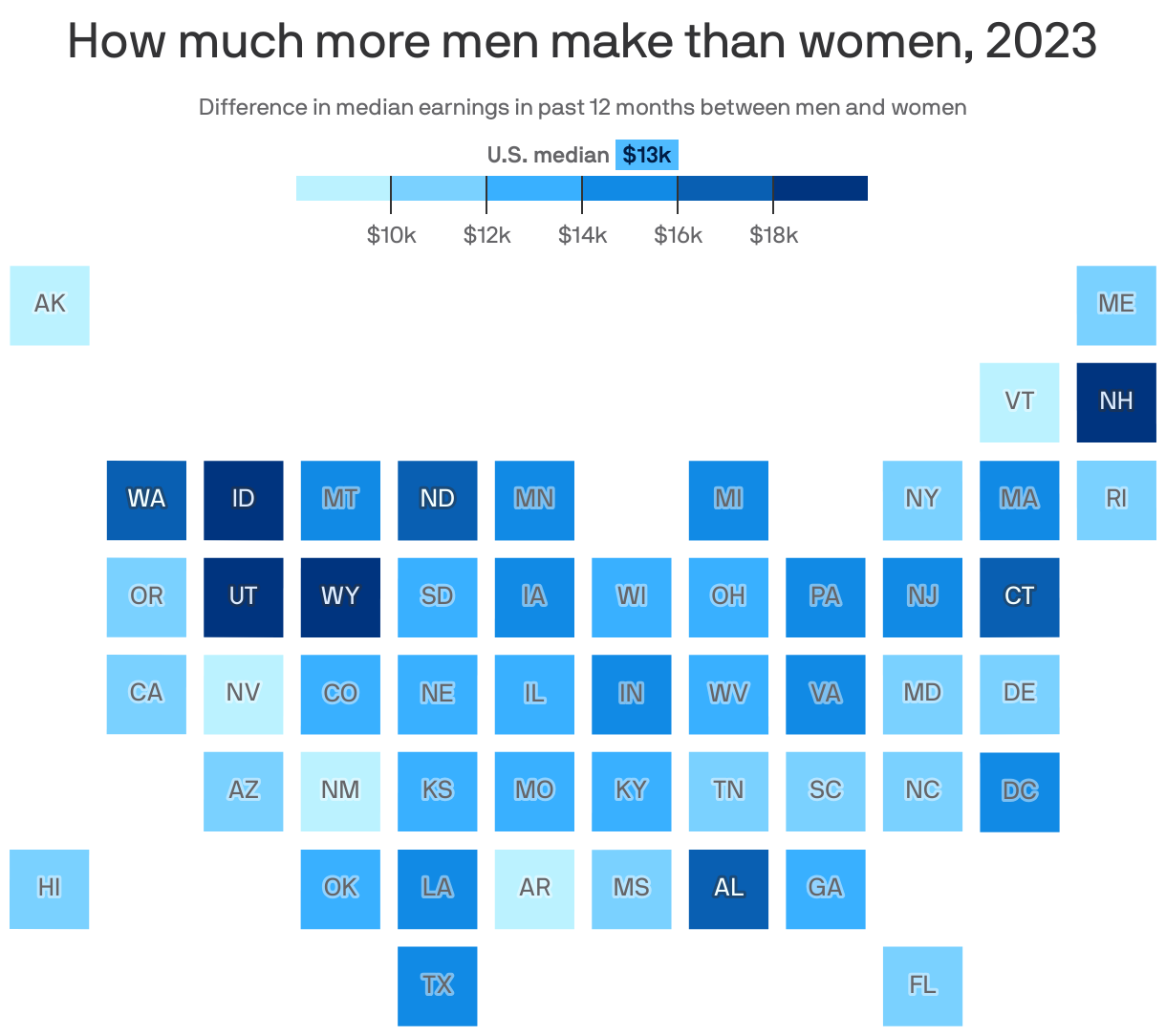
Indiana has a gender pay gap that exceeds the national average, according to 2023 census data.
Why it matters: Gender pay differences persist in part because of discrimination, job segregation and "a lack of workplace policies that support family caregiving, which is still most often performed by women," according to the National Partnership for Women and Families.
By the numbers: The median pay for women who worked in Indiana in 2023 was $35,800 — about $14,500 less than men, according to data from the Census Bureau's American Community Survey.
- That's the 15th largest dollar gap in the U.S.
Zoom out: Utah had the highest overall gender wage gap ($21,400) in 2023, while Vermont had the lowest (about $8,500), according to census data.
- On average, U.S. women lose a combined total of nearly $1.7 trillion annually due to the wage gap.
- The wage gap among full-time workers also widened in 2023 — the first time this has happened since 2003 — going from women making about $10,390 less in 2022 to making about $11,550 less.
Yes, but: Black women, Indigenous women and other women of color continue to face even larger wage gaps compared with their white, non-Hispanic male counterparts.
- The data finds that white, non-Hispanic women in Indiana make about $17,200 less than white, non-Hispanic men.
- Asian-American women make about $17,800 less, Black women make $21,700 less, Native American women make $24,000 less and Latina women make $24,500.
Between the lines: Women are also overrepresented in lower-paying jobs and face more career interruptions, according to the Pew Research Center.
- Other factors that are difficult to quantify, such as gender discrimination, may also contribute to the ongoing discrepancy.
Threat level: According to the National Partnership for Women and Families, if the wage gap keeps closing at the current rate, women workers will not reach parity until 2088. Timelines are even longer for racially marginalized groups.
- Native American women will have to wait until 2202, Latinas until 2198 and Black women until 2362, according to the study.
State of play: The analysis says if the wage gap were eliminated, Hoosier women could, on average, do one of the following:
- Pay 14 months of rent.
- Pay nine months of health insurance premiums.
- Pay for a year and a half of child care.
- Pay off their student loan debt in just over two years.