Circle City Readers needs funding to sustain its successful tutoring program

Add Axios as your preferred source to
see more of our stories on Google.
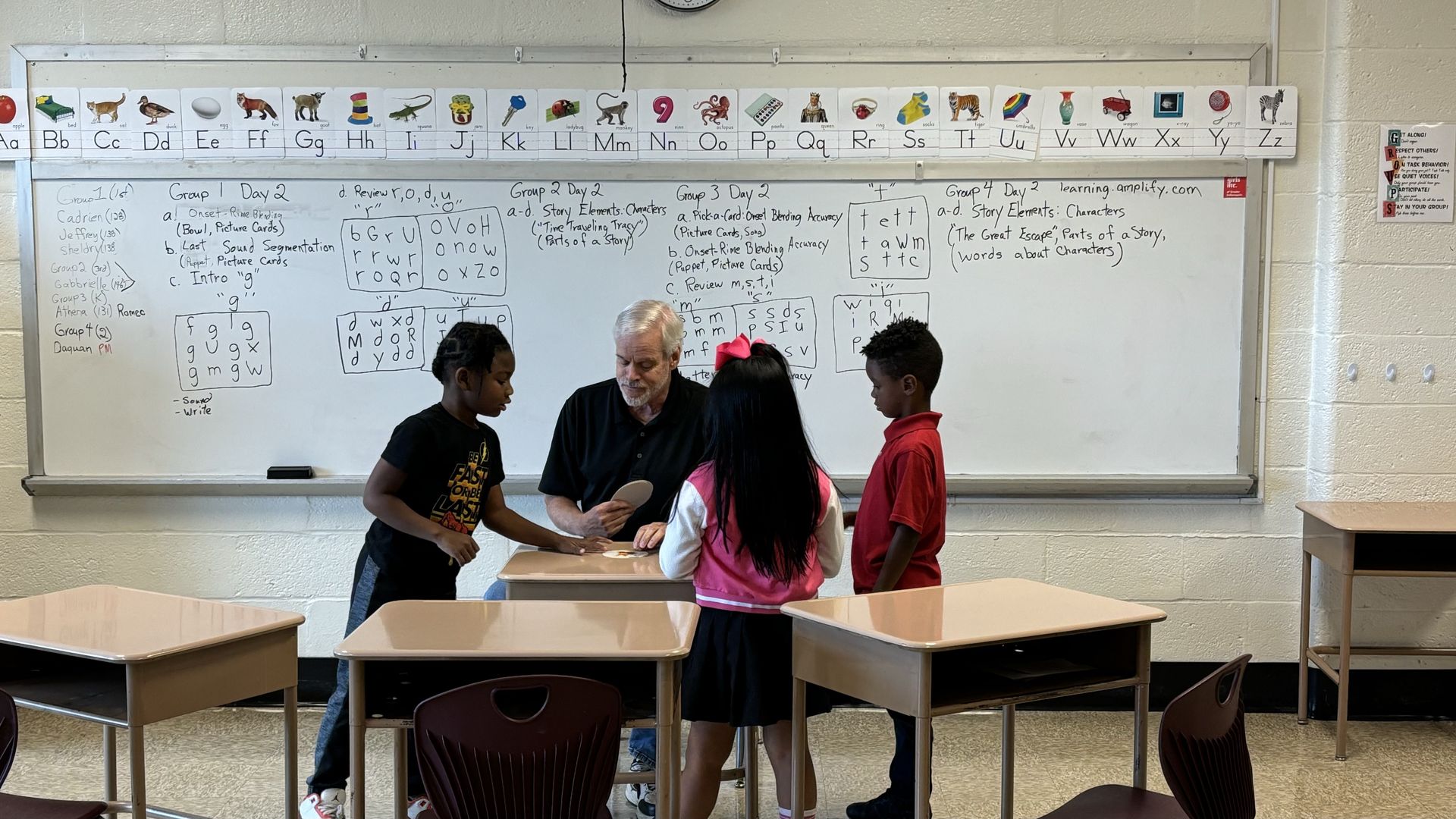
Michael Guy, working with first graders at Sankofa School of Success. Photo: Arika Herron/Axios
In elementary schools around Indianapolis, a few dozen reading tutors are deploying each week for the second year of Circle City Readers.
Why it matters: The city-sponsored program has seemingly cracked the code on one of education's biggest challenges — learning to read. Roughly 30% of Marion County students fail to learn to read by the end of the third grade — a pivotal turning point in a child's education.
- Those kids are also now at risk of being held back as the state looks to crack down on the "social promotion" that some policymakers fear sets children up for failure later in life.
Driving the news: The city's Office of Education Innovation (OEI) shared with Axios new data from Circle City Readers' first year that shows it has accelerated learning growth for students most at risk of falling behind.
- In its first year, the program served more than 500 students in grades K-3 at 10 schools across Marion County.
- Nearly half of participating students who started the school year "well below" their grade-level benchmark — the lowest rating a student can achieve — progressed at least one proficiency level.
- CCR students outpaced their peers in learning growth, and 60% of the program's third graders passed the IREAD exam — the same rate as all students in the Indianapolis Public Schools district, even though CCR students were identified among the most at risk for not passing the state test.
What they're saying: CCR leaders say that although the results are significant, they expect to see even better outcomes in the program's second year.
- "If that is the data we get just by trying to figure out how to build this plane while flying it. … Yeah, I'm excited to see [this year's] data for sure," said Brooke Arnett-Holman, program director for Circle City Readers at OEI.
Reality check: Without a philanthropic backer, this year could be the program's last.
- OEI paid for the first two years of the program with federal COVID relief money that will soon dry up.
- Holly Morgan, assistant director of academics at OEI, told Axios the program needs a new funding source — possibly a grant or major donation — because the city's recently passed budget did not allocate dollars for it.
- At its current size, the program's annual budget is around $1.3 million.
How it works: Rather than relying on volunteers, CCR hires paid part-time tutors and trains them on delivering the program's research-based science of reading curriculum.
- Schools identify at-risk students in kindergarten through third grade.
- Students are then sorted into small groups of usually one to three, based on how they perform on beginning of the year assessments.
- They meet in those groups with their tutors at least three times a week.
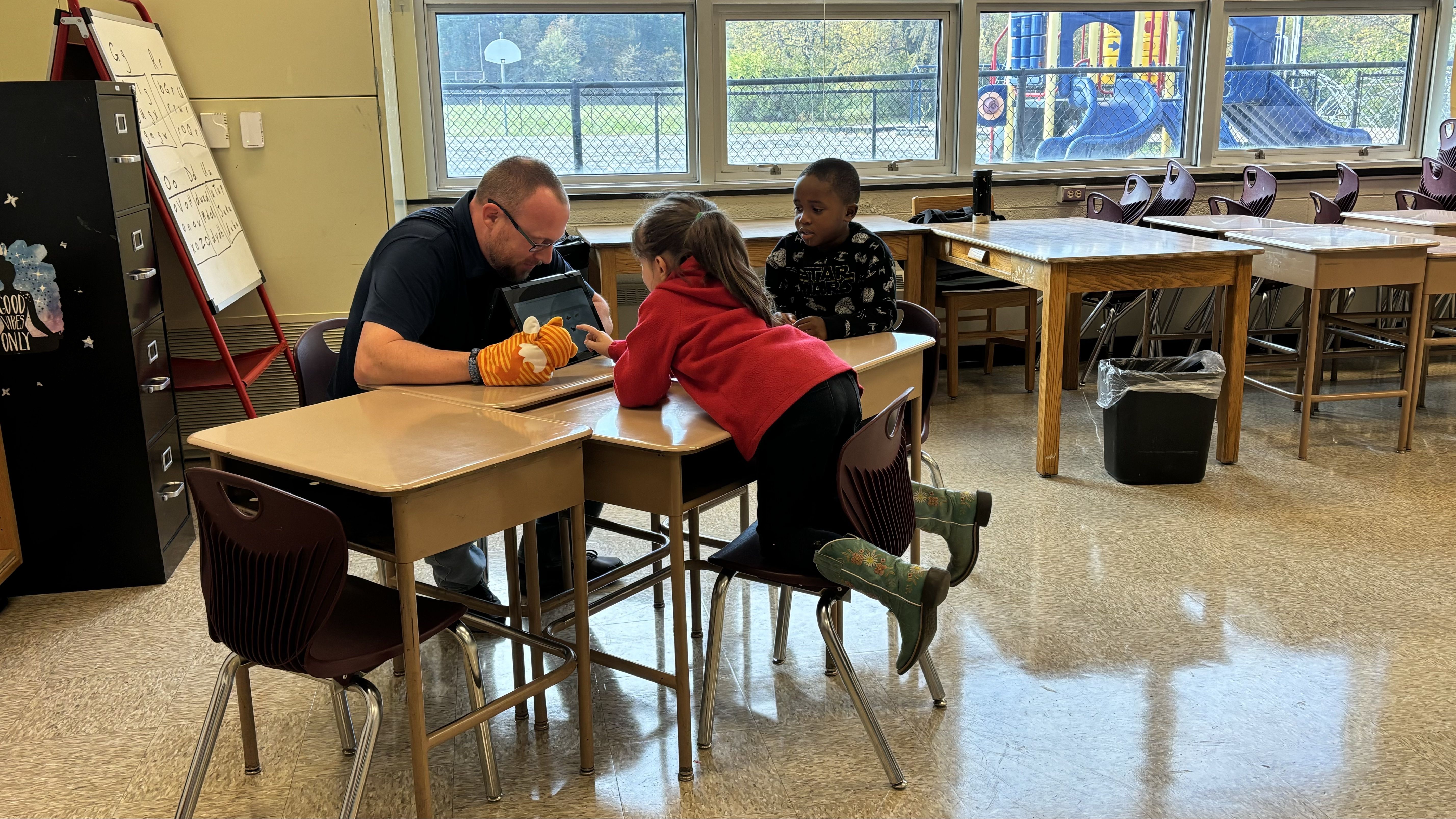
Tutors include Michael Guy, who applied last year after seeing an ad for the program. He didn't have any education experience, but after retiring a few years ago he had the time and interest.
- "I've always thought the best thing for a kid to be successful in life is getting a good education," Guy said. "I always said that, but what did I ever do about it? So I thought … let me give this a shot."
On a recent Wednesday at Sankofa School of Success, Guy and his assistant — a hand puppet puppy named Buster — were helping a group of wriggly first graders with their letter sounds.
- In another corner of the classroom, tutor Joshua Curtis was helping his students practice writing the uppercase and lowercase versions of letters.
- Curtis is new to the program this year and said it's been exciting to see kids make progress — both in their attitudes about participating in the lessons and in their reading skills.
Between the lines: Tutors meet students where they are, moving between activities so they don't get bored and allowing them to get up and write at the board if sitting too long makes them antsy or, in the case of one student, let them do cartwheels between answers.
- This relationship between tutors and their students is the key to CCR's success, said Arnett-Holman.
Yes, but: It's also one of the barriers to expanding the program.
- Paid tutors who receive in-depth training before working with kids are an important piece of the puzzle, but they also make the program more expensive than similar volunteer-based initiatives.
- Recruiting enough high-quality tutors who will stick with the program has already been an ongoing challenge, Arnett-Holman said, though nearly half of last year's tutors returned.
How to help: The program still needs a few more tutors for the current school year. Interested applicants can email [email protected].
The bottom line: The program is expensive, Morgan said, but it works.
- She said the hope is that another year building on the program's success will convince someone, anyone, that keeping it going is an investment worth making.