Economic distress fuels Hoosiers' growing reliance on government aid


Add Axios as your preferred source to
see more of our stories on Google.


Hoosiers in nearly half of Indiana's 92 counties draw at least a quarter of their total income from government aid — most of them are at least partly rural and all voted for former President Trump in 2020.
Why it matters: America's reliance on government programs has soared in the past half-century — with a stunning acceleration in the past 25 years (charted above) — and what happens with those programs could depend on the upcoming election.
- Economic distress in much of the country is driving massive social and political upheaval.
The big picture: Residents in more than half of America's counties now draw a substantial share of their total income — more than a quarter — from the government.
- In 2000, that was the case in just 10% of counties.
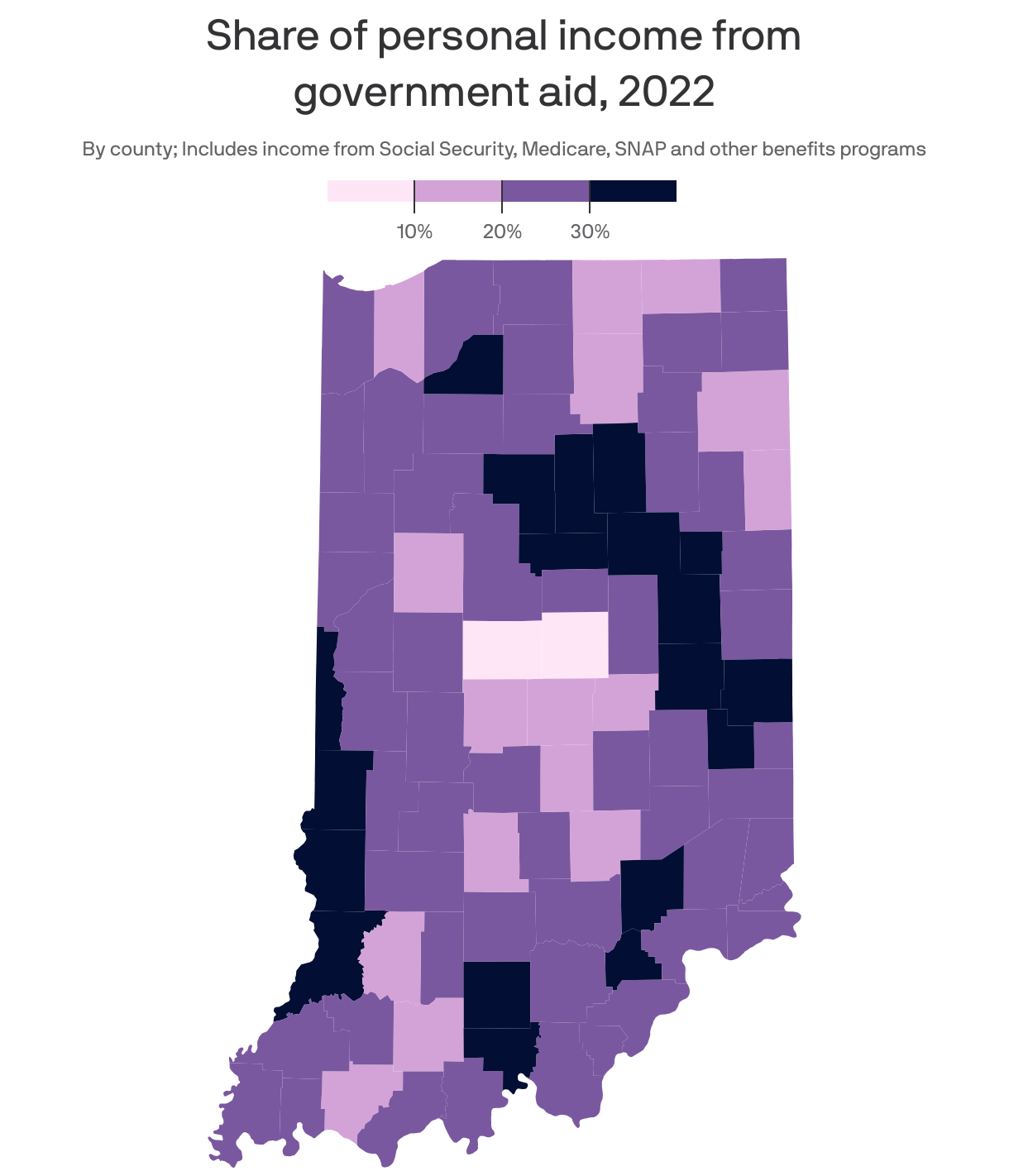
Zoom in: Unsurprisingly, Hamilton County had the lowest share of personal income coming from government aid at 7.4%.
- Residents in Fayette County had the most dependence with 38.6%.
Between the lines: Three huge trends explain the massive increase in America's dependence on these programs, which include Social Security, SNAP, Medicare and Medicaid.
- An aging population: The country is evolving into an older society, and the largest social safety net programs are designed to keep seniors out of poverty. Their share of the population will only increase as the last Baby Boomers reach retirement age.
- Economic opportunity: High-paying jobs tend to be concentrated in a small number of wealthy hubs. Older, rural areas aren't faring as well: Appalachia, the tribal Southwest, the rural South and the northern Great Lakes.
- Health care: Rapidly rising health care costs make Medicare and Medicaid a larger share of their recipient's total income. Medical costs "have risen nearly twice as quickly as overall inflation over the past several decades," the report says.
What they're saying: "The country is on a collision course with politically fraught trade-offs," EIG says in the report.
- "Significantly raising taxes and dramatically cutting ... programs could choke off the very economic activity that finances [them] and immiserate the lives of people who depend on them."