The evolution of AI racing starts in Indianapolis

Add Axios as your preferred source to
see more of our stories on Google.
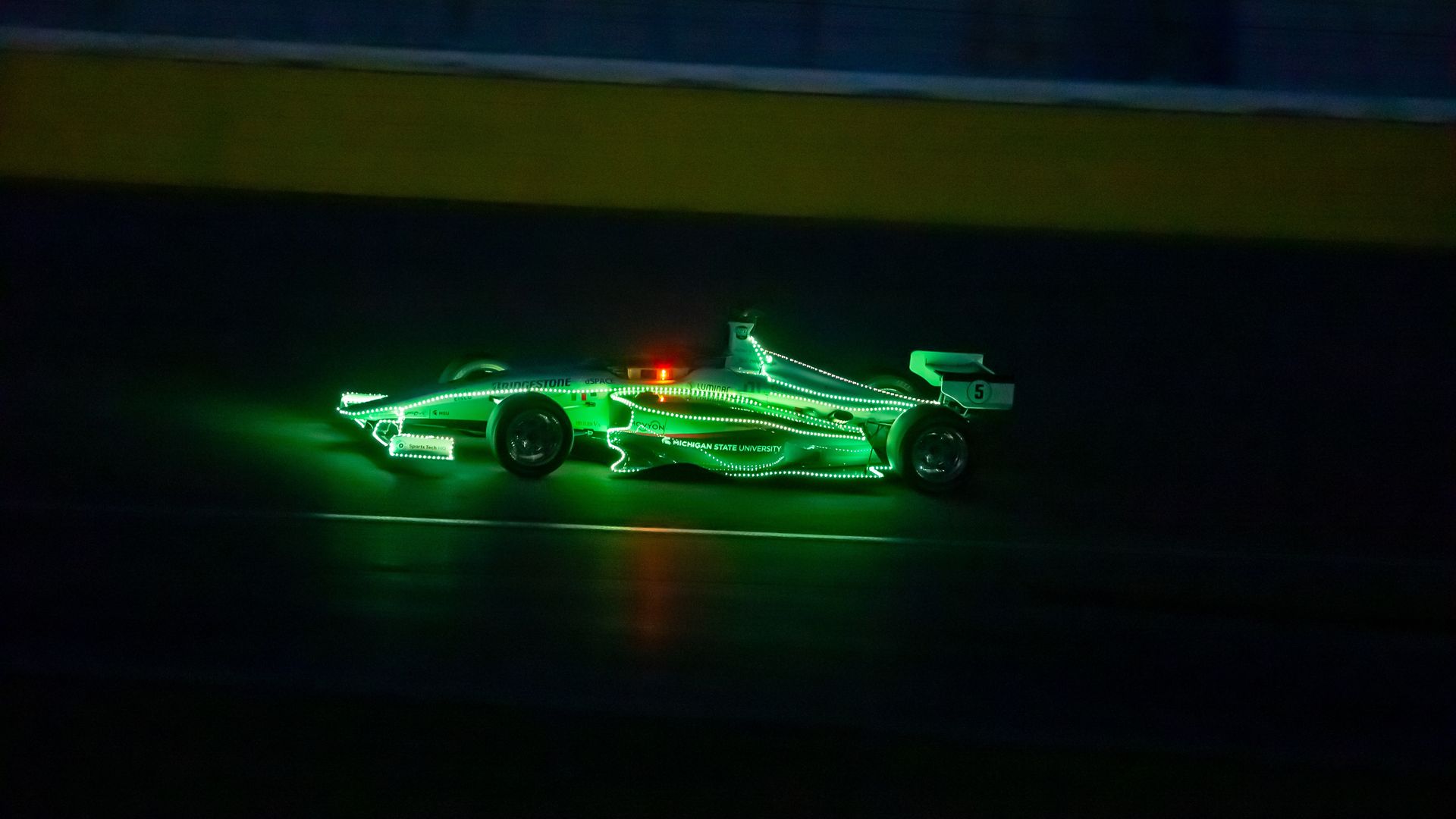
An autonomous racecar drives in the dark during an Indy Autonomous Challenge event at CES 2024. Photo: Courtesy of Indy Autonomous Challenge
An autonomous racing initiative originally designed to be a single-day Circle City attraction will now play a role in the nation's development and training of physical AI.
The big picture: The Indy Autonomous Challenge (IAC), a local nonprofit that organizes autonomous racing competitions among university-affiliated teams, has become a Defense Advanced Research Projects Agency (DARPA) partner.
Why it matters: As AI interest and implementation expands, local tech leaders believe having Hoosiers behind the controls could be a boon to us all.
State of play: Systems like self-driving cars, unmanned aircraft and humanoid robots learn from modeling and simulation.
- But the training process can take years, carry significant risk and fail to account for real-world uncertainty, creating a phenomenon known in the world of robotics as the "simulation-to-real gap."
Driving the news: To close that gap, DARPA has implemented a new program and brought on IAC to help it safely speed up the training process.
What they're saying: "Our program is not simply a motorsports initiative or a collegiate student competition, or even just a showcase of technology innovation," Indy Autonomous Challenge CEO Paul Mitchell said. "It is also a platform for the rapid development, testing, validation and eventual commercialization of physical AI software."
How it works: Over the next three years, IAC teams will craft evaluation platforms to improve the efficiency of AI driver training.
- The platforms will benefit high-speed ground vehicles and could be applied for air, sea and space vehicles.
Between the lines: With AI being such a hot — and often controversial — topic, Mitchell said it's a "mixed bag" of reactions when explaining the work being done by the IAC.
- "There's certainly people that say, 'Oh, are you trying to replace the drivers? Are you trying to turn the Indy 500 into a robot race?'" he said. "We're always quick to dispel that.
- He adds the purpose is not to replace human drivers, but to help human drivers be safer while going faster.
Flashback: The first IAC race was a $1 million competition with more than 30 university teams competing at Indianapolis Motor Speedway in October 2021.
- "We were really focused on it being a one-off … and when we ran that event, it was clear that the teams were developing AI drivers that were capable of running these race cars, but that they could do a lot more if given more time and more testing," Mitchell said.
The latest: IAC returned to IMS on Sept. 6 for its seventh race.
- Indiana was represented by the Purdue AI Racing (PAIR) and IU Luddy teams.
- Cavalier Autonomous Racing from the University of Virginia won the time trial competition.
- PoliMOVE-MSU, a collaboration between Michigan State University, University of Alabama and Politecnico di Milano in Milan, Italy, won the passing competition.
The intrigue: This is a situation where machines can't keep up with humans.
- The University of Virginia team set a world record for autonomous speed on a racetrack by hitting 184 mph.
- That would have been an impressive top speed at the Indy 500 more than 50 years ago.
What's next: The next IAC race will take place at Las Vegas Motor Speedway in January as part of the CES 2025.