Fewer Hoosiers are going to religious services



Add Axios as your preferred source to
see more of our stories on Google.
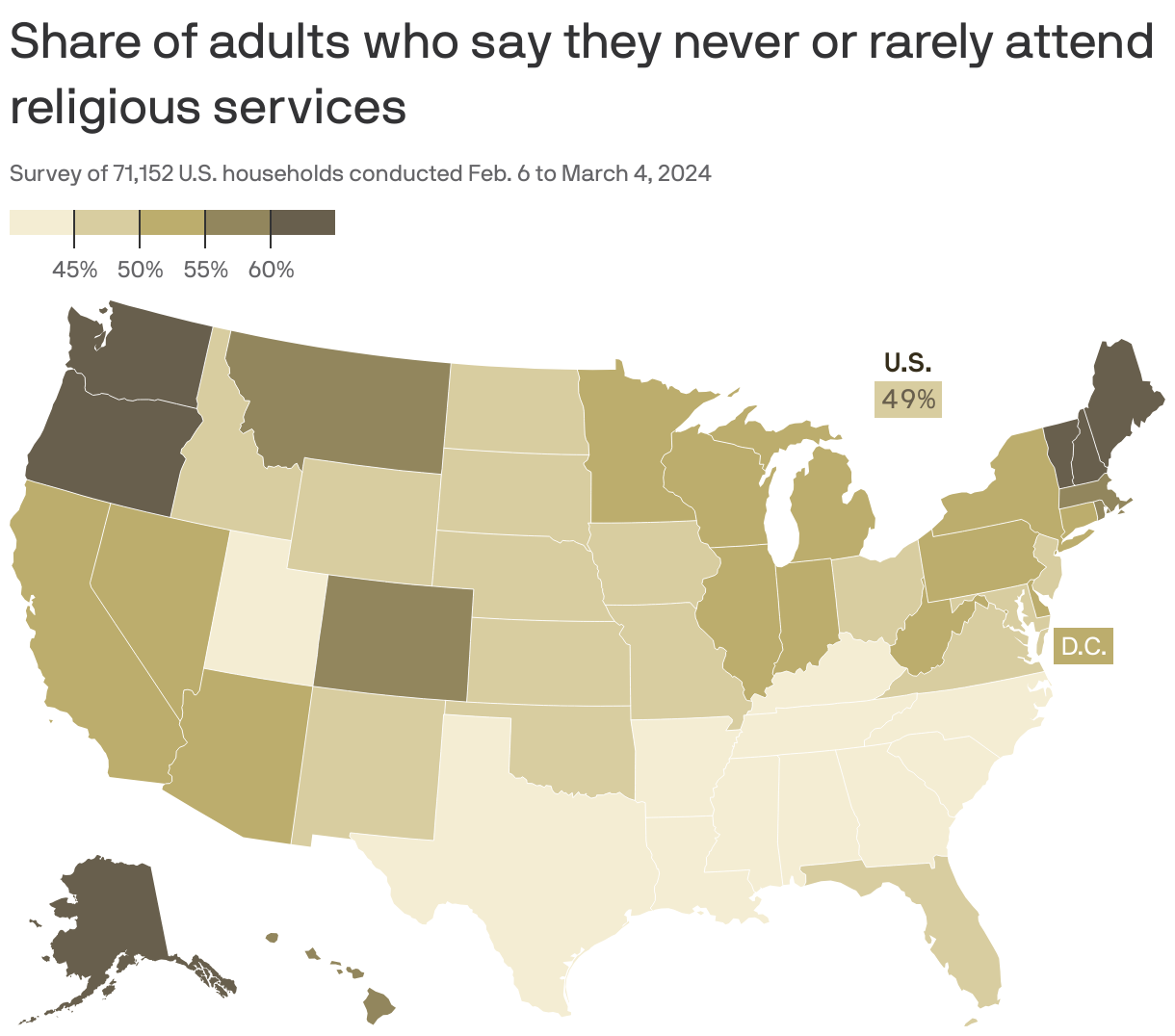
As Easter weekend arrives, most Hoosiers say they probably won't make it to church service on Sunday.
Why it matters: More than three-quarters of Americans say religion's role in public life is shrinking, per a recent Pew Research Center survey — the highest level since the group first started tracking such sentiment in 2001.
- Many are unhappy about that, with about half of Americans telling Pew both that "religion is losing influence and that this is a bad thing."
- About 57% of adults say that religion has a positive impact on American life, per Pew.
By the numbers: 51% of Indiana adults say they never or seldom attend church or religious services, compared to the national average of 49%, according to a Household Pulse Survey conducted Feb. 6–March 4.
- 12% of Indiana residents attend services 1-3 times a year, 5% attend 4-11 times per year, and 22% attend 12 or more times.
Zoom out: Vermont (75%), New Hampshire (66%) and Maine (66%) have the highest share of adults who don't attend religious services.
- Mississippi (32%), Alabama (36%) and Louisiana (37%) have the lowest shares.
Friction point: Nearly half of U.S. adults say they feel at least "some" tension between their religious beliefs and mainstream culture, Pew found.
- That's up from 42% in 2020.
Zoom in: A separate Gallup survey published this week found that Latter-day Saints, also known as Mormons, are the only religious group wherein a majority say they attend services weekly, at 54%.
- 30% of Protestants say they attend services weekly, compared to 28% of Muslims, 23% of Catholics and 16% of Jews.
Yes, but: Religious service attendance has been dropping for decades, per Gallup, driven largely by "the increase in the percentage of Americans with no religious affiliation — 9% in 2000-2003 versus 21% in 2021-2023."