New mental health facility on a mission to mend Black and brown minds

Add Axios as your preferred source to
see more of our stories on Google.
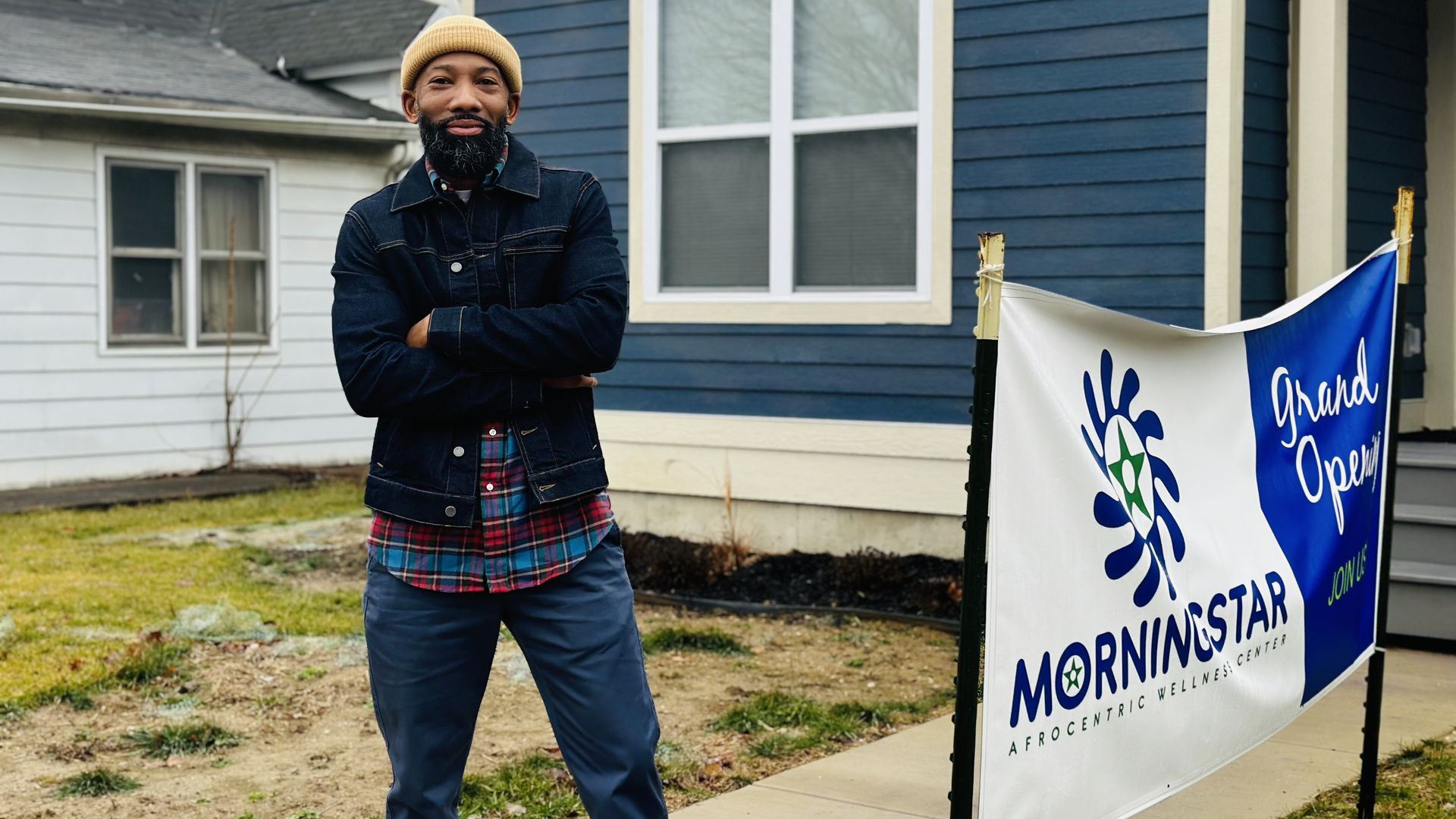
Bwana Clements stands outside the Morningstar Afrocentric Wellness Center. Photo: Justin L. Mack/Axios
A new mental health facility at the corner of West 23rd Street and Dr. Martin Luther King Jr. Street wants to strip away the stigma that comes with seeking help in communities of color.
Driving the news: The Morningstar Afrocentric Wellness Center, a subsidiary of local nonprofit Flanner House, opened in October.
- Center director Bwana Clements tells Axios the goal is to serve people of color who traditionally avoid care because of fear of judgment, barriers to access and deep-rooted mistrust in the medical system.
Why it matters: Black U.S. adults are more likely than white adults to report symptoms of emotional distress, research from the Substance Abuse and Mental Health Services Administration finds, but just one in three Black Americans suffering from mental illness receives treatment.
Details: Services include individual, couples and family therapy; shelter for women and children in crisis; bereavement therapy for residents impacted by violence or trauma; laundry services and more.
- The center accepts Medicaid. For those not covered by Medicaid, there is a sliding scale fee for services based on income, but Clements said no one who asks for help will be turned away due to an inability to pay.
Between the lines: This time of year can be particularly difficult for Black Americans — while Black History Month is a time of celebration, it is also littered with reminders of enslavement and injustice.
- "We try our best to make it a joyous and celebratory occasion, yet 99% of the celebrations start with the enslavement of our people. Because that is part of our story," Clements said.
By the numbers: Morningstar has an all-Black staff — a first for similar facilities in the city, according to Clements — including seven graduate-level professionals and two Black male employees.
- Nationally the number of Black psychologists hovers at around just 4% of the total workforce, and the number of Black psychiatrists sits at about 2%, according to an Association of Black Psychologists report.
- Clements said the stats get even worse when looking at Black males in the industry, noting that he was the only Black man in his graduate school cohort at the Indiana University School of Social Work.
Of note: The center also includes youth outreach with planned spaces for audio production, clothing design, barbers, beauticians and more.
- But any young person who wants to take advantage of those features must actively participate in Morningstar's youth discussion groups or other center programming.
How to get help: Anyone interested in Morningstar's services can email [email protected] for assistance.