Good news, bad news on Marion County school funding

Add Axios as your preferred source to
see more of our stories on Google.
Indiana invested more than $8.8 billion in K-12 schools for the school year that's just started, giving them an average of 5.2% more per student than the previous year.
Driving the news: The state budget bill passed in May sets the funding formula for this school year and next.
- Some school districts saw increases in per-pupil funding of 8% or more this year, while others were below 4%.
Catch up fast: The Indiana General Assembly added $300 million to the education budget in a last-minute maneuver after local school districts pushed back on the original appropriation.
- Initially, the budget would have provided an average increase of just 3.5% this year and 1.1% the following, while funneling more than $1 billion into the state's expanding private school voucher program.
- The final appropriation increased the education budget by 7.9% in the first year and another 2.2% in the second.
How it works: The funding formula starts with a base appropriation, calculated on the number of students enrolled in each district.
- Districts get additional dollars for things like the number of students living in low-income households, receiving special education services, learning the English language and taking advanced classes.
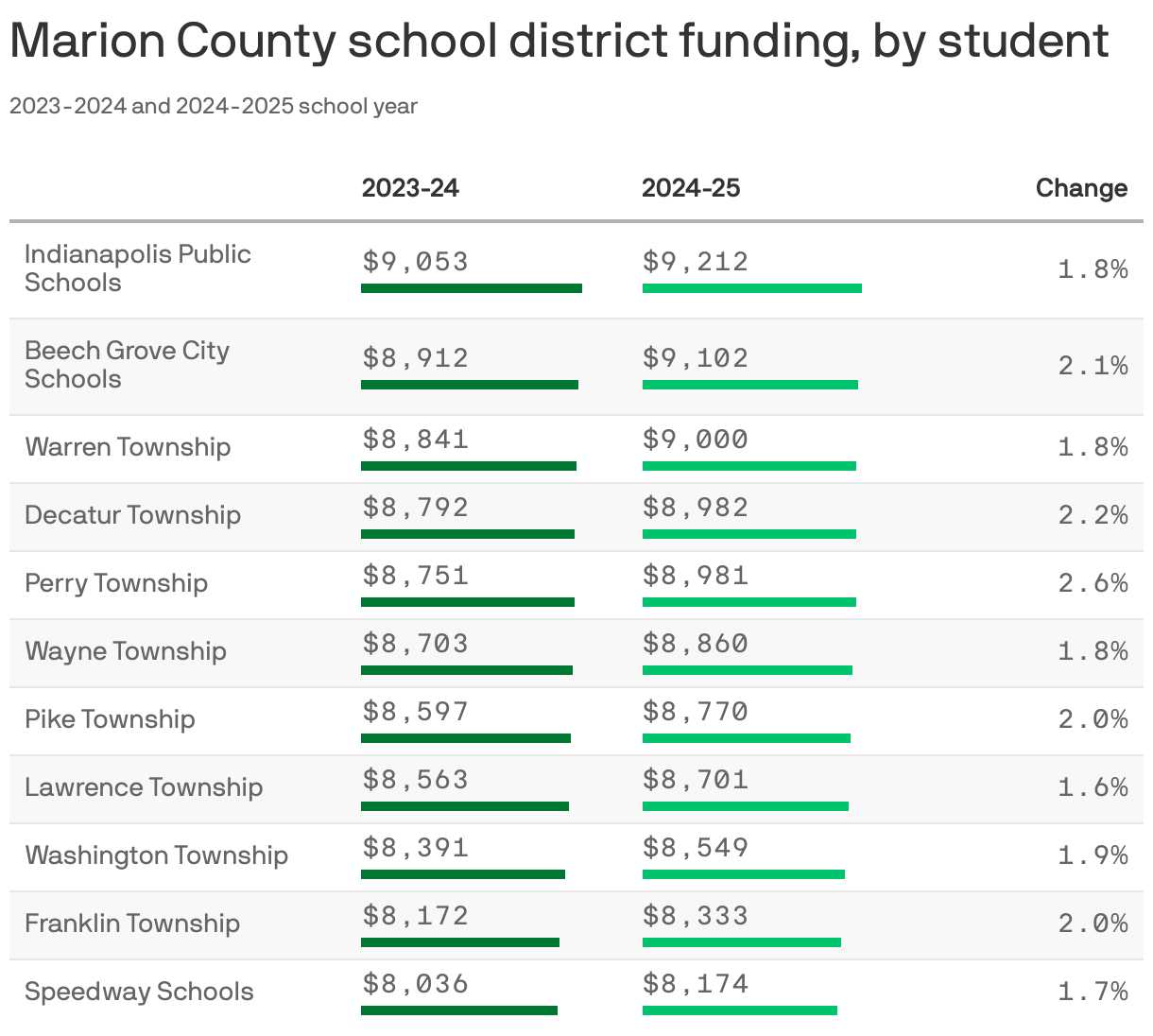
Zoom in: In Marion County, the increase in per-pupil funding for the current school year ranges from 5.2% to 7%.
- Estimates for the increase next school year range from 1.6% to 2.6%, according to state projections.
Of note: A change to the formula this year — new academic performance grants — rewards schools with students who have done things like completed a dual credit course or earned an associate degree.
- That change helped boost funding this year for districts like Wayne Township Schools, whose early college program graduates more than 100 students with an associate degree each year.
- Wayne Township saw the greatest per-pupil increase of Marion County districts this year — up 7% from last year — but is only expecting a 1.8% bump next year.
What they're saying: "We will accept and utilize any increase we receive," said superintendent Jeff Butts. "We're looking at a 13% increase in utility costs … that's an expense I was not anticipating."
- "The 7% certainly looks great but not all of that will be able to go toward teachers' salaries or resources in the classroom."