Harris County among top areas for unauthorized immigrants


Add Axios as your preferred source to
see more of our stories on Google.
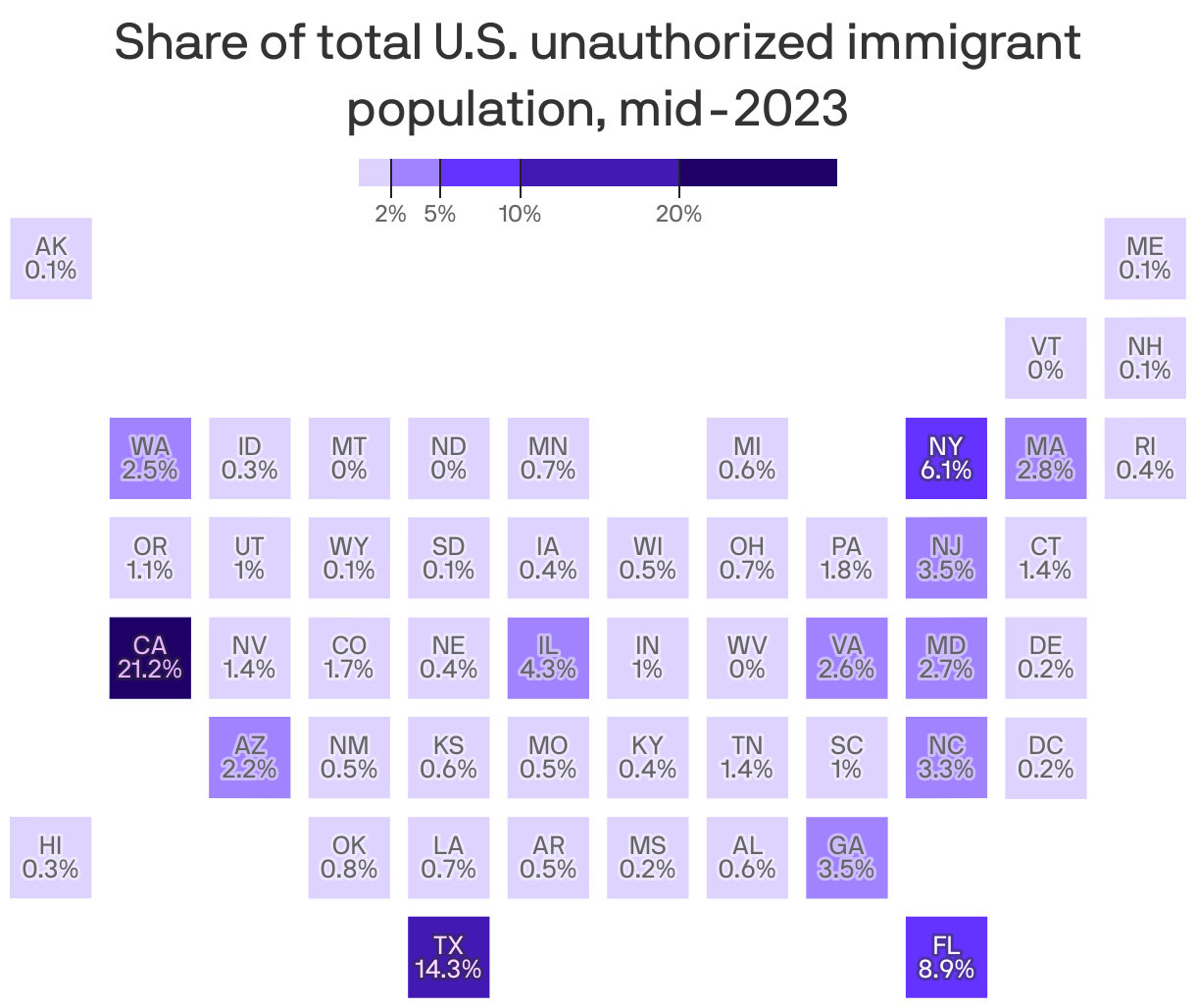
Harris County is home to more than 600,000 unauthorized immigrants, according to new estimates — 4.4% of the nation's 13.7 million people lacking legal immigration status — though that figure could be lower now, after President Trump's deportation efforts.
Why it matters: The report, from nonpartisan think tank Migration Policy Institute (MPI), offers insight into a group that's notoriously hard to count — and thus understand.
By the numbers: 14.3% of the nation's unauthorized immigrant population, or nearly 2 million people, live in Texas.
- Harris County's unauthorized immigrant population is second only to Los Angeles County, home to 8% of the nation's total. Most are from Mexico and Central America, per MPI.
- About 70,000 school-aged children in Fort Bend, Harris and Montgomery counties don't have legal immigration status.
Driving the news: Immigration and Customs Enforcement has maintained a strong presence in the Houston area, making nearly 11,000 arrests between January and July across its field office region, which covers Southeast Texas and areas near Waco, per the Deportation Data Project's most recent figures.
The latest: After months of denial, Mayor John Whitmire acknowledged that Houston police are cooperating with federal immigration authorities.
- "I'm not going to say that we're not cooperating with ICE, because that's frankly not true," Whitmire said, adding he thinks it was necessary to avoid retaliation from the Trump administration.
Zoom out: Of the 13 million unauthorized immigrants ages 16 and older in 2023, 94% had jobs, per the report.
- Nearly 2 million work in construction, followed by 955,000 in food services.
The big picture: The overall U.S. unauthorized immigrant population grew by 3 million between 2019 and mid-2023, MPI found, noting the country "has not experienced a pace of change this rapid ... since the early 2000s."
Yes, but: Unauthorized immigration probably stopped growing last year and potentially began reversing this year, due to fewer border crossings, stronger enforcement and efforts to discourage immigration overall, MPI's report notes.