Where Houston kids have the most and least opportunity


Add Axios as your preferred source to
see more of our stories on Google.
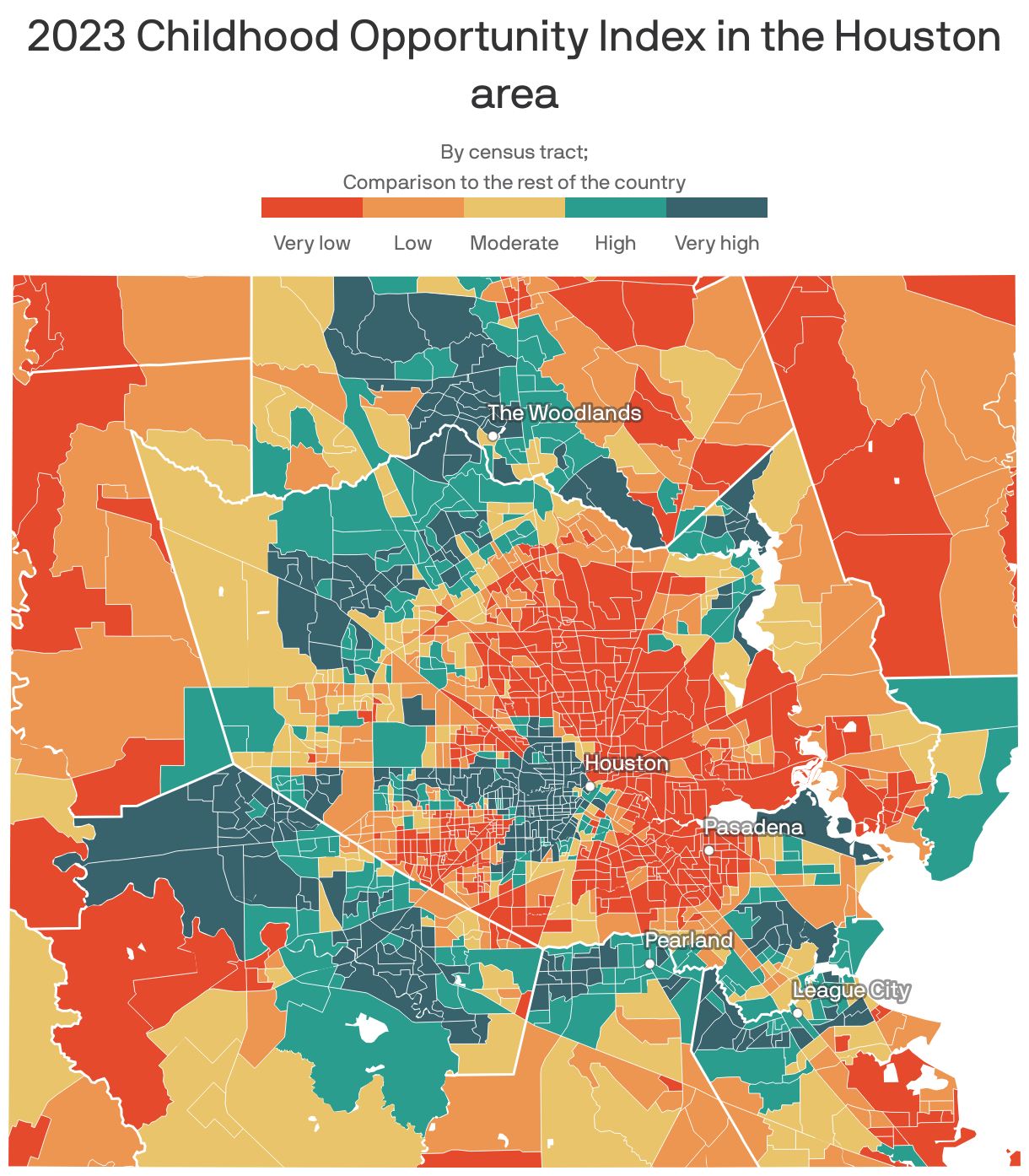
A new national analysis of quality-of-life factors underscores a hard truth: Kids in Houston's poorest neighborhoods face daunting odds on multiple levels compared to their counterparts in wealthier areas.
Why it matters: Where children grow up often shapes their health, education and future.
The big picture: The analysis comes from the latest report of the Child Opportunity Index (COI), which rates communities on 44 factors that help determine a child's success, and awards scores from 1 to 100.
- The most affluent neighborhoods, clustering near Memorial Villages, the Heights and Upper Kirby, scored a 100.
- By contrast, the poorest areas in Southwest, Northwest and East Houston, like Sunnyside and Greenspoint, have single-digit scores.
The intrigue: Houston's child opportunity map reflects a shape many Houstonians know well: the "Houston Arrow."
- It's the recurring pattern of prosperity pointing inward to the city's wealthiest enclaves, while a backward "C" of low-opportunity neighborhoods wraps around them.
- Maps of income, health and climate impacts often trace the same outline — a stark reminder of how inequities are embedded in Houston's landscape.
What they're saying: "Neighborhoods are important for families and children, shaping the economic, social and environmental contexts of their everyday lives and influencing their childhood and long-term health, education and socioeconomic outcomes," the authors write in the latest report.
Context: The COI was created in 2014 by Boston University researchers to gather rigorous data "to improve child wellbeing and increase racial and ethnic equity in opportunities for children."
- Researchers originally calculated scores on 19 metrics, but in this latest report, based on 2023 data, the metrics have more than doubled to now cover school quality, safe housing, access to healthy food, parks, clean air and economic opportunities.
The bottom line: Harris County's racial opportunity gap correlates with national trends. "Hispanic and Black children are more likely to have lower opportunities for healthy development," the report notes.
- "They live in families and neighborhoods with much higher poverty rates and attend schools with more limited resources than white children. This inequity affects not only children but all of us."