Texas is a hot spot for immigration enforcement


Add Axios as your preferred source to
see more of our stories on Google.
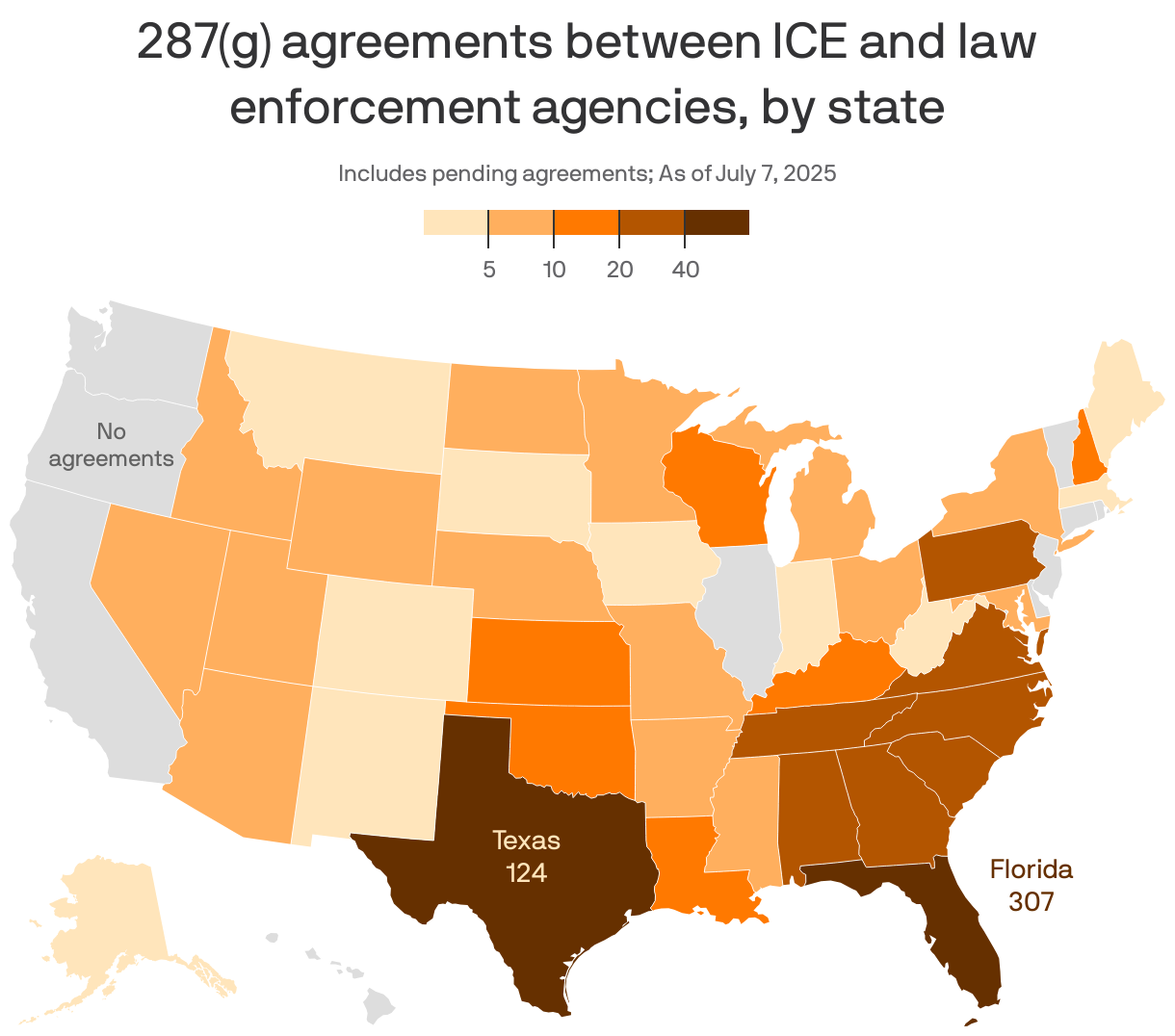
Efforts to arrest and remove unauthorized immigrants appear most aggressive in Texas and other southern states with Democratic-leaning cities, according to an Axios analysis.
Why it matters: Harris County saw more immigrants (2,460) ordered removed in March than any other county in the U.S., per data from the nonpartisan Transactional Records Access Clearinghouse (TRAC).
The big picture: Axios' review of removal orders, pending deportation cases and agreements between immigration officials and local law enforcement agencies, sheds light on where the Trump administration is dispatching resources to support its mass deportation plan.
- The analysis shows local law enforcement agencies in Texas, Florida, Georgia, North Carolina and Virginia have been most cooperative with Immigration and Customs Enforcement (ICE) in rounding up immigrants through deals known as 287(g) agreements.
- Nationwide, there are 629 of these agreements in place. Over 90 — roughly 14% — are in Texas alone. Harris County does not have a 287(g) agreement, but neighboring Fort Bend and Austin counties have signed on in recent months.
State of play: Senate Bill 8, which would require most Texas sheriffs to work with federal immigration authorities, is awaiting Gov. Greg Abbott's signature.
- Trump recently urged leaders of the National Sheriffs' Association to have their members partner with ICE.
- "We have a limited number of resources at ICE," border czar Tom Homan told Axios. The 287 (g) agreements are "a force multiplier and are going to help us achieve higher numbers."
The latest: ICE raids continue in the Houston area. A weeklong operation in early May resulted in over 500 arrests, with at least another 140 reported later that month, per ICE Houston's press release.
The other side: Immigration advocates are criticizing ICE's partnerships with local authorities, saying the pacts harm communities and public safety.
- "It means that communities are less likely to trust local police and report crime," said Nayna Gupta, policy director of the American Immigration Council.
Go deeper: Where the hot spots are for immigration enforcement.