How many hours of daylight Houston is losing


Add Axios as your preferred source to
see more of our stories on Google.
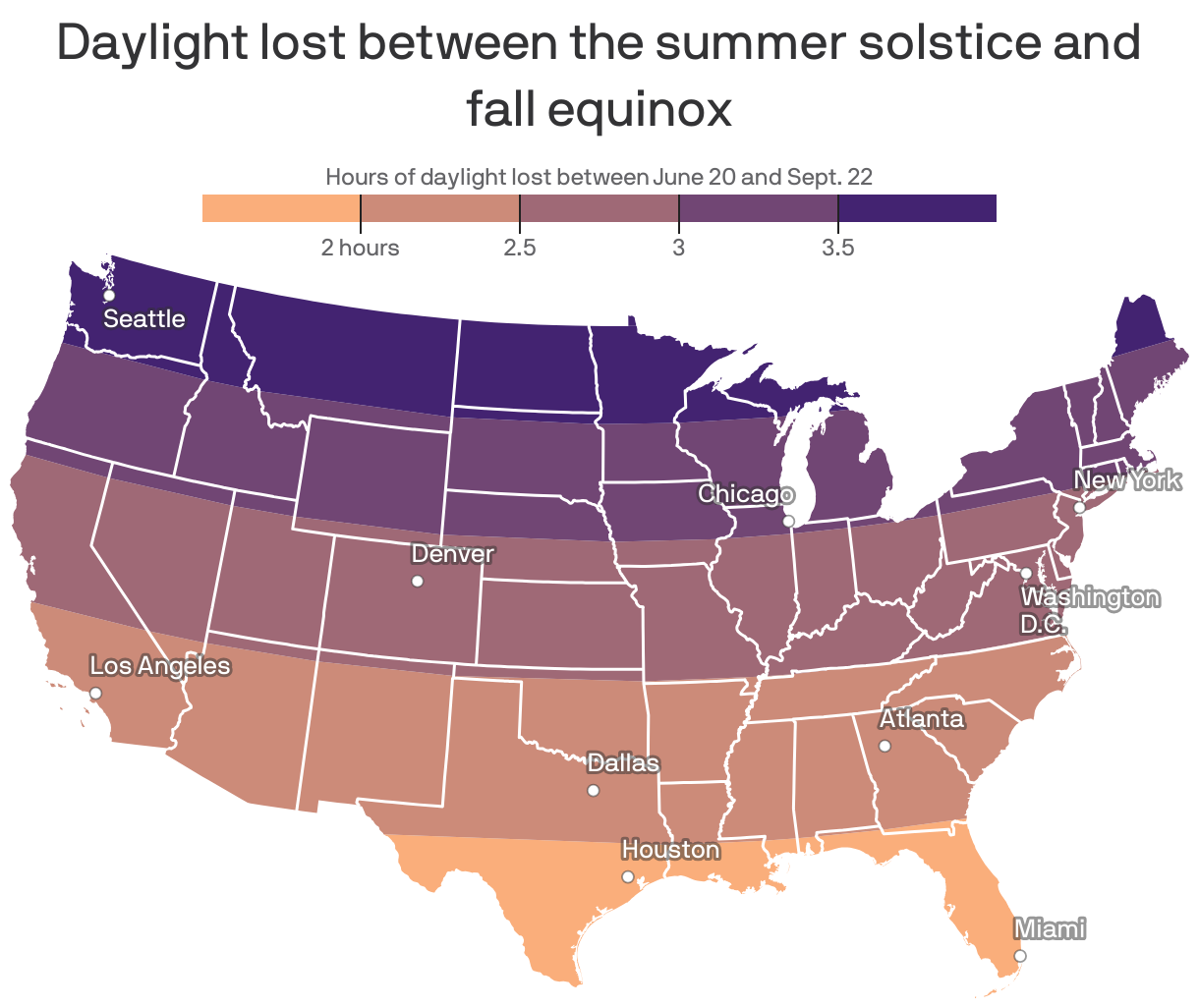
Brace yourselves, because darkness is coming.
Driving the news: In Houston, we'll have lost two hours of daylight between the June 20 summer solstice and the Sept. 22 fall equinox, per the National Oceanic and Atmospheric Administration's handy Solar Calculator.
- We'll lose nearly another two hours between the fall equinox and the Dec. 21 winter solstice.
How it works: Here in the Northern Hemisphere, northern latitudes lose more daylight in the fall and winter compared with areas closer to the equator as the Sun's path through the sky shifts southward.
The big picture: Parts of the northern U.S. have already lost more than three hours of daylight.
Reality check: The Texas House overwhelmingly supported a bill in 2023 to permanently stay on daylight saving time, but it died in the Texas Senate.
- The Senate also let similar bills die in 2021.
- Making that change wouldn't have given us more daylight, however.
What's next: In October, Houston's sunrise will occur between 7:15am and 7:30am, and the Sun will set starting around 7pm early in the month and near 6:30pm by the beginning of November.
- When the clocks shift to standard time, sunrise will occur around 6:30am and sunset will be around 5:30pm, per NOAA.
💭 Jay's thought bubble: All this means soaking up as much daylight as you can is crucial in the meantime.
Things to do while the Sun is still up:
- 💦 Ride a pedal boat at Hermann Park.
- 🖼️ Locate all of the Big Art. Bigger Change murals in downtown.
- 🍸 Grab a drink at one of Houston's best patio restaurants.
And things to do when it gets dark:
- 📖 Cozy up with a new read from Brazos Bookstore.
- ✨ See the stars with the astronomically minded in Memorial Park.
- 🎵 Catch a show on the lawn at White Oak Music Hall.