Remembering Apollo 11's short-lived American flag

Add Axios as your preferred source to
see more of our stories on Google.
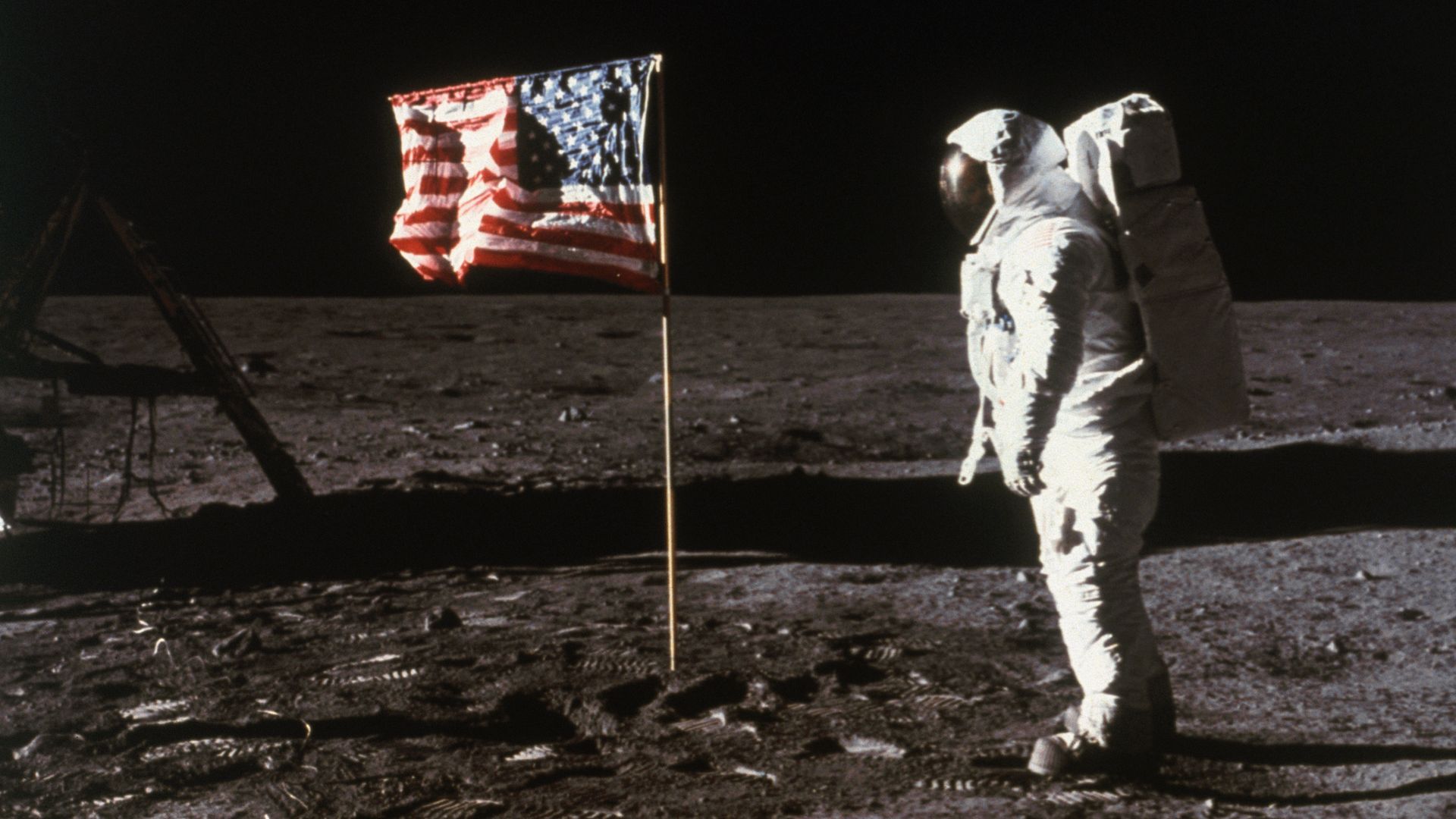
Astronaut Buzz Aldrin saluting an American flag on the Moon. Photo: Neil Armstrong/NASA via Getty Images
Saturday is the 55th anniversary of the historic Apollo 11 Moon landing, wherein astronauts Neil Armstrong and Buzz Aldrin planted the first American flag on the Moon during their historic moonwalk.
Yes, but: The flag didn't fly for long.
Flashback: Among their scientific duties while traversing the lunar surface on July 20, 1969, Armstrong and Aldrin put together the official Lunar Flag Assembly.
- Planting an American flag on the Moon was the brainchild of NASA's Committee on Symbolic Activities for the First Lunar Landing created shortly before the launch, according to the agency.
The intrigue: As patriotic as it was to see Aldrin saluting the Stars and Stripes on live television, the flag's ultimate fate was worse than history often portrays.
- The flag truly never stood a chance.
What happened: Not only did the horizontal pole holding the flag taut fail to extend all the way, but the two astronauts could penetrate the lunar surface only about half as deep as the flagpole required because of the Moon's dense soil, Aldrin later told NASA engineers.
In fact, Aldrin was worried it might fall over during the live broadcast of their moonwalk, telling Fast Company in 2019 he "dreaded the possibility of the American flag collapsing into the lunar dust in front of the television camera."
The flag stood its ground during the broadcast watched by hundreds of millions of people around the world.
- But by the time viewers' televisions were off hours later, Armstrong and Aldrin were ready to rocket off the Moon in the lunar module Eagle to join astronaut Michael Collins in the orbiting command module Columbia for the trip back to Earth.
When the Eagle lifted off to join the Columbia, Aldrin reported seeing the rocket blast knock the flag over, an unceremonious end to a very ceremonious beginning.
Subsequent Apollo astronauts planted flags farther away from the lunar lander to avoid a similar fate, though many have still been destroyed.
- At least three of those flagpoles remained standing as of 2019, although experts speculate that the flags themselves have been bleached white.
What's next: NASA's Artemis II mission, in which four astronauts will rocket around the Moon to test flight capabilities, is expected to launch in late 2025.
- That mission makes way for Artemis III later this decade, when Americans plan to walk on the Moon — and plant a flag — for the first time since 1972 in an effort to explore the lunar south pole.
- NASA plans to ultimately establish a Moon base to help work toward sending humans to Mars.
Editor's note: This story has been corrected to reflect that the flag pole that didn't extend all the way was horizontal, not vertical.