Metro removes safety stripes from trains

Add Axios as your preferred source to
see more of our stories on Google.
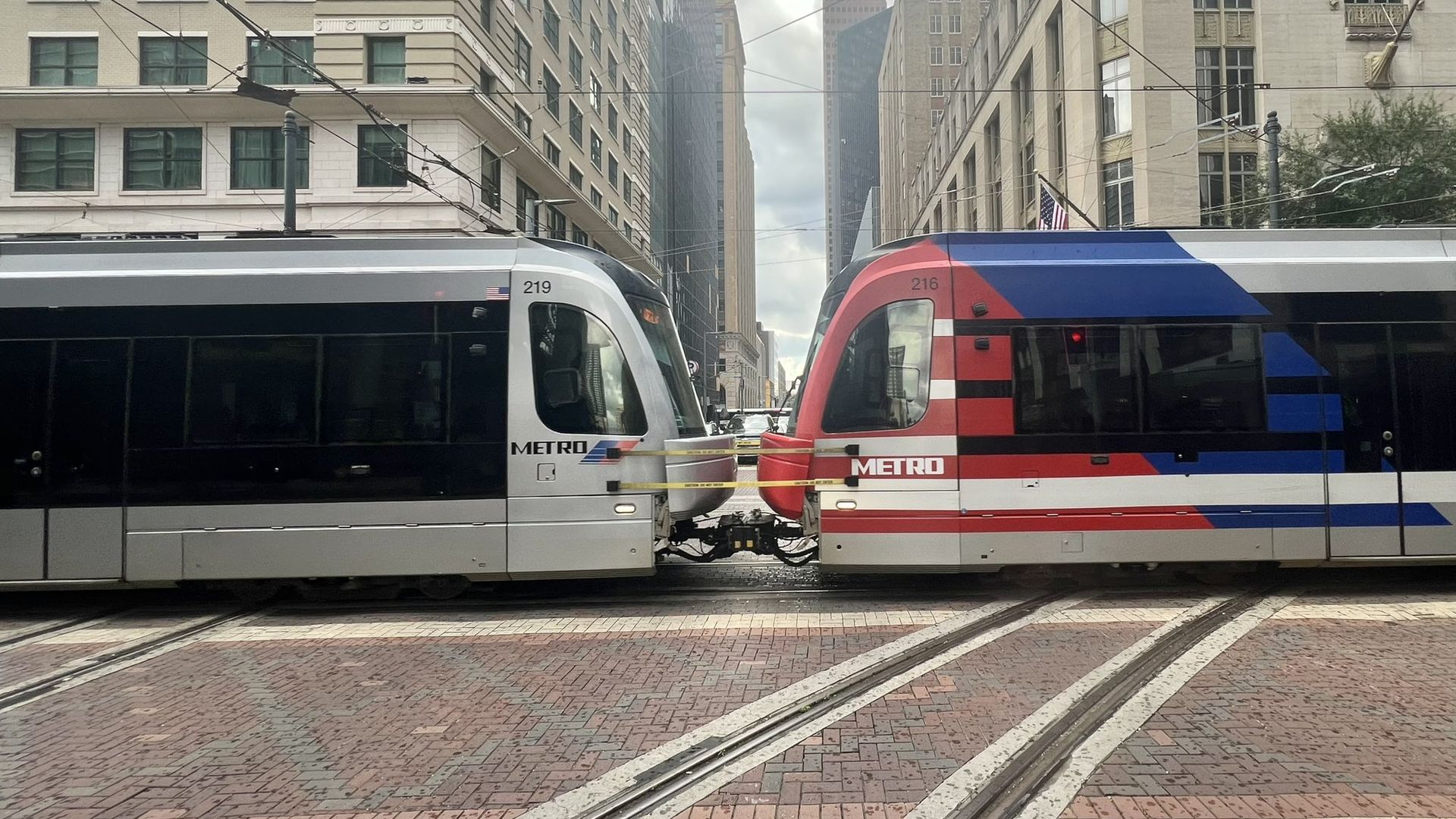
Metro trains with and without the red and blue stripes. Submitted photo
The Metropolitan Transit Authority is removing from its trains high-visibility striping originally intended to improve pedestrian safety around the tracks.
Why it matters: While Metro chair Elizabeth Gonzalez Brock says the change is part of a broader initiative to increase public safety on the system, it revokes a 2017 decision aimed at the same goal.
Catch up quick: Most of Metro's light rail trains were all gray from the time they were introduced in 2004 until 2017, when the Metro board voted to add giant red and blue stripes to the front and back of each vehicle.
- The 2017 vote was an effort to increase the probability that someone sees an oncoming train when encountering tracks — whether on foot, on a bike or in a car.
- "[The gray] blends in with the urban canopy," then-board member Jim Robinson told the Houston Chronicle at the time. "These stand out now."
Driving the news: In May, Metro began removing the stripes and other wraps from its trains and buses, leaving them looking "naked" and nondescript.
What they're saying: "We are working to increase our police department's presence along the transit system, provide better lighting, and remove wraps from our buses and trains," Brock said in a statement.
- "This will enable our officers to better monitor what is going on inside of the vehicles."
The intrigue: Metro sometimes wraps trains with promotional graphics that cover the passenger windows.
Yes, but: The stripes affixed to the front and back of trains did not cover any windows.
When asked why Metro was removing the stripes in light of their intended purpose, spokesperson Douglas Delony said the agency's safety department deemed the stripes ineffective in reducing crashes.
- "The authority is continually exploring initiatives aimed at reducing accidents," Delony said.
By the numbers: Metro trains were involved in 108 collisions in 2016, according to Metro data.
- There were 101 collisions in 2017, 97 in both 2018 and 2019, 58 in 2020, and 77 in 2021. Those numbers jumped to 117 in 2022 and 115 in 2023.
- There were 34 collisions through the end of May this year, on track to record around 80 through the end of the year.
- Of note: The data doesn't specify whether the collisions were with pedestrians, cyclists or other vehicles.
The bottom line: While board members voted to add the stripes in 2017, the current board didn't have a say in removing them.
- Delony did not provide an estimated cost for removing the decals from trains and buses.
- "Some of this work will be handled in house and some will be contracted out," Delony said. "The work needed to keep our vehicles clean and in a good state of repair may be considered at a future committee/board meeting once crews get a complete picture of what's needed."