Texas cancer diagnoses expected to hit record high


Add Axios as your preferred source to
see more of our stories on Google.
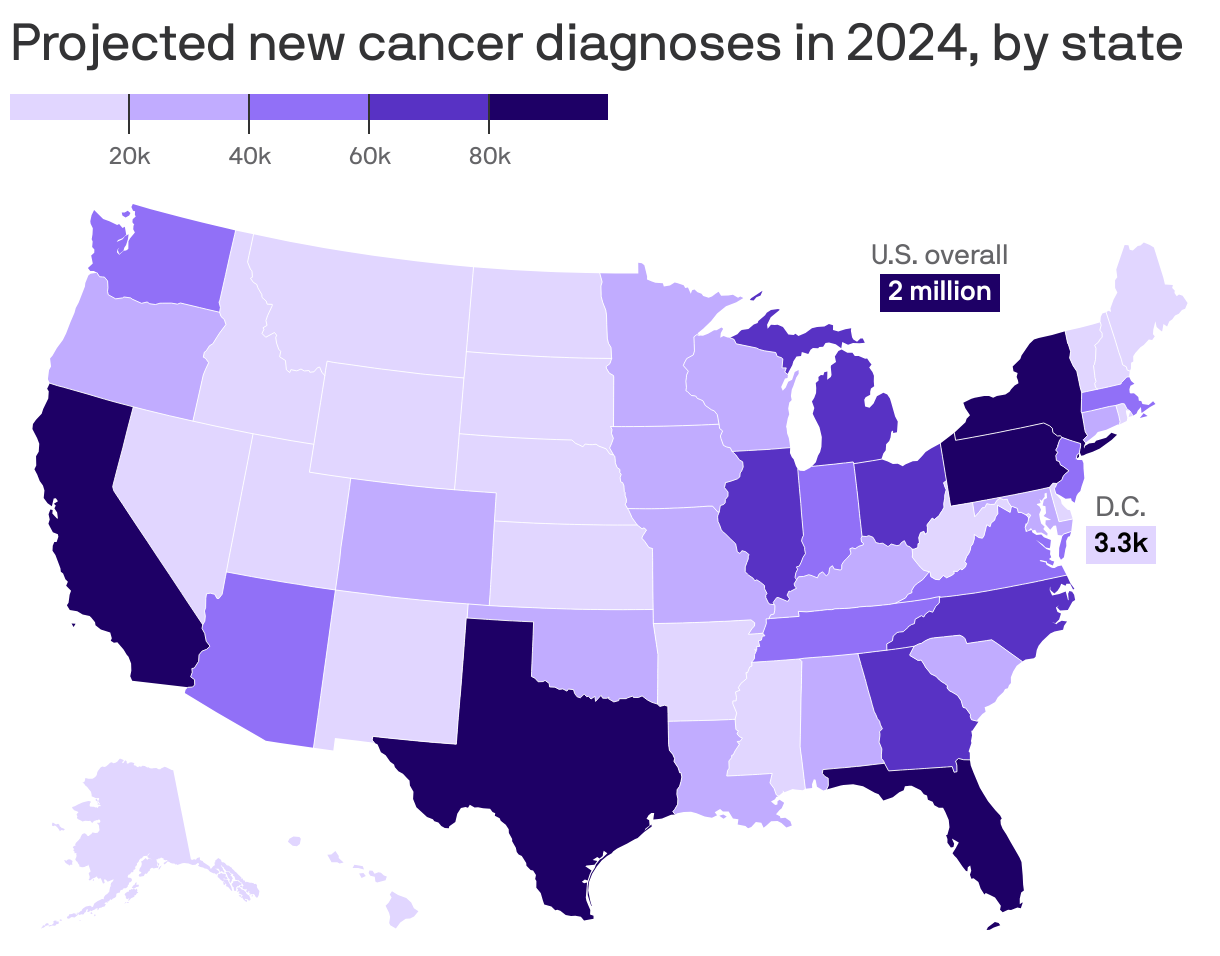
Nearly 148,000 Texans are expected to be diagnosed with cancer in 2024, according to new American Cancer Society data.
- That number is up from 2023's 139,000 projected new cases.
Why it matters: The numbers are driven in large part by an increase in cancers among younger Americans, Axios' Tina Reed reports.
- There have been major improvements in cancer survival, but there's a rise in some cancers. At the same time, doctors are trying to figure out why they're seeing more young patients with cancer.
The big picture: The proportion of people 65 and older diagnosed with cancer dropped from 61% to 58% in the last 30 years, even as the size of that group increased. The proportion of those diagnosed between ages 50 and 64 was largely stable.
- "Notably, people aged younger than 50 years were the only one of these three age groups to experience an increase in overall cancer incidence during this time period," the ACS report said.
- Doctors don't know exactly what's behind the uptick in new cases and deaths among younger patients in many cases.
By the numbers: Texas ranks third among states for residents expected to be diagnosed with the disease this year.
- The top three on the list are the most populous states. Only Florida (161,000 new cases) and California (194,000 new cases) are expected to see higher gains than the Lone Star State.
- More than 23,000 of Texas' projected diagnoses are expected to be for female breast cancer, nearly 21,000 for prostate cancer, and about 14,500 for lung and bronchus cancer.
Of note: There is some good news in the data. The decline in cancer mortality has resulted in more than 4 million fewer deaths in the U.S. since 1991 when compared with the number of cancer deaths expected if rates had remained at their peak.
- Still, the study projects cancer will kill nearly 612,000 people this year, up from a projected 609,820 in 2023.
The bottom line: American Cancer Society chief scientific officer William Dahut said the study highlights the importance of timely screening, particularly among people with a strong family history of cancer or who are experiencing symptoms of the disease.
- "Most things, of course, won't be cancer. But if things seem abnormal, make sure you know you are satisfied by the workup," Dahut told Axios.