Houston light rail turns 20

Add Axios as your preferred source to
see more of our stories on Google.
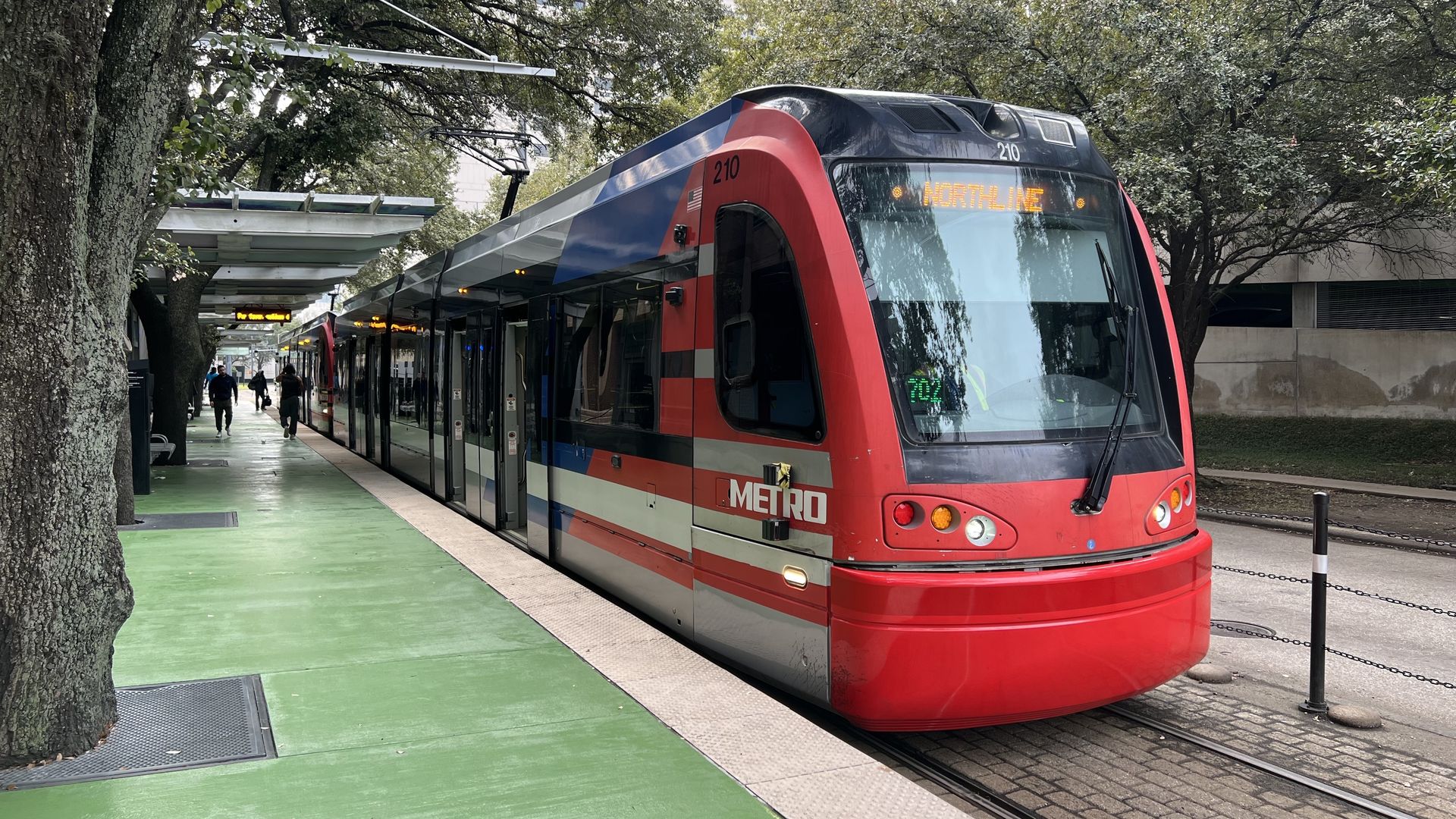
A northbound train stops in the Museum District on Jan. 1. Photo: Jay R. Jordan/Axios
It's been 20 years light rail was introduced in the Bayou City.
Why it matters: The decades leading up to light rail's introduction exemplify Houston's love-hate relationship with rail transit, particularly the heavy politicking.
Driving the news: Metro's Main Street line — known today as the Red Line — took its first passengers on Jan. 1, 2004, a day of celebration with promises of a brighter public transit future in Houston.
- The original route went from the Fannin South Transit Center to the University of Houston Downtown.
- Today, Metro operates three light rail lines totaling 23 miles in Houston's inner loop.
Flashback: Houston had its share of streetcars in the early 1900s, but those were replaced by buses by the 1940s.
- By the 1960s and 1970s, public transportation — operating under HouTran — was abysmal across the city, the Washington Post reported at the time.
In response to rising traffic congestion and an ailing public transit system, Houstonians voted to tax themselves and create the Metropolitan Transit Authority in 1978.
- From the get-go, the authority had its sights set on rail despite the public's skepticism.
What happened: Voters were set to approve a $2.3 billion bond for a rail system in June 1983, five years into Metro's existence.
However, board members earlier that year had authorized the purchase of 130 rail cars, likely banking that Houstonians would approve the bond.
Yes, but: Voters ultimately rejected the proposal that June, handing Metro its first major defeat on rail transit.
But, but, but: In 1988, voters reversed course and gave the green light for a new light rail system.
- It was around the same time that rail skeptic Bob Lanier was appointed to lead Metro.
- Board members eventually voted to scrap the plans for light rail, in part over Lanier's doubts about ridership projections.
- Lanier resigned in 1989 and was replaced with the pro-rail Anthony Hall.
By 1991, the debate over rail only ramped up — and Lanier was once again a key player.
- The Metro board that year approved plans for a monorail system that was widely criticized by residents and businesses along the corridors where it would be built.
Also that year, Lanier ran for Houston mayor on a platform of ending the monorail project, and one of his first actions after being elected was gutting Metro's savings and ultimately killing the project.
Flash forward to 1997. Houston has a pro-rail mayor in Lee P. Brown. Metro publishes its 2020 Regional Transit Plan, which calls for light rail along the Main Street corridor.
- The time was finally right for rail in Houston. Only this time, Houston voters didn't initially have a say.
The Houston City Council and Metro in 2000 moved forward with a light rail plan for Main Street initially without asking voters.
- After some hiccups, including a lawsuit fighting the project from a City Council member, Metro and its partners broke ground in March 2001.
- A series of separate lawsuits eventually got the issue before voters in November 2001, and they gave the final green light for Metro to continue the project.
State of play: In the two decades since its inaugural run, however, Metro's priorities have shifted from expanding light rail to building out its bus rapid transit lines.
- Metro doubled down on the bus in 2015 by redesigning its routes to make them more frequent and reliable.
What's next: Still, there are plans to extend Houston's light rail lines, notably the Green and Purple lines south to Hobby Airport. But those improvements are years, if not decades, away from coming to fruition.