Small Texas city in the spotlight of new docuseries "A Town Called Victoria"

Add Axios as your preferred source to
see more of our stories on Google.
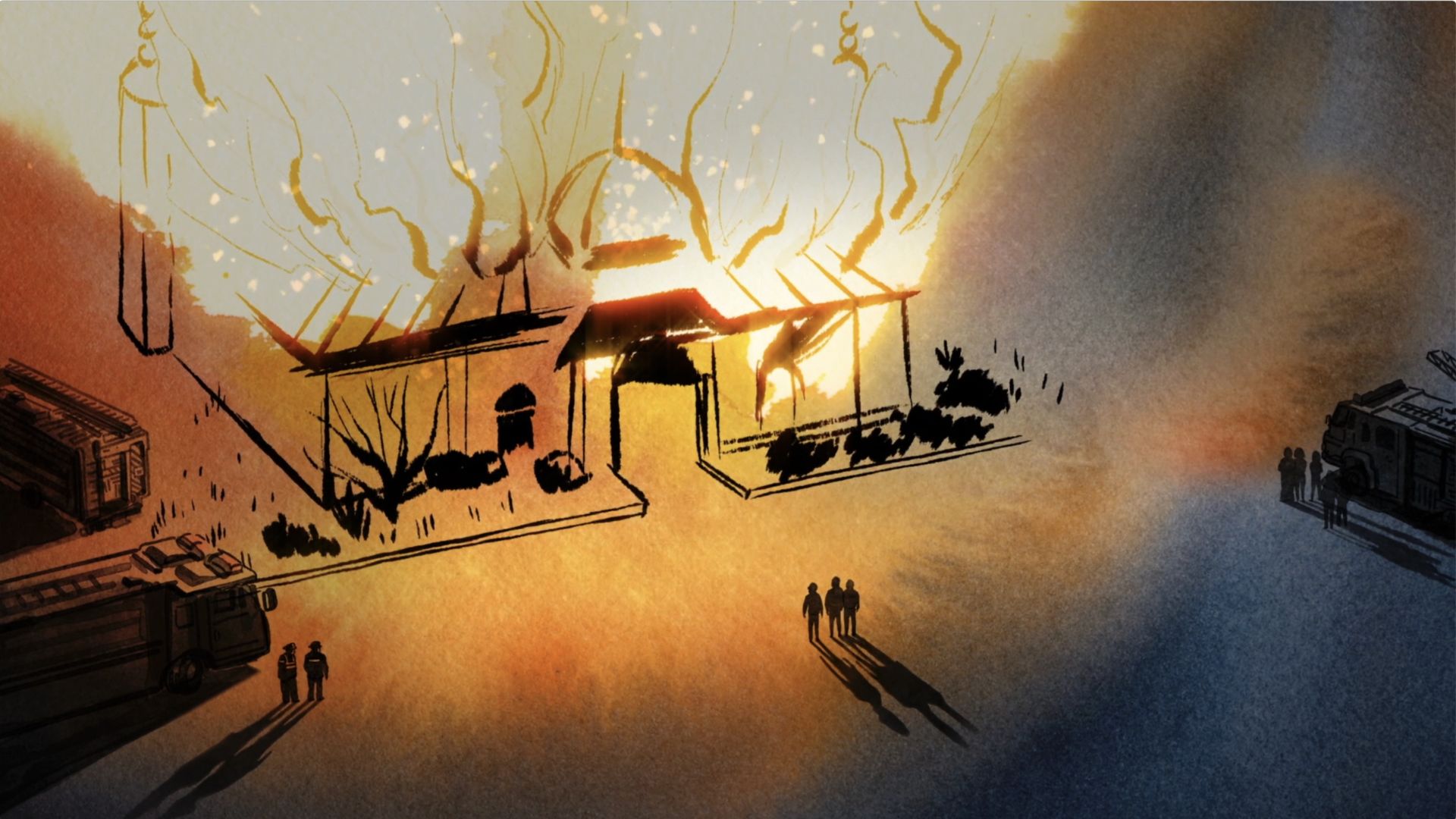
Animation of the night of the Victoria Islamic Center arson. Image: Courtesy of PBS/ReelSouth/Independent Lens
A new documentary series offers a deep, nuanced view into Victoria — a small South Texas city about 120 miles from Houston — as it unpacks the aftermath of a 2017 mosque fire that rattled and rallied the conservative community.
Why it matters: Unlike the frenzy of national media that left almost as quickly as it came, award-winning filmmaker Li Lu, who grew up in Sugar Land, stayed.
- During the seven-year project, she interviewed more than 100 people to capture the town's complexities and collective healing.
Details: "A Town Called Victoria," which premiered nationwide last month on PBS, centers on a Muslim congregation whose house of worship was destroyed in a fire just hours after former President Donald Trump announced a Muslim travel ban.
- Over three episodes, the docuseries details everything from the court trial to the mosque's rebuilding, which was made possible with donations from around the world.
- In the process, it explores how deep-seated racial, religious, political and economic differences have shaped the city and those who live there.
What they're saying: "When I drove into Victoria and started filming, it's almost like a visceral thing — you feel the air get heavier around you as you enter the town," Lu told Axios.
- "You get the sense there are some ... unspoken rules here."
Catch up quick: The Victoria Islamic Center's 16-year-old mosque — the first and only one in the city — erupted in flames in the early morning hours of Jan. 28, 2017, sparking national attention and a federal investigation.
- Within four days, the mosque raised more than $1 million from across the U.S. and overseas to rebuild.
- In July 2018, resident Marq Vincent Perez was found guilty of intentionally starting the blaze, deemed a hate crime.
- He was sentenced to 24 years in federal prison in October 2018 — the month after the mosque reopened to the public.
The intrigue: Some community members said the hate crime felt unusual because Perez — who is Latino — is a person of color, raising questions about power, oppression and othering.
By the numbers: The city of Victoria — with about 65,000 residents — is 55% Hispanic or Latino and 34% white, according to U.S. Census Bureau data.
- An estimated 68% of Victoria County voters supported Trump in the 2020 presidential election.
- Roughly 18% of city residents live in poverty.
The big picture: Victoria is not only "a microcosm" of communities across the country reckoning with racism and the right way forward, Lu said, but it also offers a lesson.
- "I really hope that the story … shows people some examples of how they can actually show up for people, and how to have enduring support for people who are hurting right now from these communities," she said.
My thought bubble: It was really special to see a mirror held up to the town where I was born and raised, and to recognize so many people and places — my uncle waving to a friend downtown, my old desk at The Victoria Advocate, the entryway of my elementary school.
- I also admired Lu's ability to capture the small-town sensation of feeling claustrophobic amid wide-open fields.
- As one of my hometown friends put it, Lu's portrayal of Victoria was an "honest" but "loving" reflection of a town we deeply care for but have felt compelled to escape.
The bottom line: The mosque has been rebuilt, but scars remain.
- "The community will always remember this fire happened — so they can never fully feel safe," Lu said. "There's a lot that's still unprocessed and in the process when it comes to restorative justice."