Houstonians are walking less than pre-pandemic


Add Axios as your preferred source to
see more of our stories on Google.
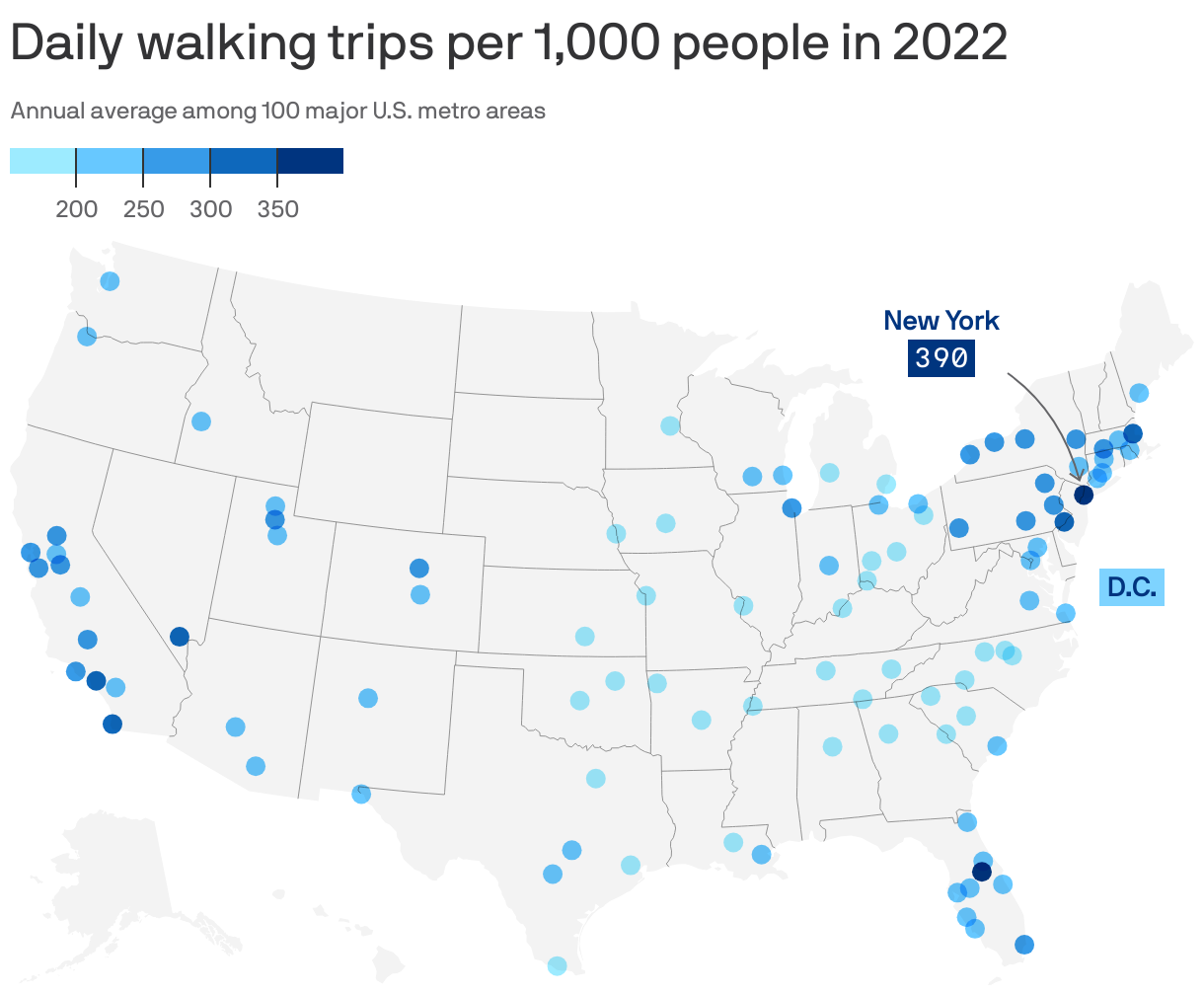
There's been a staggering decline in the number of trips Houston residents take by putting one foot in front of the other, Axios' Alex Fitzpatrick and Kavya Beheraj write.
Why it matters: Walking is good for us.
- That's true both on an individual level (thanks to the many health benefits it confers) and in the big-picture climate change sense (given that it's the OG form of zero-emissions travel).
Driving the news: The number of annual average daily walking trips per 1,000 people in the Houston metro area dropped 40% between 2019 and 2022, per a new StreetLight Data report.
- There were 180 annual average daily walking trips per 1,000 people in 2022, compared to 300 in 2019.
How it works: StreetLight measures travel behavior based on anonymous data from mobile devices, vehicle GPS systems and more.
- For this analysis, one "walking trip" was any trip taken by foot that was more than 250 meters — about 820 feet — from start to finish.
The big picture: Nationally, the number of annual average daily walking trips dropped a whopping 36% in the contiguous U.S. between 2019 and 2022.
- "In every metro and state that StreetLight analyzed, walking trips declined over the three-year period by at least 20%," per the report.
The intrigue: "Active transportation" — that is, walking and biking — accounted for just 10% of overall trips in 2022, down from 14% in 2019.
- Driving, however, was only 4% below 2019 levels — yet another sign that America is a country of car lovers.
What they're saying: The pandemic had an "obvious impact," StreetLight says. But beyond that, the group isn't sure what's keeping Americans off their feet.
The bottom line: "For communities focused on safety, climate, health and equity initiatives, an all-hands-on-deck strategy across safety, transit, land use and more will be needed to increase walking activity," per StreetLight's report.