Houston's cycling deaths still on the rise

Add Axios as your preferred source to
see more of our stories on Google.
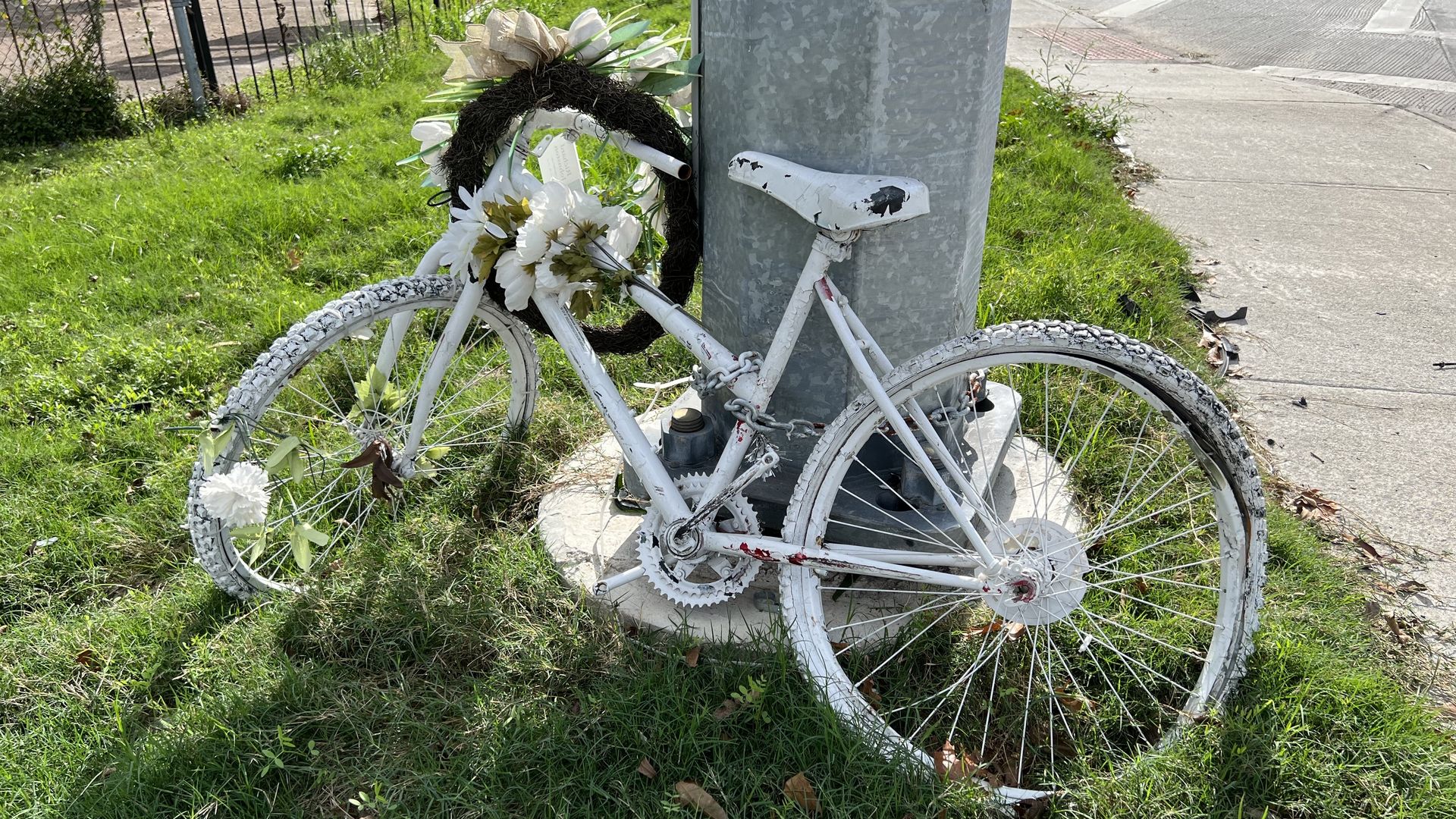
A ghost bike at the corner of Texas 288 and Southmore Boulevard. Photo: Jay R. Jordan/Axios
Houston is investing millions in bike lanes, but nearly as many cyclists have died on its streets this year as in all of 2022.
Why it matters: Houston remains on pace this year to be almost twice as lethal to cyclists as in 2022, when 11 were killed in crashes with motor vehicles.
- 10 cyclists have been killed in 2023, by the Houston Police Department's count.
- By this time last year, there were seven deaths, per Texas Department of Transportation data.
What they're saying: "The trend is clearly heading in the wrong direction," Joe Cutrufo, executive director of BikeHouston, tells Axios. "The places where people are being killed are places that don't have dedicated bike infrastructure. Nobody has been killed on a street with protected bike lanes."
Deaths don't account for the true toll of crashes involving cyclists in Houston, which left 30 people seriously injured in 2022, per TxDOT data. In all, there were 361 crashes involving cyclists in 2022.
- There have been at least 20 serious-injury crashes and at least 202 bike crashes in 2023, including those that turned deadly.
Of the 10 cyclists killed, six were preliminarily found to be at fault in the crashes, according to HPD Lt. Jonathan French.
- "That's not to put blame on anybody," French tells Axios. "We need more awareness."
The intrigue: Houston is in the middle of constructing 1,800 miles of bikeways, having built out 406 miles since 2017, with another 155 miles in the works as of this month, according to the Houston Planning & Development Department.
- Houston's budget for bike lanes is $3.66 million for this upcoming fiscal year.
- The city is vying to become a Gold Level Bike-Friendly City, an accreditation bestowed by the League of American Bicyclists, by 2027. The city is currently at the bronze level.
- The League focuses on what they call the five E's to determine each city's status: equity and accessibility; engineering; education; encouragement; and evaluation and planning.
Yes, but: Cutrufo says there ought to be even more investment from the city.
- "We would need to be investing tens of millions of dollars every year in bikeways to meaningfully bring down this number," Cutrufo says.
From a police perspective, the onus is on both cyclists and drivers.
- "Everyone has got to play their part to make the streets safer," French said. "Houston is moving toward a goal of making us a bike-friendly city. I don't think we're quite there yet, but it's a goal the city is working toward."