Harris County is no longer in a drought

Add Axios as your preferred source to
see more of our stories on Google.

Illustration: Brendan Lynch/Axios
Recent rains helped significantly reduce most of Southeast Texas' drought risk.
Driving the news: The U.S. Drought Monitor releases new data every week to show how different parts of the country are affected by varying levels of drought.
The big picture: Much of Harris and surrounding counties were labeled abnormally dry or in a drought until late November, but the Drought Monitor's new map from Thursday shows improvement across the region since Nov. 22.
Why it matters: The recent rain should bring some relief after months of dry conditions that were slowing crop production, increasing the risk of grass fires and drying up pastures for cattle.
- The Texas drought was also blamed for record-setting cattle sales earlier this year.
Threat level: Before the week of Nov. 21, parts of Central Texas were in extreme drought, and the San Antonio area was experiencing exceptional drought conditions that accounted for lower honey production and burn bans.
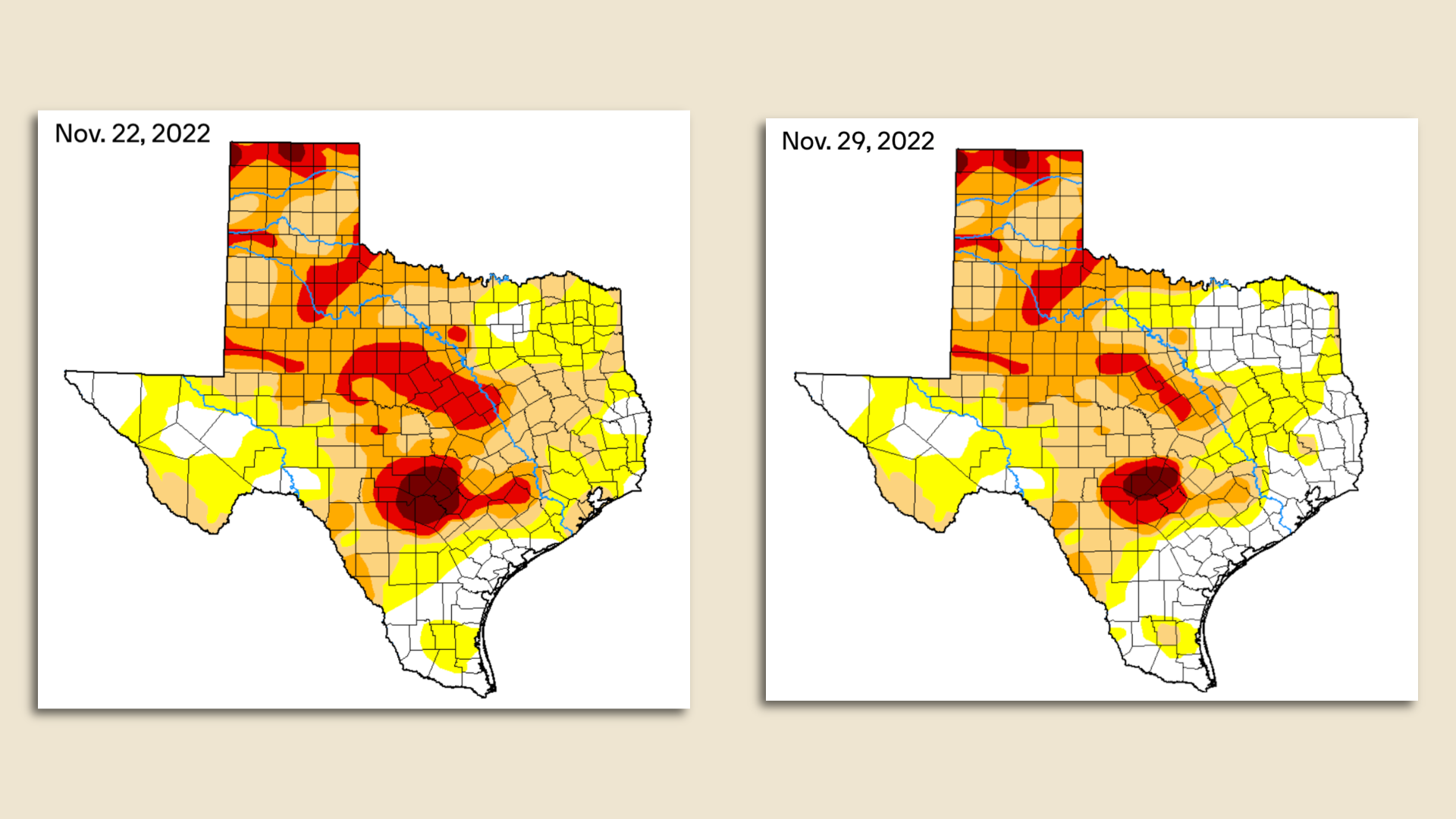
State of play: Most of the counties in Southeast Texas are no longer experiencing dryness or drought, and the state's most intense drought conditions are southwest of Austin, per the U.S. Drought Monitor.
Of note: November was a slightly abnormally wet month for Houston, according to the National Weather Service.
- Houston received nearly 5 inches of rain in November, 1 inch more than normal.
- Before that, however, the area received below-average rainfall, which invigorated drought conditions.
- Heavy rains in North Texas also contributed to better conditions in Houston as water flowed south toward the Gulf of Mexico, according to ABC13.
What they're saying: The drought relief wasn't brought on by buckets of rain but rather more moisture being pushed into the area through weak cold fronts, according to National Weather Service meteorologist Bradley Brokamp.
- "A lot of what we've seen and what we're going to see is not really an issue for us in terms of having rain, per se," Brokamp says. "Obviously [we've seen] a decent amount of showers, but nothing that's really helping us get heavy rainfall rates."
The big picture: The National Weather Service expects La Niña conditions to persist throughout the winter and account for below-average precipitation for the southern part of the country, from California to Florida.
What's next: Houston is slated to receive another cold front, and potential showers, later this week.