Michigan's forgotten grave-robbing era

Add Axios as your preferred source to
see more of our stories on Google.
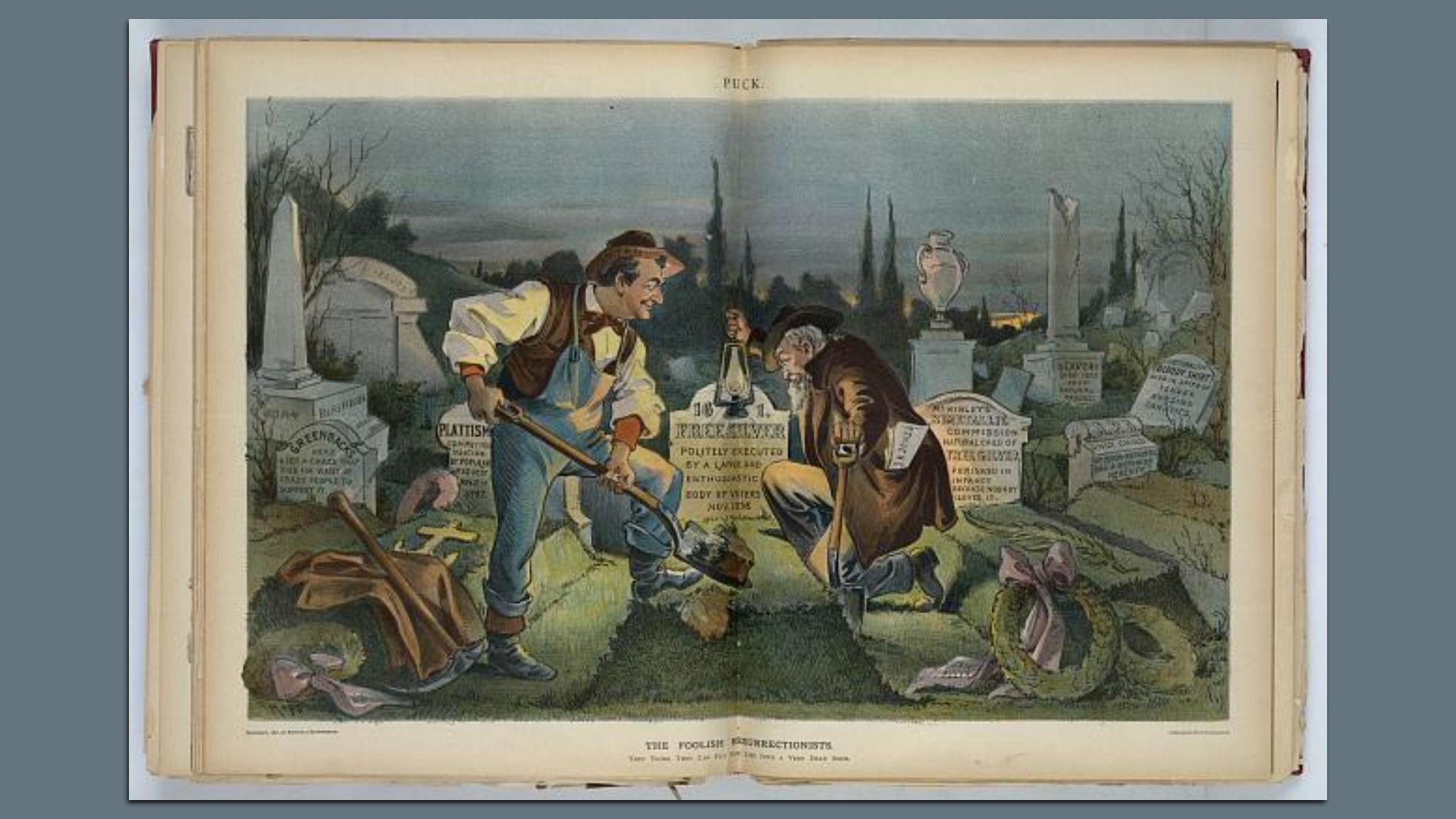
An 1897 cartoon titled "The Foolish Resurrectionists." Photo: Artist Udo J. Keppler, courtesy of Library of Congress
Long before voluntary body donation became widespread, the University of Michigan and many other medical schools in need of cadavers sourced some through grave robbing.
Why it matters: Medical students still need donated bodies to learn anatomy, but the system has evolved drastically from the mid-19th century to today's informed consent.
Flashback: As more medical schools opened in America in the 19th century, including U-M in 1850, researchers and students didn't have enough bodies to legally rely on.
- Many turned to the illegal hiring of professional grave robbers, known as "resurrectionists."
- An 1878 Detroit Evening News article pointed to a "well-organized ring of grave robbers" in Ohio, Indiana, Illinois and Michigan.
Zoom in: Historian James Tobin tells a story of construction workers arriving in 1857 at a site about 40 miles from Ann Arbor and finding disturbed graves, mounded earth and drag marks.
- The sheriff was unsurprised to find the missing bodies hidden by medical students at U-M.
- In another example, a U-M anatomy assistant named Edmund Andrews personally dug up 13 bodies one winter and was chased by authorities but never caught.
Grave robbing largely ended in Michigan with the state's Anatomy Act of 1881, which allowed unclaimed bodies of people in public institutions to go to medical schools. Often those people lived in poverty and did not give consent.
Perspectives changed over time, with voluntary body donation gaining acceptance and popularity in the post-World War II decades, per historians from the University of Tennessee and the University of Wisconsin-Madison.
Today, dignity and transparency are central to donating one's body after death, says Glenn Fox, director of the U-M Anatomical Donations Program. Prospective donors sign agreements, and next of kin or funeral representatives complete the process after death.
- Despite advances in technology, studying anatomy through donors is still the "gold standard," Fox says, and virtual reality can't replace it.
- The program's yearly Service of Gratitude honors donors and families. Medical, dental and other students think of donors as their first patients.
What they're saying: "When people hear sometimes about the history of anatomy — and there is much to understand … they oftentimes will confound the history with the modern state of anatomical donations because they don't have anything to compare it to," Fox tells Axios.
- He adds that he wishes people better understood the "profound effect that a single donation can have upon the career of our learners."
Zoom out: Fox looks back on the evolution of anatomy science and ethics over the last 150 years, reflecting on the ever-present need to change and improve.
- Just as they do now, Fox is confident that in 100 more years, "people are going to look back and think of all the ethical short failings of this program," he says. "One of the things that I'm very proud of where I work is that people are interested in learning more and doing better."
The latest: U-M historically received 200-300 donations a year, according to Fox, but he said he isn't sure the university will break 200 in 2026.
Go deeper: The history … Making anatomical donations