Business Brief
Detroit automakers face shrinking growth options amid China rise


Add Axios as your preferred source to
see more of our stories on Google.
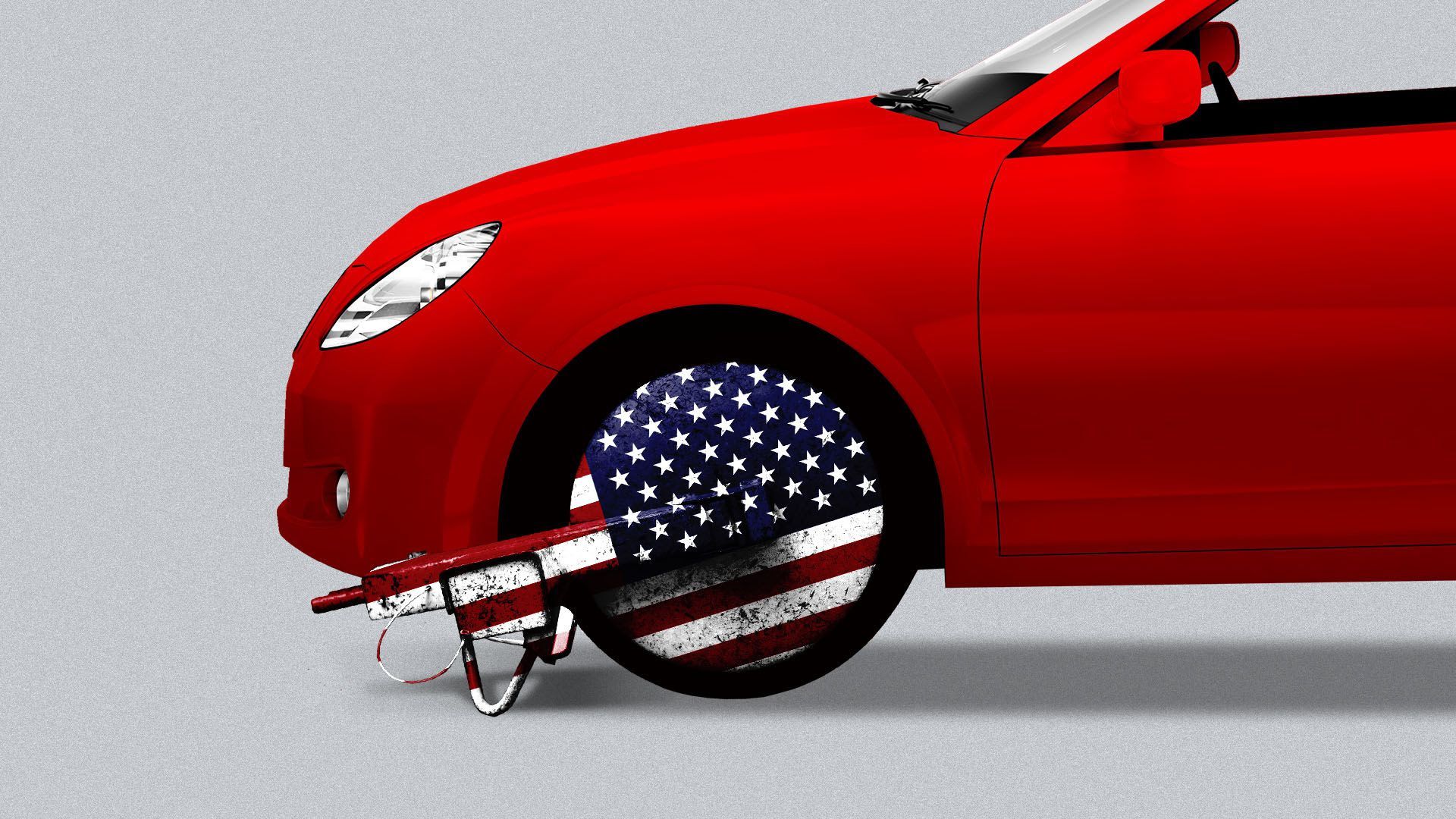
Illustration: Sarah Grillo/Axios
Detroit's automakers are running out of room to grow after years of retreating toward their most defensible turf: pickups and SUVs.
The big picture: Japanese and Korean rivals are taking more U.S. market share, while Chinese competitors are squeezing Detroit overseas.
Driving the news: Asian brands are expected to top 50% of U.S. sales for a second straight quarter in Q3, Cox Automotive predicts, while the Detroit 3 fall to just over 36% — a record low.
- Toyota is closing in on No. 1 GM, while Hyundai Motor Group is expected to pass Ford for third place.
State of play: The shifting landscape stems from decades of Detroit's choices. The automakers responded to competitive pressure by concentrating on where they had the biggest advantages.
- They largely abandoned sedans and small cars, ceded ground in many overseas markets and doubled down on profitable large vehicles.
- It mostly worked, but left little room to maneuver with market shifts.
- "If you don't have vehicles to catch consumers where they are, other manufacturers will step in," Erin Keating, Cox Automotive's executive analyst, told reporters at a recent briefing.
Zoom in: Soaring fuel prices have accelerated a shift to hybrids, where Detroit's offerings are slim.
- Hybrids now account for more than 20% of U.S. vehicle sales, up from 13% a year ago.
- Toyota, Honda, Hyundai and Kia built broad hybrid lineups, while Detroit focused mostly on EVs — only to pull back as demand softened.
Overseas, Detroit has to fight to stay relevant. Chinese automakers dominate their home market and are expanding rapidly in Europe and emerging markets with inexpensive, high-tech EVs and hybrids.
By the numbers: Chinese automakers now command 25% of the worldwide market, up from 14% in 2020, while U.S. carmakers' global share has stayed flat at 12%, according to the Center for Automotive Research.
- In Western Europe, Chinese-brand car sales have tripled since 2020.
What they're saying: "The competitive threat from China really requires a complete reinvention," Ford CEO Jim Farley said at an automotive industry conference in Detroit in late September, per the Detroit News.
After years of retrenchment in Europe, Ford is now partnering with China's Geely to manufacture low-cost vehicles in Spain.
- Stellantis is deepening its partnership with China's Leapmotor to better compete in Europe.
- In China, GM stabilized its sinking business by leaning on products developed locally with Chinese partners SAIC and Guangxi Automobile Group.
Reality check: Detroit's pickup and SUV fortress is still enormously profitable, and even the gas-price shock could just be a temporary pain.
The bottom line: The problem for Detroit is that the paths to growth are getting harder to find.
- "There's just not a lot of juice left to squeeze" for Detroit automakers, says Mobility Global's Peter Nagle, associate director of demand forecasting for the Americas.