Folk star ends U of M residency with new work ahead

Add Axios as your preferred source to
see more of our stories on Google.
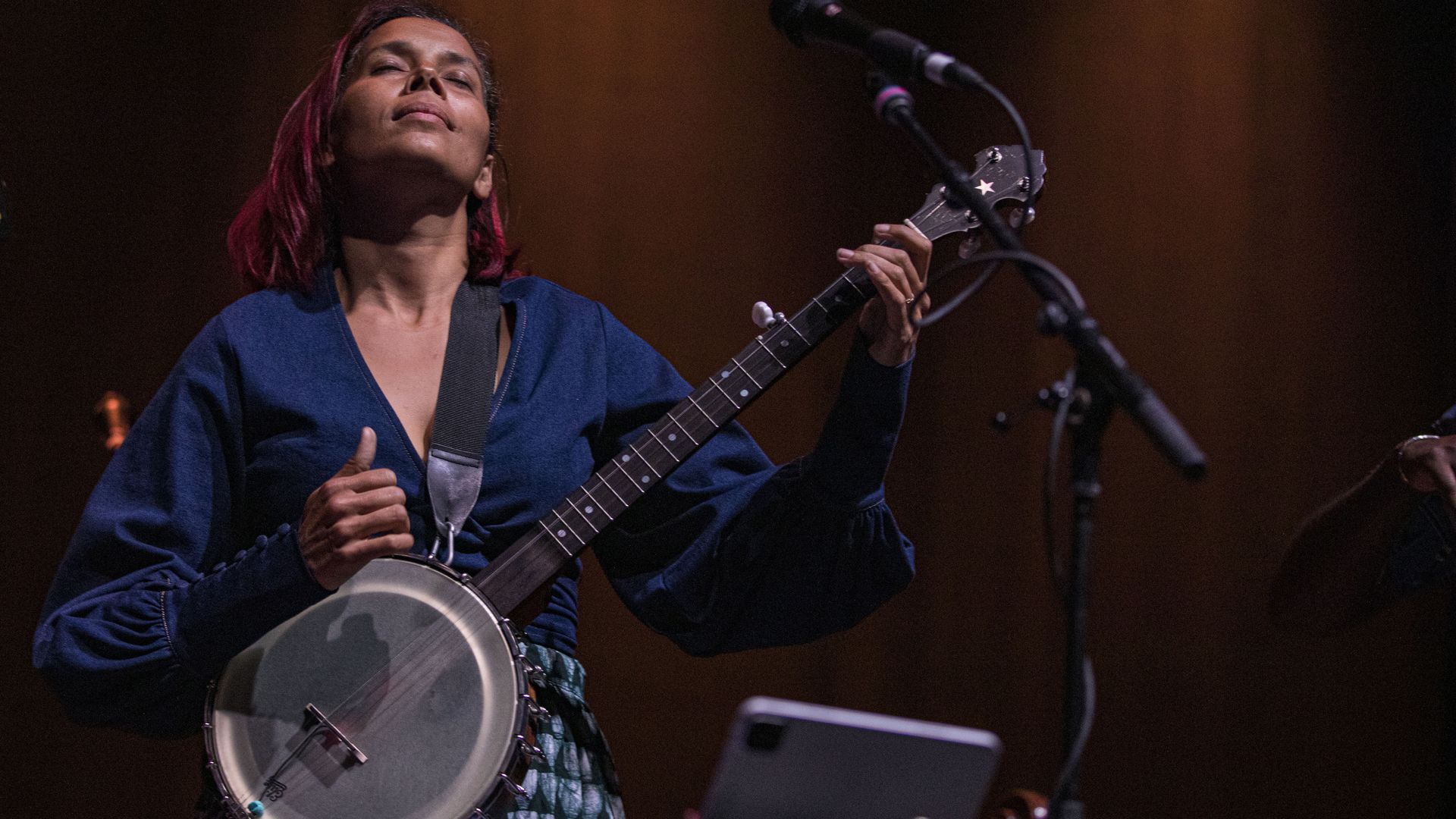
Rhiannon Giddens performs at The Observatory North Park in June in San Diego. Photo: Daniel Knighton/Getty Images
Rhiannon Giddens, a folk musician who's won a Grammy, a Pulitzer and worked with Beyoncé, just wrapped up a yearlong residency at U of M, where she researched her next projects.
Why it matters: Giddens was U of M's first artist-in-residence. The biennial program started last year to amplify the work of transformative artists by inviting them to campus.
What they're saying: The experience was invigorating and will be reflected in an upcoming book and musical on the American underclass, Giddens said in a recent interview.
- "I'll have pieces come out. I'll have the book come out … this musical, and they'll all have the DNA of U of M. It'll all have the DNA of Ann Arbor," Giddens said.
State of play: Giddens, who lives in Ireland, visited Ann Arbor periodically over the year, visiting with students and faculty and spending time in the university's libraries with a research assistant.
The intrigue: She is a founding member of the Carolina Chocolate Drops, a Black string band founded in 2006, and the co-composer of the Pulitzer Prize-winning opera "Omar."
- She broke further into the mainstream last year by playing the banjo on "Texas Hold 'Em," Beyoncé's nod to country music's Black roots.
Between the lines: Intense research is not new for Giddens. Her work highlights the historic contributions to American music of Black Americans and other marginalized groups.
- She considers herself an "embodied researcher" who uses history to inform her art. Her objective is to help others connect emotionally to the humanity of past events or lived experiences.
- "The more I learn about history, the better my art gets," she said.
Context: Giddens described her research and art as being driven by an underlying premise.
- Her previous work focused on the idea that "the banjo is an instrument of the African diaspora," she said.
- Since then, including her time at U of M, Giddens' guiding light is that "American music is working-class, cross-cultural collaborative music."
The bottom line: "We need to understand that we draw strength from each other, because ain't none of us millionaires," she said. "We need to stop enabling the system in the hope that one day we'll get to have a Gucci bag. Who cares when people can't eat?"