What's next for Detroit with credit rating boost

Add Axios as your preferred source to
see more of our stories on Google.

Illustration: Brendan Lynch/Axios
Heading into a new mayoral administration, Detroit is prepared to weather a future economic slowdown, a prominent national agency says as it boosts the city's credit rating yet again.
Why it matters: The new mayor will inherit a strong financial position. That positivity comes because the city emerged from its 2013-14 bankruptcy with a good game plan and then instituted conservative spending practices under Mayor Mike Duggan, who took office in 2014.
Context: The rating is a measure of the city's financial health, depicting the quality of its debt — or how likely it is to be able to repay its debt. A lower rating mean riskier bonds.
- A better credit rating means it's less costly for the city to borrow money to improve its infrastructure in the future.
State of play: After Moody's Investors Service upgraded the city's bond rating to investment grade last year for the first time in 15 years, it upped the rating again last month, officials said in a Monday press conference.
- Getting further above investment grade means Detroit is seen as much less risky than it used to be.
- Moody's cites the city's pipeline of major construction projects and robust financial reserves, though it also discusses big challenges like unemployment and the city's high poverty rate.
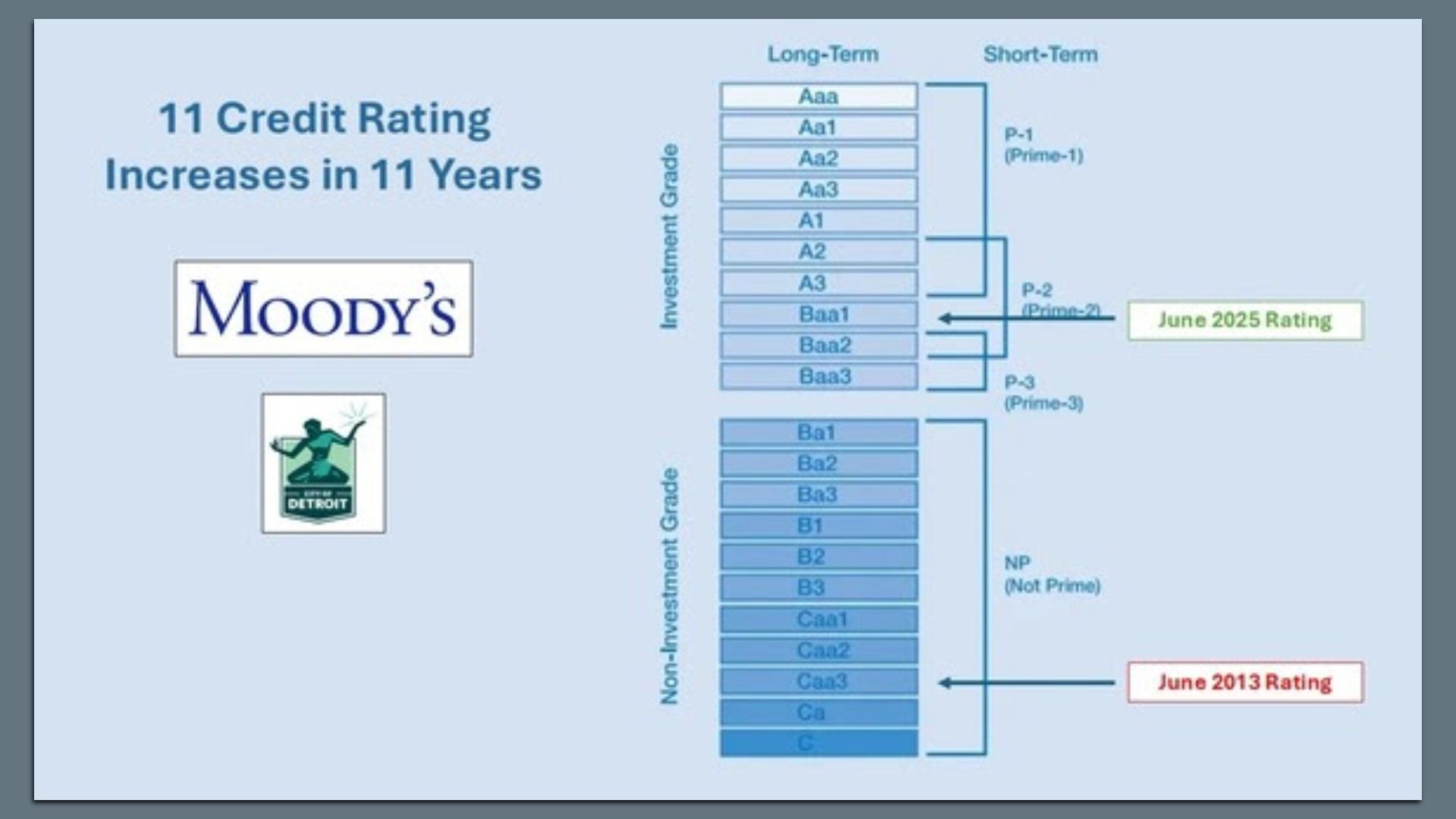
Between the lines: In April, another rating agency, S&P Global Ratings, kept Detroit's current investment-grade rating, as opposed to lowering it or boosting it like Moody's did.
- Former Detroit budget director Steve Watson, who co-founded a financial strategy firm, tells Axios that holding steady was a positive with the even greater economic uncertainty coming from Washington, D.C., at that time.
What they're saying: The next mayor will take over with strong finances, but "budgets may become tighter as the economy softens," Watson says. "A tighter budget doesn't necessarily mean a problem. It just might mean the city will have to prioritize among many competing needs."
What's next: The next mayoral administration could choose to issue bonds — with voter approval — to further its goals around structural improvement needs, like aging fire houses or other infrastructure.
- The next mayor would need to balance any potential bond plans with providing tax relief for Detroiters, also taking into account any losses in federal funding alongside potential gains in state funding, Watson says.
- Citizens Research Council of Michigan president Eric Lupher tells Axios he advocates for avoiding debt in the near term because Detroiters' property taxes are among the highest in the state.