Taylor police among Michigan agencies officially helping ICE


Add Axios as your preferred source to
see more of our stories on Google.
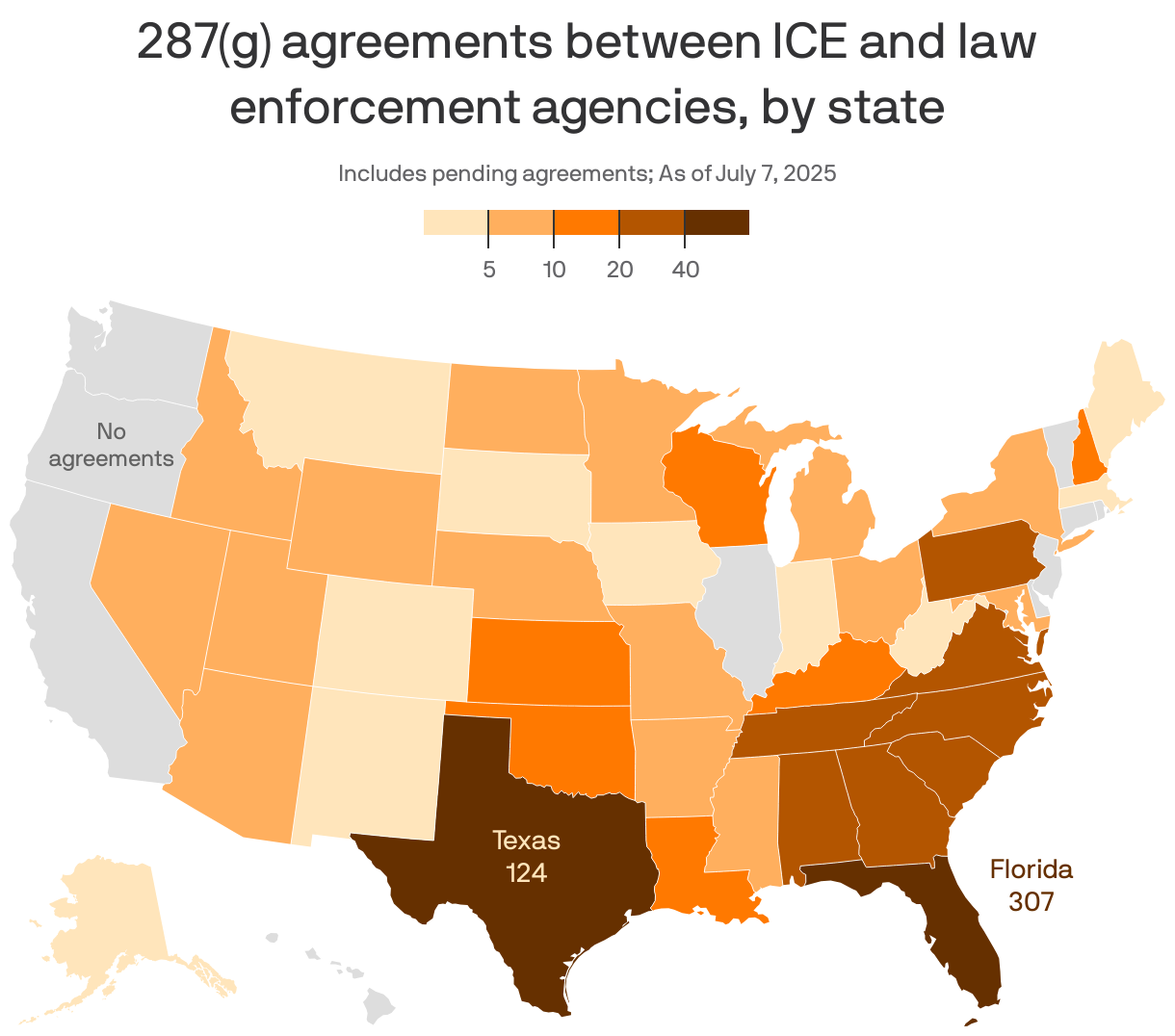
Several Michigan law enforcement agencies are cooperating with federal efforts to arrest and remove unauthorized immigrants through a partnership program with U.S. Immigration and Customs Enforcement (ICE).
Why it matters: An Axios analysis of removal orders, pending deportation cases and agreements between immigration officials and local law enforcement agencies nationwide sheds light on where the Trump administration is dispatching resources to support its mass deportation plan.
Zoom in: The Taylor police department is the only Metro Detroit agency with a signed agreement with ICE known as a 287(g) agreement, per federal data as of Thursday.
- Others with such deals include sheriff's offices in Berrien, Calhoun and Jackson counties.
- Roscommon County's sheriff's office has a pending application.
What they're saying: Taylor police defended its agreement against criticism from immigrant rights advocates that it gives officers the powers of immigration agents.
- "If we encounter an individual during the commission of a criminal act and they are arrested, we will identify them as is required by law," Deputy Chief Michael Lividini told the Free Press.
- "If in the process of identifying them it is determined they are in the country illegally, we will contact ICE. This has been our practice for decades. "
The big picture: Axios' review shows local law enforcement agencies in Texas, Florida, Georgia, North Carolina and Virginia have been most cooperative with Immigration and Customs Enforcement (ICE) in rounding up immigrants through 287(g) agreements.
- There are 629 such agreements now in place across the country. About 43% of them are in Florida, followed by 14% in Texas and 5% in Georgia.
State of play: Trump recently urged leaders of the National Sheriffs' Association (NSA), to have their members partner with ICE.
- "We have a limited number of resources at ICE," border czar Tom Homan told Axios. The 287(g) agreements are "a force multiplier and are going to help us achieve higher numbers."
The other side: Immigration advocates are criticizing ICE's partnerships with local authorities, echoing the idea that the pacts harm communities and public safety.
- "It means that communities are less likely to trust local police and report crime," said Nayna Gupta, policy director of the American Immigration Council.